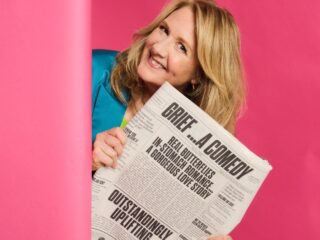
Alison Larkin and humour as the way to write about grief


Alison Larkin found true love in her 50s, only to lose her partner, Bhima, five days after they decided to marry. In her book Grief... A Comedy, she explores bereavement through humour, reflecting on a relationship that changed her understanding of love, loss and how to live after someone dies. She explained her thoughts to Eyleen Gomez in this interview.
When did you first realise that humour could be part of telling the story of losing Bhima?
I have an irrepressible sense of humour, and I am a comedian, so I am unable to write anything that doesn't have humour in it. Also, Bhima was very funny so it would have been impossible for me to write Grief... A Comedy without humour. I tend to see humour in everything and the kind of deep comedy I'm interested in is often painful to write about.
You found what you describe as true love in your 50s, only for Bhima to die five days after you decided to marry. Did experiencing such extraordinary happiness immediately before such profound loss change your understanding of grief?
Yes. And I think it changed my understanding of love, which I had avoided my entire life because, like many adopted people, I was afraid of loss. As I tell audiences in theatres, "the key to dealing with a fear of abandonment is to date people you don't like, so if they do leave you, it doesn't matter."
I spent a lifetime avoiding love because I was so afraid of the worst happening. Then I found it. But then, when the worst did happen, instead of wanting to give up on life, I found I wanted to live, and love, more fully than ever.
When people die, the body goes, but love doesn't go anywhere. It remains. And so does the bond you had with the person when they were alive. I didn't know that until I experienced it firsthand. And that has changed everything.
The book begins with Bhima turning up six weeks after his death and encouraging you to find love again. Why was that way the right way for you to tell the story?
I don't know. The story just came out - I didn't think about the right or wrong way to tell it; I just wrote it.
We often talk about 'moving on' after someone dies. Do you feel that society misunderstood what healthy grieving can look like?
In Western culture people are discouraged from talking about death, loss, grief. Which I find rather a shame, as we all live, love, lose people and must find ways to move forward, and talking with others about our shared experiences of loss is always healing.
Grief... A Comedy is, in part, a book about the bond that continues with someone we love very deeply after they die. People don't talk about it very often for fear that people will think they're bonkers. But you'd be astonished by the number of people who have emailed me and told me they too have a continuing bond with their loved ones who have died. The story seems to be resonating.
Your friend Archbishop Desmond Tutu encouraged you to tell this story because he believed it could give hope to other people. Did that give you a sense of responsibility about how to write something so personal?
Archbishop Desmond Tutu had read The English American, my first autobiographical novel about an adopted English woman who finds her all-American birth parents in the US. He knew I knew how to make a tricky subject entertaining and accessible through humour.
When he found out what happened after Bhima died, he told me I must do everything I could to make sure this story is told as widely as possible, because he said, "it will bring hope to people who might otherwise condemn themselves to a life of despair."
I was tired and grieving. But then he asked me again. And again. And you can't say 'no' to Archbishop Desmond Tutu and I figured that if I could pull it off, it would give purpose to the tragic loss of this magnificent man. So, I got to work.
Writing and performing the show and then the book has taken up the last five years of my life, but I have just about fulfilled my promise.
After a packed out run at Edinburgh Fringe and the Soho Theatre in London, the show was filmed for an upcoming TV Special in front of a live audience this past June, directed by [Barbra Streisand: Back to Brooklyn director] Scott Floyd Lochmus and will be released internationally in 2027.
You have now told this story in various formats, live comedy, a book and on TV. Do you change how the story is told when the medium is different?
There's only so much you can do in an hour-long comedy show. With a book, you can tell so much more of the story, because you have more time. Plus, the book is really the follow-up to the show, when Bhima shows up at my kitchen table, determined to help me find love again. He accompanies me on dates and has a great deal to say that there was no time to cover in the show.
You spoke about Grief… A Comedy at Oxford earlier this year as part of the Gibraltar Conversation and will now come to Gibraltar itself. What do you hope someone who may be living through their own grief takes away from hearing your story?
One woman reached out to me via my alisonlarkinpresents Instagram recently and told me she had lost her beloved husband a few years ago and had resigned herself to a lifetime of loneliness. She said that the book gave her permission to date again - and that now she has fallen deeply in love - at 68.
Another woman told me that reading a love story about two people who meet in their 50s helped her realise that now her children have left home, she wasn't finished - she was just getting started.
I hope it will encourage young people who are afraid of love to risk it anyway, because if I can not only be ok, but living fully after losing Bhima, what is there to be afraid of?
I hope it will encourage people to live fully. To quote the lyrics to the final song of the show, "Each day you get to choose how you will spend it. Don't waste a minute, cos tonight might end it. Don't waste your time."