


Economic Crime Unit’s new offices unveiled, alongside a call for further investment
Chief Minister Fabian Picardo unveils a plaque at the new Economic Crime Unit's office alongside Commissioner of Police Owain Richards. Photos by Johnny Bugeja.


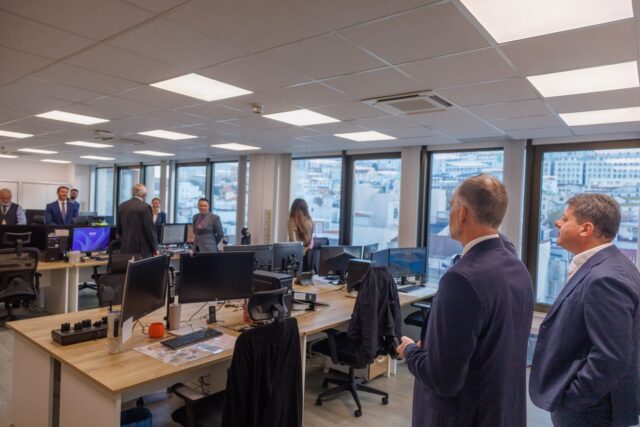
The RGP Economic Crime Unit unveiled its new offices on Line Wall Road staffed by a 21-strong team to meet the complex needs of Gibraltar’s growing economy, an investment formally unveiled on Tuesday accompanied by calls for further Government expenditure in policing.
Speaking at the formal opening, RGP Commissioner Owain Richards welcomed the investment in the modern office at NatWest House but said additional spending was needed, including on a new police headquarters.
The office, whose staff includes police officers, civilian investigators and accountants, was toured by the Governor Lieutenant General Sir Ben Bathurst, Chief Minister Fabian Picardo and Mr Richards on Tuesday morning, with the Chief Minister formally opening the premises and unveiling a plaque to mark the occasion.

The staff are specialised in dealing with complex economic crime including crypto fraud, money laundering, terrorist proliferation, point of sale fraud, and deal with both local and international crimes.
Mr Richards said he welcomed the recent increase in the RGP’s annual budget from £17m to £20m and £2.8 million capital investment, which is being spent on IT infrastructure, vehicles, refurbishment of the existing New Mole House police station.
“But of course we need a new police HQ,” he told the Chronicle.
“It's been this Government's manifesto commitment, I think, for nearly 15 years.”
Mr Picardo recognised this in his speech to officers and staff, highlighting that the economy had changed over the past 15 years and that it was “hugely important” for the RGP to have the resources it needs.
“I very much look forward to the RGP as a whole having offices befitting the work they need to do,” Mr Picardo said.
“I know you have long grown out of New Mole House and that needs to be dealt with.”
“New Mole House is a completely different scale of project with a completely different scale time of requirement.”
“If we could quickly put you into a building we would, but we’ve learnt the lessons of New Mole House and putting you into something that is not bespoke, and therefore, although it may take a little longer and it may be somebody else’s name on the plaque, I think it will be a worthwhile wait.”
Mr Picardo told this newspaper that investments in the RGP are needed due to the treaty and the fact that digital crime has increased.
Mr Picardo said the 30% increase of investment in the RGP budget reflects the complexity of policing in Gibraltar, adding that the treaty meant that, while the Rock would remain safe, it needed to be policed in “a different way”.
He also pointed to the growth in the number of Government prosecutors and the introduction of the post of Director of Public Prosecutions.
But Mr Picardo acknowledged that Gibraltar “has to keep up” and that this included a need for investment.

Mr Richards said “hopefully” the investment for a new headquarters would “come through, because our officers and staff deserve it.”
He added that Gibraltar has a good reputation for the prevention of economic crime and the RGP is working very hard on the upcoming Moneyval assessment.
“Previously officers were in Sir Joshua Hassan House, which was not fit for purpose,” he said.
“There were leaks, there were rodents, there were officers working from cupboards effectively, not very conducive for a modern professional specialist team such as the Economic Crime Unit.”
“I'm delighted that the Government has invested in these offices.”
“I now urge the Government to bring forward a plan for a new police headquarters because we have outgrown New Mole House. I would describe it as ‘Old Mole House’.”
“I call upon the Government to develop a strategy to provide premises befitting of an organisation which I think is professional, is focused on the community here in Gibraltar, is focused on the mission of national security, keeping people safe.”
“The Royal Gibraltar Police, in my view, is a fantastic place to work.”
“But of course we need the premises to provide the motivation and the morale for our officers to give their best, and these officers do that.”
Mr Richards said economic crimes range from seizures in cases where criminals have used the proceeds of crime to buy property, to international fraud involving organised crime, alongside point-of-sale fraud, cryptocurrency fraud and tackling cyber scams targeting vulnerable victims.
Detective Chief Inspector Luis Miguel Garcia White, who heads the Economic Crime Unit, said the team had grown with the economy.
When he joined in 2015, the Economic Crime Unit was called the Money Laundering Investigation Unit and had a team of under a handful of officers.
“It's a huge change and I think it mirrors the economy,” Mr Garcia White said.
“The economy is, across the world, diversifying into cryptocurrency, diversifying into digital assets.”
“It's no longer the traditional frauds, traditional money laundering that you see. It's now diversifying into complex structures and using digital assets.”
“It's harder to investigate. There's more need for investigators to be acquainted with more training. It's an investment in the future.”
“Officers that come here are invested into the unit. They receive a lot of training and their work is really shown through that training.”
Mr Garcia White said the RGP had increased public confidence in the reporting of financial crimes, including fraud committed either over the phone or via email.
His advice is for the public to always double-check with their bank, adding the “telltale indicator” is that no bank will ask for personal details.
Mr Garcia White added that it is difficult to recoup funds once fraudsters have struck.
“It is difficult, but there are tools out there that we utilise through international bodies like Interpol, where we can put stop markers onto transactions,” he said.
“That doesn't always work, unfortunately, due to the quick and versatile way in which they hold the money. But what we do find is the modus operandi of these groups is as soon as the money hits that account, it's then transferred out to someone else.”
“And what we find is that the money mule that was used to open the account maybe doesn't exist, is not in the jurisdiction, can't be found, etc. So very quickly, from you sending the money, the money could end up in three or four bank accounts within three or four hours.”
Even so, there have been success stories.
“We have stopped monies from leaving Gibraltar in other countries, and we have stopped money in other countries and been able to make sure that money doesn't move and repatriate to the victims of the crimes in Gibraltar,” Mr Garcia White added.
He said the team aims to continue to grow with the economy and invest in specialisms, with every financial investigator being an accredited through a programme in the UK.
Most Read
New group to plan healthcare jobs and placements for returning graduates
Tue 13th Oct, 2026
6,000 appointments annually and 20 new referrals a month at Cancer Relief
Mon 12th Oct, 2026

Today's Paper
13th October 2026
Read our latest newspaper by downloading our app from the link below.


