


Ben Arogundade on Hollywood’s history of exclusion


Ben Arogundade is an author, journalist, broadcaster and creative director who trained as an architect before moving into publishing, graphic design and journalism. His first book, Black Beauty, was honoured by the New York Public Library and adapted into a BBC documentary. He has since written fiction and non-fiction, founded White Labels Books and developed self-help apps. He also works as a BBC radio broadcaster and voiceover artist. His books include My Terrifying, Shocking, Humiliating, Amazing Adventures in Online Dating and Hollywood Blackout, which examines the experiences of people who have challenged discrimination and fought for recognition in the film industry.
Q. What was the Hollywood Blackout?
A. Hollywood Blackout was the headline of a cover story published in the March 18, 1996, edition of the US celebrity magazine People. The article was published in protest at the absence of African-American actors among that year’s Oscar nominees.
The headline read: ‘The film industry says all the right things, but its continued exclusion of African-Americans is a national disgrace.’ The cover featured Angela Bassett, Denzel Washington, Laurence Fishburne and Whitney Houston, all of whom had been overlooked that year.
The article examined racism within the industry, concluding that it was institutionally racist, from the soundstages to the boardrooms. “For African-Americans, breaking into Hollywood can be like climbing a mountain of marbles,” wrote Pam Lambert.
The article and its headline were significant because minority groups had been excluded from Oscar nominations year after year, while the press had seldom appeared to take much notice. Protests usually came from within the Black community, but on this occasion a powerful, white-owned national magazine, known for its escapist frivolity, was highlighting Hollywood racism on behalf of African Americans.
Q. Looking back through the history of the Academy Awards, which story of exclusion do you find the most heartbreaking?
A. In 100 years of the Academy Awards, Native Americans have won no Oscars. They have received one nomination for Best Actress, for Lily Gladstone in 2024, and two nominations for Best Supporting Actor, in 1971 and 1991. There have been no nominations for Best Actor, Best Supporting Actress or Best Director.
Their role in Hollywood films has remained unchanged for more than a century. The industry does not recognise their existence as part of mainstream society.
Q. The Oscars have a long and complicated history with diversity. How is the film industry addressing exclusion based on race, gender or political ideology today?
A. Over the last decade, the Academy has diversified its voting membership, comprising the film industry professionals who collectively decide the Oscar winners. The membership list, which was once secret, is now published, and new members from diverse backgrounds are added each year. This is a significant change.
In 1927, the Academy of Motion Picture Arts and Sciences began with 36 members, 92 per cent of whom were white men and eight per cent white women. By 2025, it had approximately 11,200 members, including 10,143 voting members. Of these, 65 per cent were male, 35 per cent female, 78 per cent white and 22 per cent from underrepresented ethnic and racial communities. Members came from 60 countries and territories outside the US, with international members accounting for 21 per cent.
At the same time, the Academy introduced new diversity compliance rules for filmmaking. From 2024, films have been required to meet specific inclusion standards to qualify for the Best Picture Oscar.
However, some Hollywood insiders remain unhappy with these changes. They believe the art of filmmaking should not be interfered with and that filmmakers should be free to cast or exclude whoever they choose, even if this reinforces the status quo.
Nevertheless, the modernisation of the voting membership is changing the types of films and actors receiving nominations. In 2020, Parasite became the first non-English-language film to win Best Picture. At the 2025 awards, five minority artists, representing 25 per cent of those in the acting categories, were nominated. They included Karla Sofía Gascón, the first openly transgender actor to receive a Best Actress nomination, for Emilia Pérez.
Such developments would not have been possible a century ago.
Q. What originally sparked your interest in investigating these issues?
A. In 2020, I was enraged by the murder of George Floyd and those of other unarmed Black citizens. I was desperate to find somewhere to direct my energy constructively, so I began thinking about a book examining racism and discrimination.
Hollywood Blackout had existed as notes on my computer for some years, and I adapted it to address this need. The inside flap of the book is dedicated to Floyd, Breonna Taylor, Michael Brown, Eric Garner and others who brutally lost their lives.
But I am a Londoner with a multi-racial cultural background, and my heart and sympathies are with all disenfranchised people and underdogs, not just Black people, but women, Asians, Indians, Native Americans, Latinos and the poor white working class, among others.
Q. How did the film industry, artists and professionals, reacted to your work?
A. I didn't expect anything from this group. The book's narrative has resonated more with diverse audiences outside Hollywood, or with people trying to enter the industry. They read it and learn something about how things work and why. My book might help inform their strategy or provide an enlightening moment.
History books like mine are more important than ever for these audiences, given the political and cultural opposition to diversity that exists in so many quarters.
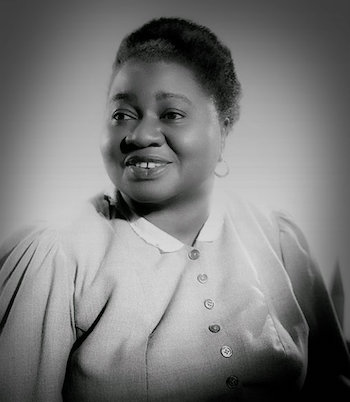
Photo of Hattie McDaniel. Courtesy of African American Registry.
Hattie McDaniel, the first non-white actor to win an Academy Award
On February 29, 1940, African-American actor Hattie McDaniel became the first non-white actor to win an Academy Award for her supporting role as Mammy, Scarlett O’Hara’s maid in Gone with the Wind. The moment marked an early step in Hollywood's move towards diversity and inclusion.
Since then, minority groups and women have continued to face barriers to recognition at the Academy Awards within a system designed to discriminate against them.
Hollywood Blackout explores their journey from exclusion to inclusion and from segregation to celebration.
Author Ben Arogundade brings together the experiences of Black actors and filmmakers with those of Asians, Latinos, South Asians, Indigenous peoples and women. Their progress towards Oscar recognition has been driven by boycotts, civil rights protests and social media activism, including the #OscarsSoWhite campaign.
Most Read
HMS Queen Elizabeth sails into Gibraltar, strengthening long-standing links
Sun 25th Oct, 2026
Govt raises concerns with Taxi Association over weekend service outage
Fri 23rd Oct, 2026

Today's Paper
26th October 2026
Read our latest newspaper by downloading our app from the link below.


