


A day in the life of lifeguards: Sandy and Catalan Bay
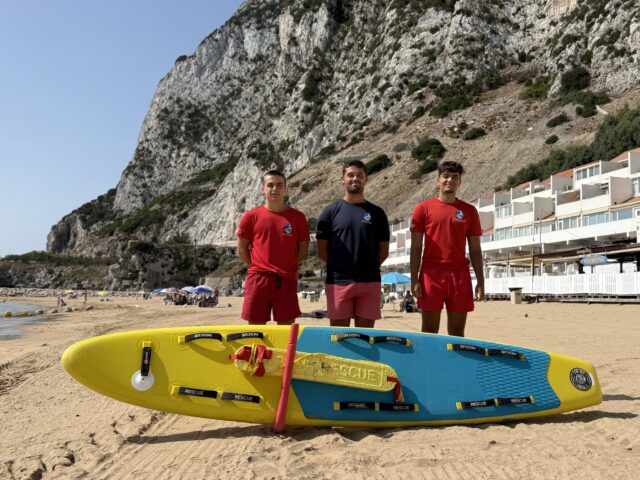
Jayan, Jayce, Thiago, Aaron and Ashton at Catalan Bay


All of Gibraltar’s beaches and pools are attended by a team of qualified lifeguards and attendants who are directly overseen by head lifeguards and beach supervisors.
This is the last of a four-part series and, today, Chronicle reporter Eyleen Gomez focuses on Sandy Bay and Catalan Bay.
Head lifeguard at Sandy Bay on the day was Sascha Gravett, who described being a lifeguard as a “perfect summer job” that demands constant training and sharp reflexes.
Sascha is now in his sixth year as a lifeguard and said: “I love the job.”
Lifeguards undergo regular endurance tests, including a set run–swim–run sequence.
The standard test involves a 200m run, 300m swim, and a further 200m run, all to be completed within eight minutes.
“Everyone needs to pass. We’ve got 16-year-olds here that are doing the same thing that I’m doing,” he said.
Most candidates complete the beach test, but those who struggle can opt for a pool-based course which, while not necessarily easier, is less demanding than the open-water.
Training is held every Thursday, rotating between beaches and attendance is expected even from those on duty.
“Even if you’re working, you go to the training first and then you show up to work. If you have the day off because you’re on holiday or you can’t make it because you’re ill, then you’re fine to not go. But most of the lifeguards show up,” he said.
He stressed the importance of ongoing training throughout the summer.
“It keeps us on our toes,” he said.
“If we work the whole summer and something happens, and we’re not sure what to do because we haven’t had the training, it’s not good. But because we have this training regimen in place, we keep up to date with it. We know what’s going on.”
At Catalan Bay, lifeguards have been practising rescues from two new elevated chairs and using new radios to coordinate with supervisors.
“We set up these two new chairs, one in the middle of the beach and one closer to the SeaWave,” he said.
“We learned how to do rescues from these chairs with our new radios as well. We inform the head lifeguard that we’re going in for a rescue, get off the chair and go in.”
At the beaches, buoys generally mark the limit of the lifeguards’ area of responsibility, though the groynes at Sandy Bay and the ongoing reclamation project on the east side also play a role in defining boundaries.
“Technically, [the other side of the groyne] is out of our jurisdiction for Sandy Bay,” he said.
Even so, he said lifeguards would not ignore someone in distress just beyond that line.
“Morally, I think all of us would go out on the board, for example, because the board’s very fast to get there.”
“Rather than swimming out, we grab the board that we place down there, and we head out to the groyne to see if they’re okay first.”
“If they say no, we’ll tow them back in. But if they’re fine, they’re fine.”
Sascha described his most significant incident of the year beginning as a calm day at Eastern Beach, with “loads of people on paddle boards and dinghies”.
“All of a sudden the wind just picked up, and everyone started floating out,” he said.
The response involved multiple lifeguards and different pieces of equipment working together.
“We had one lifeguard still in the tower, making sure he had eyes on everyone,” he said.
“We had two people get on the RHIB, which is the little boat that we have.There’s certain lifeguards that are RHIB-qualified to go on there and take action. We had two on there, one lifeguard on the board just bringing people back in as well.”
“And then I went in with one of the torpedo buoys to pick out kids that couldn’t swim back in because they weren’t strong enough.”
The rescue operation lasted around 40–45 minutes, with all those in difficulty safely brought ashore.
Although the team had access to a weather report, the conditions changed very quickly.
“You can never be too accurate with the weather,” he said, “within five minutes, the wind picked up.”
First–time lifeguard Finlay Bradby says working on the beaches this summer has not only improved his fitness but also strengthened his ambition to pursue a career in sports science or physiotherapy.
“Being Gibraltarian, I’ve always loved the beaches and everything, and the opportunity to work at the beaches, be active, and since I train often anyway, training here is amazing,” he said.
He added that the first aid and CPR components of the job have given him a stronger grounding in human physiology.
“I’ve always wanted to do something like sports science or physiotherapy, something along those lines,” he said.
“It’s given me a better understanding of the body with all the first aid that we do and all the CPR that we do.”
Jamie Belilo is now in his third year in the role and said the job fits neatly around his university commitments while giving him valuable experience.
“It’s a good job to have for the summer and good experience too,” he said.
Although this season has been relatively quiet in terms of water-related emergencies, he recalled one of the more challenging moments involved a fight between two children.
“Just some kid started hitting another one like randomly,” he said.
“Even though we can’t really do anything to do with the fight, we let the police do that. We try patch up any injuries as best as possible.”
On the weekly training sessions, he said: “Training, I think it’s definitely needed,” adding that as long as lifeguards stay consistent, “it’s simple enough.”
Catalan Bay
Head lifeguard at Catalan Bay that day was Ashton Hancock, who said that strong teamwork and constant vigilance are helping keep swimmers safe during a busy summer at Catalan Bay, one of the Rock’s most popular and challenging beaches.
In his fourth year as a lifeguard and his second as head lifeguard, he returns to the role each summer while studying sports business management at university.
As head lifeguard, he oversees the team, ensuring guards are “doing their job and are where they’re supposed to be on time”. The training, he added, is key when incidents occur.
“The training for sure helps. We’re always doing rescue over rescue, so it sort of gets like muscle memory to us.”
“So when stuff does happen, we have it done perfectly, and we can execute it right.”
So far this summer, he has not had to deal with any major incidents.
He also referred to the currents around La Mamela rock, noting that the team has adapted its coverage to that risk.
“La Mamela’s hard, but we’ve now realised that, and we’ve got a chair just for La Mamela, so there’s always someone watching it in case the currents do come,” he said.
Joining Ashton that day was second‑year lifeguard Aaron Hook, who said he returned as he “really enjoyed it last year”.
He considers himself “quite lucky” not to have faced any serious incidents during his time on duty so far. Even so, he highlighted the importance of regular training, particularly the practical drills that simulate real emergencies.
“Just the practicing of casualties really makes me more confident about saving other people because I know that I'm able to do it,” he said.
Beach attendant Thiago Cruz explained that his role focuses on assisting people who might otherwise struggle to access or move around the sand and shoreline.
“If the elderly need help or people that can’t move on the beach as such, like they’re in a wheelchair or something, I help them move, or I help them with anything they need,” he said.
This is his first season on the beach, but he is no stranger to the role, having previously worked at the Pavillion and Europa Pool.
Explaining how people can request assistance, he said beach users can either approach him directly or speak to one of the lifeguards on duty.
Asked why he chose to become a beach attendant, he said the job brought together two things that mattered to him and that is being by the sea and helping others.
“I’ve always liked being in the beach, and helping people has always been something I like to do. So I thought this would be a good job for me,” he said.
First-time lifeguard Jayan Lima said that taking on the role has proved both “challenging” and “very rewarding”.
Jayan, who decided to join after several friends did the job last year, explained that the post stood out from other typical student roles.
The training, which Jayan described as intensive and sustained over several months, has also encouraged a more active lifestyle.
“I enjoy swimming. I only really did it for the training but, because of that, I found out enjoying it.”
“The training has gotten me more athletic and I appreciate that,” he said.


