A Gibraltarian poet in Patras (some notes and reflections)


By Trino Cruz
It is the 16th of September, and we are to meet at 14:00 outside the Stanley Hotel in Karaiskaki Square, a short walk from Athen’s central Omonia Square.
Poets start to trickle towards our meeting point. We first meet Mariangela Gualtieri, accompanied by her husband Cesare Ronconi and the actress Ondina Quadri, members of the Valdoca Theatre in Bologna, Italian poets receiving a special tribute at this year’s Patras Festival.
The next person we meet is Greek-Australian poet Paraskevi Dentsas, who as part of the Melbourne-based Greek-Australian Cultural League, with its prestigious publication of its bilingual periodical Antipodes, has fostered the powerful cultural links between Greece and Australia since 1970. What a start.
The bus arrives from Athens airport with some delay already half-full of poets and we join them for our two-and-a-half-hour bus ride to Patras. A drive that will take us along the shores of the Saronic Gulf towards the Peloponnese, over the impressive Corinth Canal and along the southern shores of the Gulf of Corinth.
Patras is the capital and largest city of Western Greece, a major port naturally oriented towards Italy and the western Mediterranean. Patras has much in common with Gibraltar, steeped in history it has evolved as a maritime crossroads.
The city of Patras has an extremely rich Roman past, with its beautiful odeon, stadium and an archeological museum which houses a series of beautiful mosaics reminiscent of those we can today see at the site of Italica, in the outskirts of Seville. Getting to know Patras, one of the great yet lesser-known ports of the Mediterranean, will be an important part of our experience over the coming days.
Across the Gulf of Patras on its northern shore, to the east, lies the city of Nafpaktos (Lepanto), where the decisive sea battle of Lepanto was fought in 1571 between the Holy League, a coalition of Catholic states, and the navy of the Ottoman Empire.
Famously, Miguel de Cervantes fought in the battle where he was wounded in his chest and his left hand, which was consequently crippled, thus the cruel lifelong nickname which he bore as “el manco de Lepanto”. A few kilometres to the west, lies Missolonghi where Lord Byron died in 1824 at the age of 36, from a fever while he supported the Greek War of Independence against the Ottoman Empire.
Nowadays, the north and south shores of the Gulf of Patras are connected by one of the world’s longest multi-span cable-stayed bridges, the impressive Rio-Antirrio Bridge, one of the symbols of modern Greece.
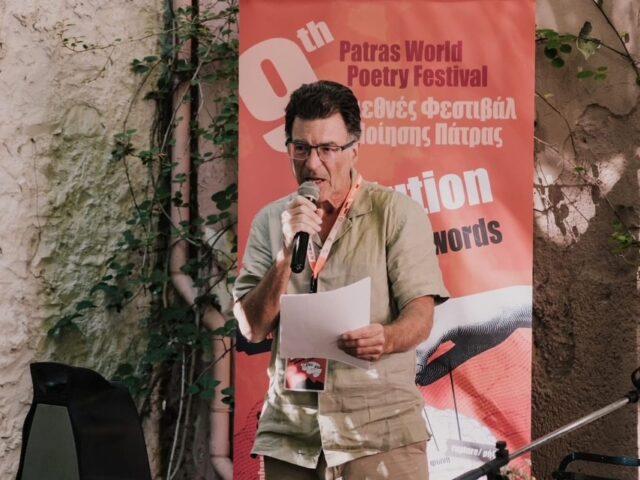
The literary pedigree of the region, together with its modern symbolic bridge, is part of the spirit and identity of this very special festival which this year celebrates its ninth edition.
At the helm of the festival is the inspired and inexhaustible poet, Antonis Skiathas, who with his experienced crew will make this Festival such an invaluable and unforgettable event.
The building up of a relationship between Gibraltarian poets and the Patras World Poetry Festival, sponsored by Gibraltar Cultural Services, is an invaluable initiative, which is connecting us with a culturally relevant place and is already bearing its fruit.
Last year, our poets Jonathan Teuma and Gabriel Moreno participated.
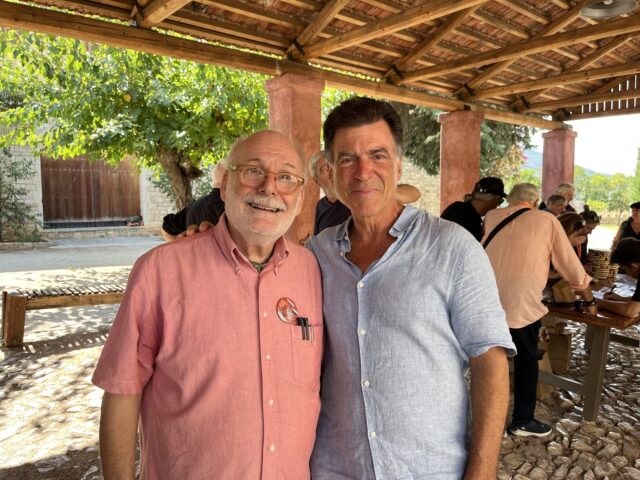
This year I was very fortunate to have been invited. Our presence is much appreciated; we are a part of the international family of poetry.
We arrive in Patras in the evening and after checking in at the Hotel Adonis, we go straight to the inauguration event and dinner at a venue at the very foot of the Rio-Antirrio Bridge, one of the symbols of modern Greece.
During the festival’s four days, starting at 8:30 am, we will be doing poetry workshops in the city’s secondary schools, followed by daily readings across the city centre and in the courtyard of the iconic bookshop and cultural space, Polyedro, where we will all be reading and listening to each other in the many languages of the festival.
Events, with poetry and music, take place in historic venues like the Roman stadium and the and the spectacular Patras Castle, built on the fringe of the Panachaiko mountains in mid-6th century AD on the ruins of the ancient acropolis, with breathtaking views of the Ionian Sea with the Gulf of Patras at our feet.
After our evening readings, we end the day with a dinner which starts no earlier than 11:00 pm. 29 Greek poets and over 40 international poets (from a further 22 countries) participate in this wonderful festival.
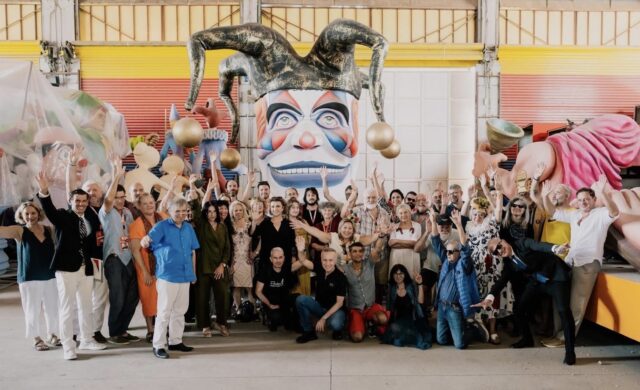
We also have a playful and original workshop, with readings and performances, with members of the Carnival of Patra, in the warehouse where they are preparing for next year’s Carnival which will take place in early 2027. The Patras Carnival is a major cultural event in Greece.
During the festival we gain an invaluable insight into contemporary Greece, which in spite of its relatively small size, having a vast coastline of almost 14,000 kilometres, remains today one of the world’s leading maritime nations. Its evolving demographics, because of significant recent immigration from the Middle East and Asia, contribute to making Greece such a particularly dynamic and exciting place.
Poets from neighbouring Albania, North Macedonia, Bulgaria and Turkey, amongst others, are well represented in our gathering.
During the four days of the festival we have countless conversations with other poets, the public and students, new relationships are being forged. A week after the festival the communication between us, the participating poets, has a momentum and life of its own.
What an unforgettable celebration of poetry and friendship this has been!