


Chai With Priya An ode to mangoes


“How do I love thee? Let me count the ways,” Elizabeth Barrett Browning said.
While her famous poem described her intense love for her husband, Robert, my affection is dedicated to the sweet, delicious, delightful mango.
While mango varieties found locally are green and crunchy, mangoes from South Asia tend to be smaller, more yellow or orange, and very juicy.
My love for mangoes started as a child, and even now in my 40s nothing makes me happier than a good-tasting mango.
I love it chilled and cut into slices, I love it on top of a chia seed pudding, I love it with plain white rice, I love it in cheesecake, I love it in salads, I love the purée version watered down and served with hot puris, I love in a spicy pickle served with a hot paratha.
My love for mangoes runs so deep we named our parrots Mango and Kerry, whose namesake ‘Keri’ are the small green sour variety of mangoes used in pickles and savoury foods.
I will never discriminate against a mango. They are all welcome, whether they originate from India, Pakistan, Brazil, or Thailand, any mango will do.
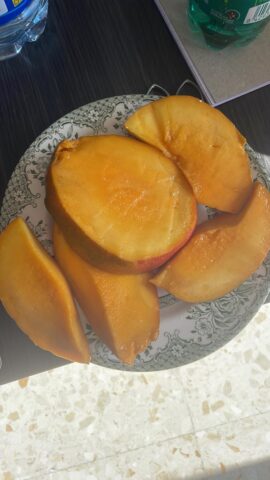
And the best thing is that, as a person of Indian origin, I know I am not the only one.
A few weeks ago I came across a feel-good news story that me laugh, and in all honest I felt equal parts of joy and jealousy.
India is the world’s largest producer of mangoes, with anything between 45-50% of mangoes grown in India.
But despite the large scale of production only 1% of those mangoes are exported.
I was overjoyed at the news that 99% of these mangoes are consumed within the country.
Whole families sitting down to eat lunch with a plate of freshly cut mangoes served for dessert.
Children being given small ripe mangoes which they squash in their hands and suck the pulp out of a small hole in the fruit.
It is a love for the fruit that goes beyond class, age barriers and geography but loved all over.
The news that only 1% of the fruit is exported to the rest of the world brought much humour to internet users both in India and among the diaspora.
“Among the one per cent of mangoes that get exported, 90 per cent are eaten by NRI’s (non-resident Indians),” one said.
Another tweet read: “Exporting mangoes is optional. Eating them is a national duty.”
“My family eats four to five mangoes daily in the summer. That’s almost 400 mangoes in three months. Almost all Indians eat at least one mango a day during the season,” another said.
While many people online boasted about eating large quantities of mangoes, food bloggers shared recipes for mango tiramisu, mango lassi and mango cake for the in-season fruit.
According to the Indian Agricultural and Processed Food Products Export Development Authority (APEDA), there are over 1,000 varieties of mango grown across the country, but only a few can be commercially cultivated throughout India.
Most Indian mango varieties have specific eco-geographical requirements for optimum growth and yield, and the major mango-growing states are Uttar Pradesh, Andhra Pradesh, Bihar, Karnataka, Gujarat, Madhya Pradesh and Tamil Nadu.
But, according to experts, as soon as mangoes come into season it is largely consumed by the local market.
With a population of 1.4 billion people, the marginal return on its export “cannot be compared”, the APEDA said.
The country produces some 24 million metric tonnes of mangoes annually, and India’s domestic mango market was valued at $2.9billion in 2025. It is estimated to grow to $3.97billion by 2030.
Its export market, by comparison, was valued at some $60million.
And as much as I wish my favourite Alphonso mangoes to be readily available in Gibraltar, the exporting of perishable goods like mangoes comes with a big set of challenges.
High international freight costs, sanitary measures, unreliable foreign distributors and bureaucratic delays are a hindrance to suppliers.
But it leaves more for all to enjoy in India, and for the lucky few who receive mango imports from South Asian countries.
When we were younger, trips to India were made during the school summer holidays which was the end of Alphonso mango season, but just the beginning of the Kesar variety.
After lunch, we’d feast on two or three mangoes as a family, with the flesh around the stone, the juiciest portion, reserved for my mum and Nani, the matriarchs of the family.
And, the day I was offered that part, it was like being inducted into our family's most exclusive club.
While studying at university in London, I would visit grocery stores in predominantly South Asian areas and lug home a box or two of mangoes for my trips home during the Easter holidays.
And, most recently, I’ve been one of those suspicious-looking people walking through immigration and asked if I was bringing back contraband mangoes in my suitcase.
And while the closest I’ve been to my favourite variety of mangoes has been out of a tin in Gibraltar, I am very grateful I will have the chance to catch the peak of mango season in India in a few weeks’ time.
Most Read
As long-stay patients move to Rooke, plans for new services at St Bernard’s Hospital
Mon 21st Sep, 2026
Gibraltar U15 finish unbeaten in UEFA Development tournament with a second win
Sun 20th Sep, 2026

Today's Paper
28th April 2026
Read our latest newspaper by downloading our app from the link below.


