


Charities fund new restraint equipment for Ocean Views


A new restraint device designed to preserve patient dignity has been introduced at Ocean Views mental health facility, in what staff describe as a significant evolution from older, more forceful techniques.
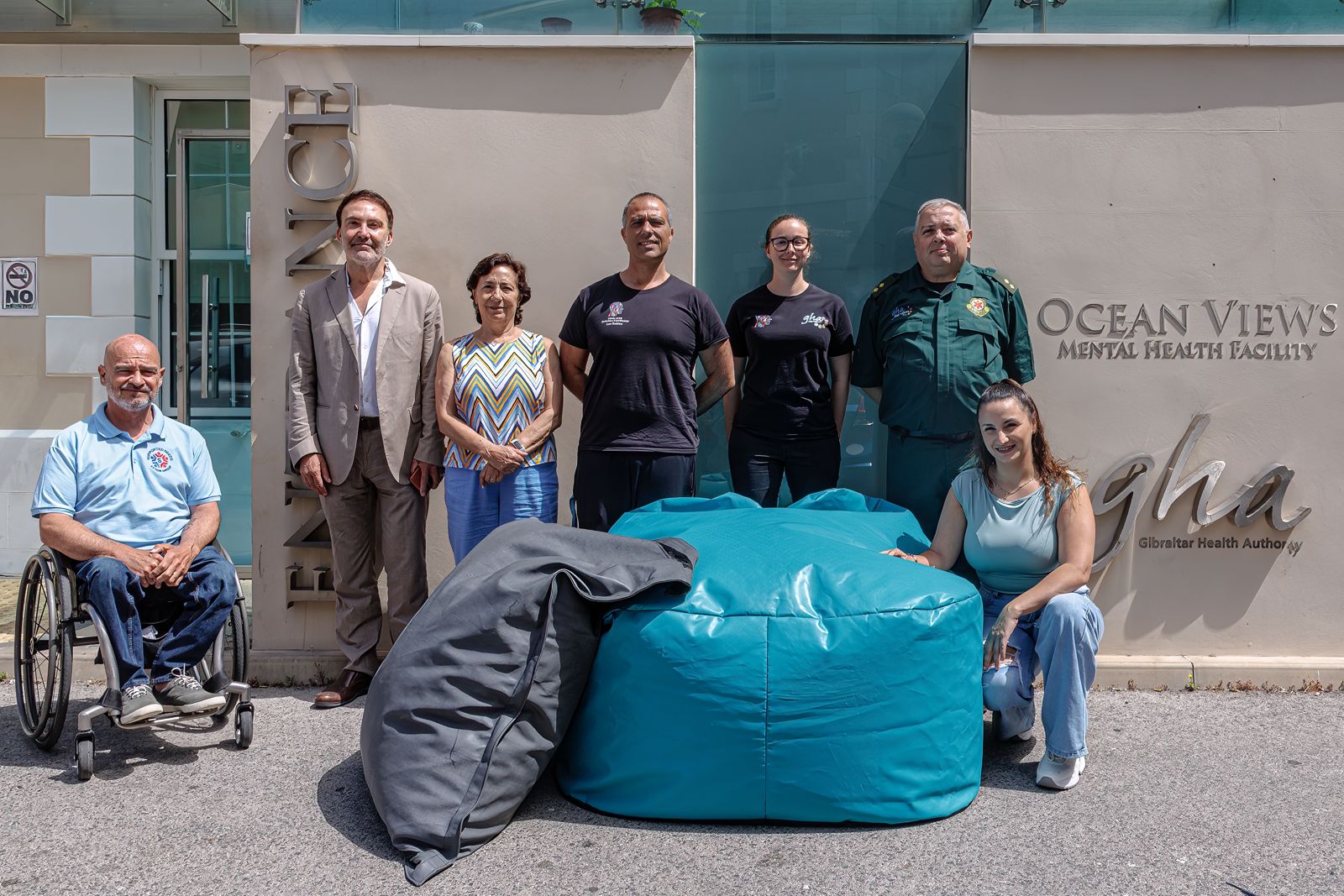
The new equipment has been purchased through the support of two local charities, the Mental Welfare Society of Gibraltar and the Supported Needs Action Group (SNAG).
Representing the charities at the presentation were Eric Rowbottom from SNAG and Mark Montovio and Conchita Triay from the Mental Welfare Society of Gibraltar.
Charlie Noguera, station officer at Gibraltar Ambulance Service, is behind the new equipment having approached both charities asking for assistance in covering the cost of approximately £4,000. This price included staff training.
During the presentation, fully trained staff showed charity representatives how the new equipment, likened to a heavily cushioned pod rather than a traditional restraint, can be used when de-escalation fails.
The safety pod is in sharp contrast to earlier methods of restraint, including methods that purposefully caused pain.
Mr Noguera explained that older systems required staff to induce pain to gain control, recalling a time when training focused on applying pressure to sensitive points on the body.
“We’ve come a long way for restraints, for the benefit of the service user, [and] for the benefit of the staff,” he said.
The most important thing prior to any use of restraint techniques, including the new pod, is de-escalation, said trainer and nurse at Ocean Views Lee Robles.
He said the new pod is much more dignified for the person, adding that the use of pain to achieve compliance was ineffective for patients in acute psychotic states who often did not respond, leading instead to injuries for both patients and nurses.
Mr Robles and his team, including Adrianne Attard and Claire Lima who assisted in the demonstration of the equipment, emphasised that restraint techniques are now embedded in care plans, with patients consulted in advance, where possible, about how they wish to be supported if restraint becomes necessary.
They feel it is important for a patient to be part of the decision-making process for their care.
In addition, after any incident, patients are debriefed, sometimes on the same day or the following day, to review what happened and what could be done differently.
The new equipment involves placing the person on the pod, where they sink down a little, with two trained personnel on either side holding their arms, and another holding their head, all done to ensure the person does not hurt themselves or others.
To avoid any lashing out with their legs, the weighted element of the equipment is placed across their lower body by two other trained personnel.
The technique also enables staff to administer intramuscular injections more easily but, most importantly, it is more “dignified” for the patient, avoiding the need to wrestle a distressed person to the ground, which would usually be the scenario in the past.
Mr Noguera underlined that the equipment is not only for local service users known to the system, but also for high-risk or unfamiliar individuals, including those brought in by law enforcement, elderly or highly distressed patients whose physical strength can be unexpectedly high, or other individuals who may self-harm.
While the Mental Welfare Society usually aims to keep a low profile with respect to the work they do, they felt it was important to highlight that “things are moving forward” in mental health practice.
Mr Rowbottom said that SNAG wanted to contribute because the equipment is good for people with supported needs too.
Staff designated as instructors and technicians have received training in refilling and emptying the pod, routine maintenance and checks to ensure it remains safe and functional and storage, particularly as the equipment is expensive, bulky and not in constant use.
They cautioned that the pod “is not a bean bag”, insisting it must not be treated as casual furniture or misused by those unfamiliar with its purpose.


