


Gothic paintings in Alcañiz Castle reveal Gibraltar battle scenes from 1309
The mural depicting the meeting, in early December 1308, between Ferdinand IV and Jaume II near the Monastery of Santa María de Huerta.


By Maria Jesus Corrales
A detailed investigation into murals decorating the walls of Alcañiz castle, in Teruel, has revealed six scenes that depict the Spanish conquest of Gibraltar from the Arabs in 1309, a key moment of the Spanish Reconquista, rather than what was previously believed to be different episodes from the history of northern Spain.
The research has been carried out by the Professor of Latin Philology at the Universidad de Cádiz (UCA) and Director of the Instituto de Estudios Humanísticos, Dr José María Maestre Maestre, who has been studying these paintings for 15 years and not only represents a major step forward in the understanding of the castle in Alcañiz, linked to the Spanish knightly Order of Calatrava, but documents Gibraltar at a key period of its history.
Speaking to the Chronicle, Dr Maestre said he considers these images, “the oldest surviving historical image of the Rock of Gibraltar”, to be “of incalculable value… not only because they are the oldest and depict such an important military enterprise, but because they are vital in resolving other historical questions, such as whether the Spanish noble Guzmán ‘El Bueno’ built a tower on the upper part of ‘the mountain of Tariq’ for his troops’ defence”.
The professor has already presented his research in the first three of 12 scientific papers, receiving positive reports from experts in different fields, and in the third instalment he revealed that some of the murals within Alcañiz castle chronicle the capture of the Rock of Gibraltar from the Arabs in 1309, by Fernando IV of Castile in collaboration with Jaume II of Aragon.
Dr Maestre bases his thesis on the results of various archaeological methods, including using documentary sources from the period to help identify the principal figures depicted in the paintings.
According to Dr Maestre, García López de Padilla, Grand Master of the Spanish knightly Order of Calatrava and commander of Alcañiz castle, sought to immortalise the military campaigns in which he had participated, among them the successful conquest of Gibraltar.
This military campaign, the professor said, is depicted in detail in several scenes of the murals.
Furthermore, Dr Maestre has managed to decipher the murals’ identifying and explanatory cartouches which, although poorly preserved, “constitute the most solid methodological basis for the research and permanently link the name of Alcañiz to something as significant as the first Spanish reconquest of the Rock of Gibraltar in 1309 and to a series of leading figures.”
“The Gothic mural paintings of Alcañiz castle have, as was customary, numerous identifying and explanatory cartouches which, until now, no one had noticed,” he said.
“These cartouches were engraved in bas-relief and form part of the walls of the castle where the paintings are located.”
“The difficulty lies in the fact that a non-expert finds it very hard to read these inscriptions, due to the narrow lettering and the loss of the paint that accompanied them over the centuries, as well as inappropriate human intervention,” Professor Maestre added.
Later attempts at restoration has made the original lettering even harder to read over time but, to assist in deciphering them, the scholar commissioned a digital reproduction of all the photographic material from the last century from the Institut d'Art Hispànic Amatller in Barcelona.
This material has confirmed what he had already suspected.
Some murals are of religious themes, such as the Wheel of Fortune, the Lion of Judah, the Tree of Jesse, and a depiction of Jeremiah 31:13, the prophet celebrating the return of the Israelites from Babylon.
Dr Maestre has focused on an ensemble of six scenes, three of greater importance and three secondary ones, though also highly significant.
These scenes had previously been attributed to different events from the reign of Jaume I of Aragon but “there were scholars who pointed out inconsistencies in the data and argued that the research should also consider later and contemporary periods to when the paintings were created, between the late 13th and 14th centuries.”
In actuality, Dr Maestre believes that one of the three main scenes features King Fernando IV of Castile and León and King Jaume II of Aragon deciding to unite to fight against the Nasrid kingdom of Granada and, more specifically, to reconquer the Rock of Gibraltar.
“After meeting for two days in early December 1308 at the Monastery of Santa María de Huerta, and for another two days in Monreal de Ariza, both kings agreed to attack the Nasrid kingdom of Granada,” he said.
Another scene, although heavily damaged, depicts the moment when that agreement was formalised in writing on December 19, 1308, in the Treaty of Alcalá, signed at the Archbishop’s Palace of Alcalá de Henares. It was agreed there that, on June 24, 1309, Fernando IV would besiege Algeciras and Jaume II Almería.”
The latter also committed to helping the Marinid sultan Abu al-Rabi Sulayman to conquer Ceuta, which had been taken from him by the Nasrid kingdom.”
A third scene shows the departure of Fernando IV from Toledo, “leaving his mother, wife and sister in sorrow” in late May or early June 1309, after convening the Cortes of Madrid to request financial support. He also asked Pope Clement V to declare his campaign a crusade and to grant plenary indulgence to its participants. The pontiff agreed and to finance the war against Granada.
The inscribed cartouches also identify the figures in the kings’ retinues, including Guzmán ‘El Bueno’, the infante Juan Manuel and García López de Padilla.
After passing through Córdoba, Seville and Jerez de la Frontera, the Castilian monarch arrived in Algeciras on July 27, more than a month later than agreed.
Jaume II was also delayed, reaching Almería on August 11.
“However, the fleet of the Aragonese monarch had already supported the Marinids in the conquest of Ceuta on July 20 or 21. In this context, and with the help of the Aragonese fleet, Fernando IV launched the reconquest of Gibraltar, both for its military importance and its symbolic value, as the landing of Umayyad forces in 711AD had marked the beginning of the Muslim conquest of the Iberian Peninsula,” the professor added.
“The Castilian monarch decided to attack Gibraltar on all fronts, ordering that, through what is now La Línea de la Concepción, the Archbishop of Seville, Fernando Gutiérrez Tello, the militias of that city’s council, the noble Juan Núñez de Lara, and the infante Juan Manuel would advance by land with Alfonso Pérez de Guzmán ‘El Bueno’ and the Order of Calatrava, led by Grand Master García López de Padilla, in the vanguard.”
“Meanwhile, the Aragonese and Castilian fleets, commanded by Admiral Jasper de Castelnou and Vice Admiral Eimeric de Bellvei, prevented the besieged from receiving aid by sea.”
More importantly, Dr Maestre notes, two scenes show that, during the campaign, Guzmán El Bueno had a tower built to protect his troops and attacked the fortress of Gibraltar with two catapults, launching stones that forced the rapid surrender of its 1,125 inhabitants at the end of August 1309. These were deported to North Africa, allowing Fernando IV’s triumphant entry into Gibraltar on September 12, 1309, which was also recorded in the mural.
Dr Maestre has identified two macaques in this last scene which, he said, leaves no doubt about the setting.
“The first to record the participation of López de Padilla in the first reconquest of Gibraltar was Jerónimo Zurita, who included him in this military operation in his Annals of the Crown of Aragon,” Dr Maestre said.
“In addition, there are various documents, some already published and others unpublished in the national historical archive, containing donations from Fernando IV to López de Padilla that mention his participation in the siege of Algeciras.”
“The fact that the earliest of these is dated early September 1309 suggests that the king’s generosity was a result of the Grand Master of the Order of Calatrava’s role in the reconquest of Gibraltar,” he said.
Once his series of 12 research papers is completed, Dr Maestre will compile his research into a book that will undergo a blind peer-review process.
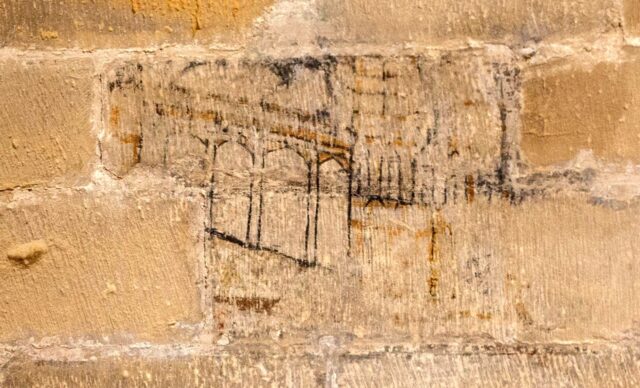
A depiction of Archbishop’s Palace in Alcalá de Henares, where the Treaty of Alcalá was signed.
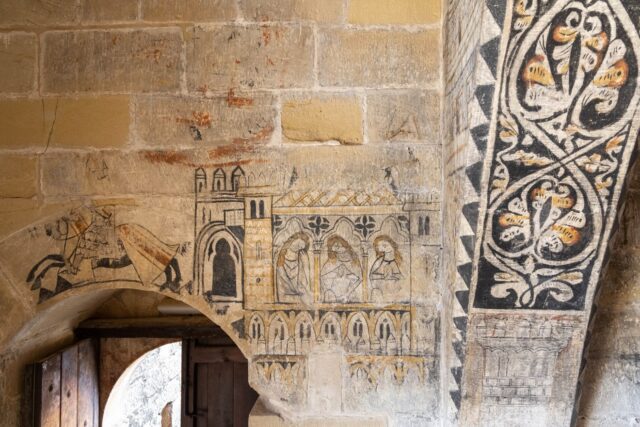
Located on Alcañiz castle’s west wall, Ferdinand IV departs from Toledo in late May or early June 1309. The scene includes three mourning figures identified as Queen María de Molina, Constanza of Portugal, and Isabel of Castile.
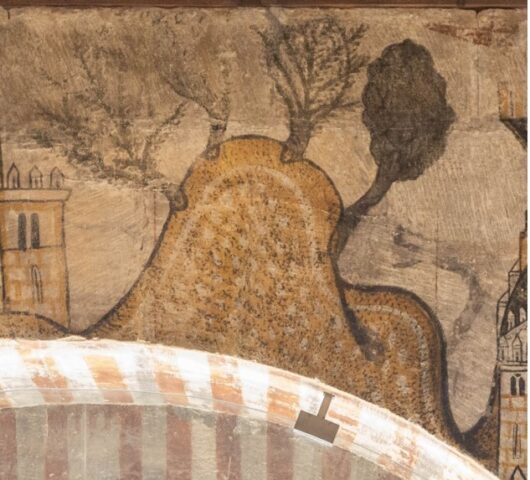
On the northern side of the castle’s south wall, this mural is identified as depicting Gibraltar. This is because it includes a Castilian fortress at the foot of elevated terrain and surrounded by water, resembling Gibraltar as seen from La Línea.
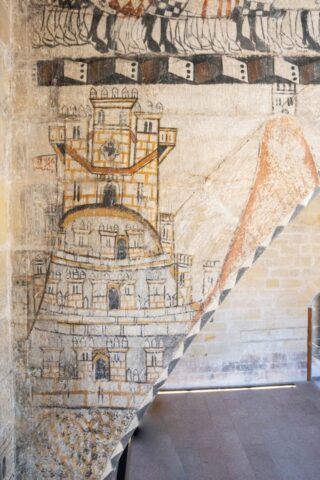
The mountain resembles the Rock of Gibraltar as seen from La Línea de la Concepción. The tower is believed to be the one constructed by Guzmán ‘El Bueno’.
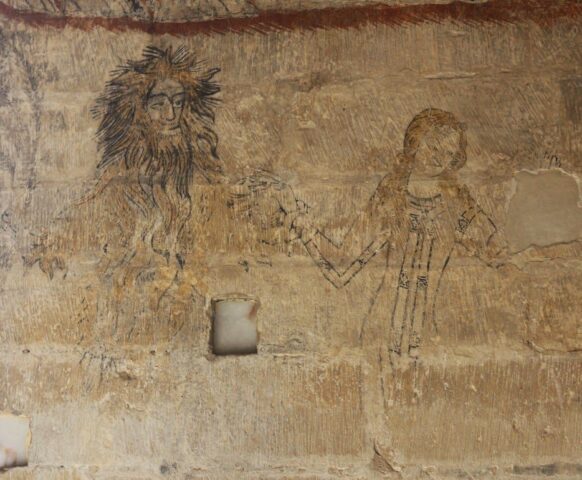
The upper section shows the Order of Calatrava’s camp and, below, a study of the heraldry identifies the figures accompanying Ferdinand IV during his entry into the castle of Gibraltar. Among them are the symbols associated with Guzmán ‘El Bueno’, including two cauldrons and a dagger recalling the episode in Tarifa where he prioritised the defence of the city over the life of his son (these cauldrons have been poorly restored, leading to confusion with those of Juan Núñez de Lara). The other identified figures include the Infante Juan Manuel, Eimeric de Bellvei, and Rodrigo Ponce de León, each represented through distinctive heraldic elements. The king is also depicted with a starry cloak in the foreground. Below them, the prophet Jeremiah dances, an allegory linking the capture of Gibraltar to the return of the Israelites to Mount Zion.
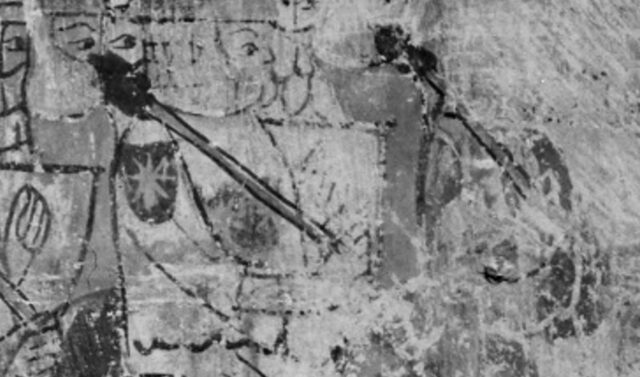
Details from the procession marking the entry into Gibraltar on September 12, 1309. Professor Maestre notes the presence of two monkeys as mascots, one clearly visible beside the king, arguing that this detail reinforces the identification of the setting as Gibraltar. This image is based on an enlarged version of a 1935 photograph from the Institut Amatller d’Art Hispànic, where the macaques are more clearly visible.


