


Music Review Stabat Mater in concert


The Cathedral of Holy Trinity was packed to witness Haydn’s Stabat Mater, presented by the Gibraltar Classical Music Society and featuring In Cantus and Friends, with an orchestra under the baton of Michelle Paccagnella.
The programme delivered one of Joseph Haydn’s best known works, which he composed in 1767. It’s based on a 13th century poem which contemplates on the suffering endured by Mary, the mother of Jesus, at his Crucifixion.
It was Haydn’s first large-scale vocal work, which in fourteen movements strikes a judicious balance between grief and expectation.
In my youth when I was an altar boy at St Joseph’s, Stabat Mater verses in Latin were sung at the Stations of the Cross during Lent and that is how many local churchgoers would have become familiar with the poem’s verses over the years.
With the music of Joseph Haydn, it lifts them into another dimension as we would witness in this landmark concert.
As was widely expected here, given their growing reputation, the concert was a resounding success for GCMS with a well-deserved standing ovation rewarding the conductor, the orchestra, the choir and the five soloists for an exceptional performance, echoes of which will remain embedded in the vaulted naves of the cathedral and also live long in the memory of those who attended the concert.
It was a spectacular classical music event.
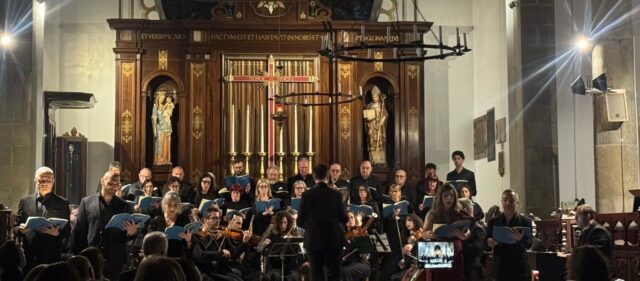
Deeply moving and breathtakingly beautiful in equal measure, it’s challenging to put into words the richness and balance of the huge sound produced by the music of the sizeable In Cantus choir, five singers and a splendid orchestra, all in full voice and helped by the beautiful acoustics for which this venue is well known.
You had to be there to experience it and I would venture that, for me as a musician, it was a truly enriching experience.
This was not a provincial concert. It would have been worthy of any small capital and Michelle Paccagnella would have been proud of what he conjured with his baton in 75 minutes of the renowned and celebrated music for Easter time.
The soloists in order of appearance were: Phillip Borge McCarthy, tenor; Anthony Roper De Almeida, alto; Tessa Pitto Duarte, soprano; Samantha Bowling, soprano and Jose Antonio Ariza Rodriguez, bass.
The well-designed concert programme listed the composer‘s biographical details, the fourteen movements in Latin and the lyrics in Latin and in English, which brought home to the reader the depth and sentiments of the religious poem then, adding Haydn’s rich musical tribute to the Holy Mother’s suffering at the point of her Son’s ignominious death on the Cross, elevated this epic work and made it comparable to Handel’s Messiah.
True, their structure is quite different but both are major sacred works and both have a special place in classical choral music.
My personal highlights are listed here:
Movement 3, when the In Cantus choir is first heard on its own.
Movement 8, when tenor Phillip Borge and soprano Samantha Bowling soar in duet.
Movement 10, when the soloists (excepting soprano Tessa Pitto), join the choir in full voice.
Movement 13, when Soprano Tessa Pitto and Alto Anthony Roper at first duet and later are joined by the rest of the singers for Movement 14, the rousing finale, Paradisi Gloria.
Congratulations are in order to the GCMS and the Conductor, Musicians, Choir and Soloists, not forgetting the sponsors whose help make these events possible.
I now eagerly look forward to the summer for the next concert by the GCMS.


