


Piano and Cello Meditation at Holy Trinity


Classical cellist Michael Kevin Jones and pianist John Bryden, no stranger to our shores, played a concert at the Cathedral of the Holy Trinity.
It was billed as a meditation and the evening’s programme was brought to us by The Gibraltar Classical Music Society (TGCMS) who are ever busy organising concerts and recitals, all of which enrich our musical culture and enjoyment.
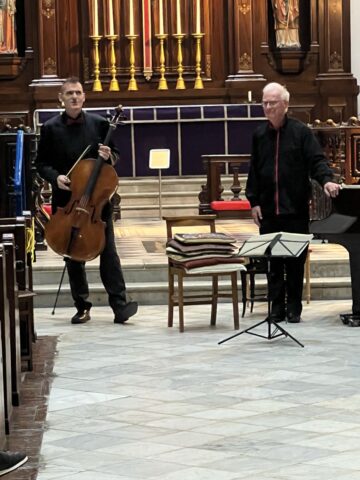
In his opening announcement, Phillip Borge McCarthy said that we were in for a treat and he was right. It was a delight to see and hear two accomplished soloists, still at the top of their game, playing important works from Martin Berteau, Beethoven and Cesar Franck in a balanced programme which was eminently suited to the rich acoustics of the cathedral.
The cello at close quarters is a formidable instrument which projects forwards and upwards and its voices were enriched by the great acoustics, so nothing was lost in translation. The clarity of the grand piano on the other hand, can be muddied in some of the upper registers, depending on quieter passages to be properly appreciated. The musical ‘meditation’ in the hands of our two soloists, who were experts in the nuances of their instruments in cathedral settings, allowed us to enjoy wonderful music in all of its glory.
The cello Sonata in G major, Op 1, No 3, by Martin Berteau, opened the concert with its strident tempo in the first allegro allowing the cellist to make the most of the beautiful melody which rang out in the expansive reverb of the vaulted naves. This sonata is considered one of the most popular Baroque works for cello and piano, so the grave and second allegro which followed were much enjoyed by all and warmly rewarded in applause. I was seated three metres away from the cello and it was a joy to watch and listen to the maestro coax the different nuances from his instrument’s voices.
Pianist John Bryden introduced the second offering, Cello Sonata in F major, Op5, No1, by telling us that “here we have Beethoven having lots of fun” which I took to mean that we were going to hear busy interplay and responses from both piano and cello because the great composer could challenge players across the range of their instruments. The solemnity of the cello’s voice came through best in the mids and lows which were quite distinct and so, at all times, we were kept engaged and enthralled by the movement in the music, especially in the Rondo. allegro vivace which crowned the sonata which was written for the King of Prussia in 1796.
There was an interval for refreshments and the second part of the programme featured Cesar Franck and his Cello Sonata in A major, which has four movements and occupied the entire second half of the concert. This sonata was written in 1886 and is considered one of the finest sonatas for violin and piano, later reset for cello by renowned cellist Jules Delsart, although, based on oral history by the Spanish legendary cellist Pablo Casals and documents, it was speculated that the work was first conceived for cello and piano and only later reset for violin and piano.
Bryden in his introduction agreed that it was written for violin first and he then added “but of course you will hear the cello” no doubt alluding to the fact that it’s a more powerful instrument that projects much better in a cathedral setting. And, of course, the magnificent and mournful lines of Michael Kevin Jones’s cello did come through, clearly advantaged by the frontal projection of the instrument. It was a dazzling display of cello technique and the evocative passages from the piano melded the melodies of both instruments clearly throughout the entire work.
At the end of the programme, the applause lingered enough to invite an encore which cellist Michael Kevin Jones introduced as “something quieter” and it was the beautiful cello classic The Swan (Le Cidre) from Camille Saint -Saens’s The Carnival of the Animals, one of the most beautiful cello melodies that we may have heard and enjoyed throughout our lifetimes, such is its enigmatic beauty. Jones deftly extracted every nuance of the melody, cementing the notion that cello and piano do indeed cause us to meditate upon the beauty of music and nature.
A truly fitting end to a great evening which was well attended but could have seen more pews filled, those who missed it may have to hear from us that “you missed a great concert.”
Well done, TGCMS, for presenting this meditation of cello and piano.


