


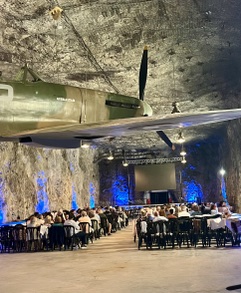
‘The Armed Man – A Mass for Peace’ performed at Spitfire Hall


A white dove, the universal symbol for peace, was the visual message on the back screen of Spitfire Hall. The image was used multiple times in between the thirteen movements of the concert by ‘Harmonics’ of the music by Sir Carl Jenkins, which has been performed over three thousand times around the world since its London premiere in 2001.
Whenever the white dove wasn’t on the screen, archive images of preparations for war, fighting, carnage and devastation, followed by cemeteries and finally joyful liberation, diverted our attention away from the superb massed choir and orchestra, whose outstanding performances held us spellbound for close on two hours.
I attended the second of two sold-out nights of ‘The Armed Man’ which had previously been successfully performed by Harmonics Choir at The Holy Trinity in 2018. This time Harmonics were augmented by Insubriae Chorus (Italy) and Zyriab Choir (Algeciras) with the Orchestra conducted by Michelle Paccagnella.
The concert was a profound experience both aurally and visually and at its end, was rewarded by a prolonged standing ovation from the capacity audience. Some seniors with tearful eyes from the emotion of watching very powerful imagery and perhaps pondering on their own war memories of lost loved ones and their evacuation in 1939.
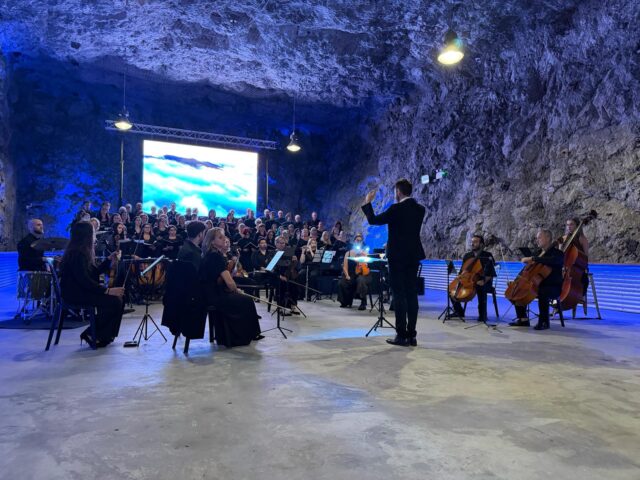
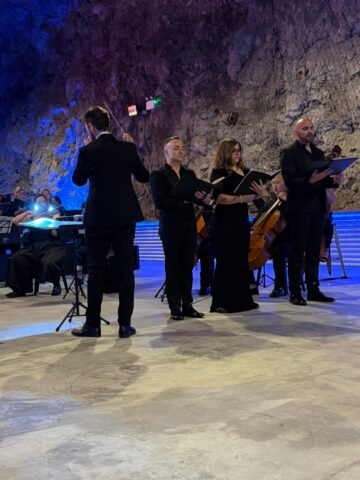
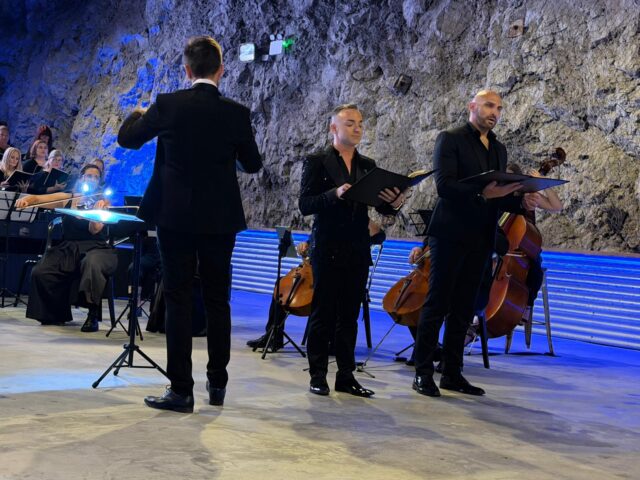
This had been the most compelling local musical performance that I have seen. It was not a comfortable experience because of the imagery, but it was a glorious one because the epic music and sublime choral movements, some based on the Latin Mass, made it a triumphant concert to have witnessed and enjoyed, in spite of the drama unfolding on the back screen most of the time.
It began with a marching drumbeat contrasting an old French folk tune on a flute, which gave way to the huge choir singing in French (‘L’homme arme’) while swaying to the beat – that was a deft touch of drama for the intro. A Muslim ‘Call to Prayers’ followed, and the ‘Kyrie’ in the third movement, where Alto Alan Roper De Almeida and Tenor Phillip Borge McCarthy sang from the front, with images of munition factories on the backscreen. That was the first on many concert highlights, as the musical variation between the ‘Kyrie’ and ‘Christe Eleison’ (Greek- Lord have Mercy and Christ have Mercy) provided solemnity and beauty.
‘Save Me from Bloody Men’ with words taken from Psalms 56 and 59, was our first chance to hear the choir tenors on their own (‘a cappella’), as a sense of foreboding crept into the music and led to the ‘Sanctus’ when percussion and brass contrasted the joyful choir chants. The next two movements a ‘Hymn before Action’ and ‘Charge’ brought the choir to screams and images of the ‘Twin Towers’ terrorist attack. It was a profound moment of tribute and stillness.
The spell was only broken by the sounding of ‘The Last Post’ with David Guillen Monje on trumpet. More stillness and drama as we had reached the middle of the concert. There was no break. No applause was allowed until the end and the stillness was only briefly interrupted by quiet rustling of music sheets, while the white dove on the screen gave hope for peace, alas, currently a long way removed from today’s reality.
The next two movements, ‘Angry Flames’ and ‘Torches’ (movements 8 and 9), were visually supported by stark images of the atomic bomb (Hiroshima on 6 August -1945) and the devastation and casualties which followed. The darkest episode of all wars-before or since. Words from a Japanese poet reflected on the bomb’s devastating effects and the choir and orchestra musically guided us through the drama of watching those powerful images.
The tenth movement was ‘Agnus Dei’ (Lamb of God). Trumpet calls and images of Arlington Cemetery with sublime music, brought hope for peace. This was a crowning moment of the Latin Mass and offered up choral parts with multiple harmonies. For me, another musical highlight of the evening. It was followed by ‘Now the Guns have Stopped’ when Anthony Roper stepped up beside the Conductor to sing about a lonely survivor who mourns the death of a friend lost in battle.
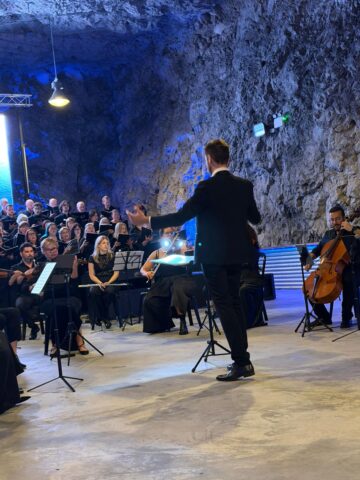
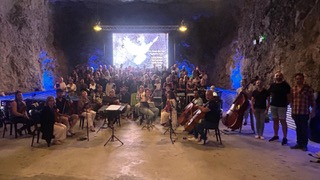
The twelfth and penultimate movement, ‘Benedictus,’ was introduced by the beautiful cello lines of Mauricio Yamamoto Gomez with images of children on screen. The Choir then taking on the melody with the words ‘Blessed is He who comes in the Name of the Lord’. A fitting finale loomed as ‘Peace’ led to rejoicing and onscreen, we found joy at last. Kisses, hugs, flags, balloons and bunting, with glorious music leading to a crescendo before returning to the first quiet cello lines of serenity.
The substantial final movement ‘Better is Peace’ reprised ‘L’homme arme’ from the choir’s intro at the beginning, followed by ‘Better is Peace’ and finally unaccompanied, the choir sang ‘God shall wipe away all tears, and there shall be no more death, neither sorrow nor crying, and there shall be no more pain’.
The ‘Mass for Peace’ had ended and the story of ‘The Armed Man’ had once again been told here, but now I’m sure, reaching new musical heights in which first class Choral singing by the augmented ‘Harmonics Choir’, an excellent orchestra led by Michelle Paccagnella, and superb archive war footage, all conspired to etch an unforgettable evening into our collective memories of great concerts. I think I speak for everyone who attended the epic concert.
Be proud all the many who were involved in this classical music milestone which closes the season for this year. We remain in awe.


