


Gibraltarian inventor hopes road safety app KYON can save lives


Gary Desoisa the inventor of KYON, a new road safety-focused technology believes he could help prevent collisions and thereby save lives on Gibraltar’s roads.
Mr Desoisa is from Gibraltar but was speaking to the Chronicle from Toronto early in the morning about what he describes as a “privacy-first vehicle to vehicle safety system” designed not just for drivers, but for pedestrians and cyclists too.
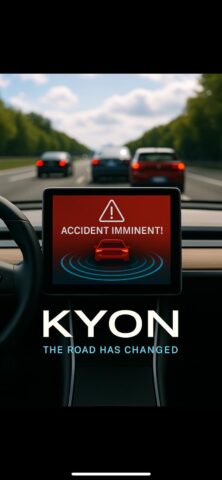
Its aim is to improve real-time communication between vehicles and pedestrians without relying on cameras, surveillance, or constant tracking. The system activates only when a safety risk or hazard is present.
Although the system is currently being validated in Toronto, his ambition is for its first real-world rollout to be in Gibraltar.
“I want to make Gibraltar proud,” he said.
“I am Canadian. I've been here for 49 years. I am 51 years old, so I came here as a small kid, but I am Gibraltarian at heart, and I would really like to implement this in the perfect scenario where Gibraltar is possibly the first country to implement a system like this. That that would be my ideal plan.”
“Given Gibraltar’s unique road conditions, narrow streets, steep inclines, high visitor traffic, and mixed pedestrian-vehicle zones, KYON could meaningfully enhance safety for both locals and tourists, particularly in high-footfall areas and congested zones.”
KYON, takes its name from a Greek word meaning “guardian” or “guardian dog”. It is an apt image, he said, as a watchful presence in the background, alerting when danger is near.
“Being a guardian is like the system is watching over you or the individual that downloaded the app to make sure that they're safe,” he said.
“This system alone is made only for safety purposes, nothing else. It doesn't care about your information. Doesn't care about your private information, your phone numbers or your credit card numbers. It just wants to keep you safe. That's it.”
At first glance, KYON sounds like a more advanced version of familiar apps such as Waze, which warn of obstacles or traffic ahead. But Mr Desoisa said it is more ambitious than that as it is an operating system for safety that enables two-way communication between vehicles and people.
“In a conceptual sense, it does imply some form of Waze,” he said.
“However, the difference is our system actually allows communications between the vehicle and the driver and the driver and other vehicles and people around it. So it's basically a situational awareness system.”
He sees it as a “bridge between current technologies of vehicles and full autonomoly” not a self-driving system, but something that could help close the gap by letting humans and machines share intent and information in real time.
To understand how it might work in Gibraltar, he gave an example of a busy street with a bus approaching a crossing. Both drivers and pedestrians can be distracted be it by mobile phones or other things, these he said are as common on pavements as they are behind the wheel.
“If this system was involved or put into public transit, school bus, and say, for example, it's coming up to a crosswalk on a busy street,” he said.
“If this bus were to come across a pedestrian walking and the pedestrian is not paying attention, the bus will actually send a message to the pedestrian, as long as they have this app, and warn them not to cross the road because it's too dangerous.”
The alert might be a chime or a vibration in the pedestrian’s pocket.
At the same time, the pedestrian’s phone would send a message back to the bus: “Hey, I'm about to cross the street.” That two-way exchange of intent is, he said, “the whole purpose.”
Gibraltar’s driving habits can also produce warnings. Such as motorbikes overtaking on the wrong side of the road, or sometimes on blind bends, are an all too familiar hazard on the Rock. Mr Desoisa said that as long as the rider has downloaded the free app, the system can warn both parties.
“If they tried to overtake a vehicle on a blind corner and you are coming on the opposite direction,” he said.
“The motorcyclist’s app will let you know that there's a hazard coming up potentially in your lane, and your app will also warn the driver that they're doing something that is inappropriate.”
KYON does not seize control of the vehicle.
“It doesn't force the drivers to make maneuvers,” he said.
“It allows the drivers to maintain control, but it does warn you and will escalate warning until you avoid the accident.”
Reaction speed is crucial to the system working and the team set themselves a strict target of the reaction being at least as fast as a human being.
“The response time, or the reaction time of the system needed to be under one second,” he said.
“It needs to be under one second because that's how humans react. Humans react in milliseconds.”
“If we can create, which we have, a system that reacts just as fast as humans, if not faster, well, then that gives you notifications to react faster. We are currently at about .4 milliseconds in reaction time.”
Beyond moving vehicles, KYON is being built as a public-centric safety platform. It can detect and respond to a car broken down on the side of the road, warning approaching drivers and providing precise location information to emergency services or recovery vehicles.
In the event of a more serious collision, the system can recognise an impact, prompt the driver to respond, and if there is no reply within about 30 seconds, automatically call emergency services based on the phone’s location.
To avoid overwhelming users, KYON incorporates what he calls an “ambient knowledge” system. It ranks events by severity, only escalating alerts when something is truly wrong, rather than “ping, ping, ping” for every passer-by in busy places like Main Street.
One major focus and something the developer stresses is the strict privacy-first approach.
“We do it bottom up. We don't need people's information,” he said.
“All we need is a phone number and your license plate. The license plate is visible to everybody, so you're not hiding anything from the public.”
Mr Desoisa has spent about two years thinking about KYON before an intense six months studying existing autonomous systems, leaning heavily on artificial intelligence tools to brainstorm ideas.
“If you're not using artificial intelligence today for technology, then I think you might be losing in the game,” he said.
“Based on three different platforms, AI platforms, every single platform is telling us that this is a viable solution to help people save lives.”
KYON will undergo testing in Toronto first and is in the process of this happening, before it will be available to Gibraltar or any other city/area.
“We are extremely confident,” he said.
“We're probably at about a 94% confident rate that this will make a difference in people's lives. But the main portion of this is to make sure that people adopt it. If it doesn't get adopted, then it doesn't work.”


