


A Noble Pursuit


Letting the genealogy out of the bottle
By Brian Porro
Outside Gibraltar, when you tell people you are looking up your family tree, the first question often asked is: ‘are you hoping to find money or an inheritance?’
Within Gibraltarian circles, it is understood that, when we are researching our ancestors, it is because we are interested in our roots or in learning more about our history – it is a somewhat higher calling.
This essay is about what I have discovered about one line in my family tree, the Porro branch.
Not that long ago, my friend and friend of Gibraltar, Martí Crespo i Sala, wrote about one of the various ‘standard bearers’ of the proud name – Bishop Francisco Bartolomé Porro. According to Martí, Francisco was the son of Tomás Porro. Tomás was born in Alicante of Genoese parents in 1698 and was in Gibraltar by the 1720s, where he married, and died in 1772. In that time, he became a very prominent member of the community as a notary and as a member of the Junta de Ancianos/Assembly of Elders.
Others who bore the name Porro in Gibraltar were merchants and diplomats. A whole dynasty stemming from Nicolás Porro, for example, from which may have come the Consul Porro whose name is engraved in the Lobby of the Parliament of Gibraltar.
None of this comes as a surprise when Porro is the name of Counts of Milan and other notables from Lombardy and Genoa.
The subject of this story, Bartolomé Porro, fits the mould exactly.
BARTOLOMÉ PORRO
I first encountered Colonel, later Field Marshal Bartolomé Porro in Ignacio López de Ayala’s work on Gibraltar, Historia de Gibraltar of 1782.
His few words about Porro’s role in the history of the environs of Gibraltar were enough to spark my curiosity. In the 1700s, this historical character had put a plan together to help Algeciras, which had been rebuilt and repopulated after the loss of Gibraltar in 1704, to wrest control of the territory that today is the ‘Campo de Gibraltar’ away from the engorged San Roque, a small settlement that itself had ambitions over the Campo as ‘displaced loyalists’.
López de Ayala leaves the reader con la miel en los labios by concluding with a fleeting reference to the fact that, after being jailed and challenging the charges of fraud and breach of contract brought by the Council of San Roque, the courts never came to a decision because Bartolomé Porro died in 1724 before proceedings could conclude.
ORIGINS OF THE FAMILY
71 years earlier, in 1653, his father Vicente Porro was born in Loano, Finale Ligure, in the northwestern segment of the coast of Liguria. At that time, the Marquisate of Finale had belonged to the Spanish Crown for just over 50 years. As a buffer territory just north of Genoa, the value to Spain of holding Finale was clear.
Vicente, seeing the opportunities in the expanding trade with the Spanish colonies in America, moved to Andalusia. This was not exceptional – merchants, military men, members of the nobility and others from Liguria had been arriving in Spain, mostly the east coast, Madrid and the southern cities, since the early 17th Century and in many cases much earlier.
Vicente was a successful businessman and also held Ligurian titles of nobility, which he registered in Spain where he arrived in Seville at around 15 years of age. He then moved to Cadiz and married Cipriana del Rio of Sanlúcar de Barrameda with whom he had three children. The eldest of them was Bartolomé, born in 1677 in Cádiz and baptised on 17 October 1677 in the parish of Santa Cruz. As the first-born son, he took over the family business which his father had built up with trade on both sides of the Atlantic. Once Bartolomé left for the army, the reins were taken over by his younger brother who led the family firm to further success.
CAREER
The War of the Spanish Succession (1701-1714) between the Bourbon and the Hapsburg dynasties interrupted Bartolomé’s business career.
Bartolomé Porro enlisted into the Bourbon army as a Captain, moving up in the Spanish system to the rank of ‘sargento mayor’ (‘Major’ in British terms), ‘sargento de brigada’ (‘Brigadier General’ or ‘Brigadier’) and Colonel when he was not much more than 20 years old. According to some reports, he saw action – the Spanish Ambassador at Genoa reported that Porro had served in ‘some of the bloodiest encounters in the last war’. He could well have been involved in the sieges of Gibraltar of 1704 and 1705 but, in any event, he would have been very aware of the circumstances of Gibraltar around the time of its capture by the Anglo Dutch force and afterwards.
However, he dropped out from his military career and moved to Finale, Liguria, where it would appear he still had property and family.
In the time before returning to Spain in 1719, Bartolomé had a life full of incident, not least because while he purported to support the Austrian powers that were now in possession of the Marquisate of Finale, which Spain had lost to the Republic of Genoa under the Treaty of Utrecht, he was actively providing information to Philip V who was now King of Spain. In that time, he was thrown into jail twice, threatened with execution by firing squad and generally diced with death.
THE BIG IDEA
Porro’s concept was not new: Spain had a long tradition of settling people in desert areas or uncultivated plains, such as around Seville or in the Sierra Morena, and of course in its colonies in the Americas, particularly in the north from Florida to California.
Bartolome Porro’s ‘big idea’ was to obtain Royal approval to establish a province in what today roughly equates to the Campo de Gibraltar. The new settlement would, according to the plan, achieve three main objectives:
• Bring in loyal former subjects from Finale, which had passed from Spanish to Genoese control, who would work the land and in industries established in the area – paper mills, fisheries and fish and agricultural production
• Populate the region after the devastation of war
• Provide a buffer zone which would keep the British confined to Gibraltar
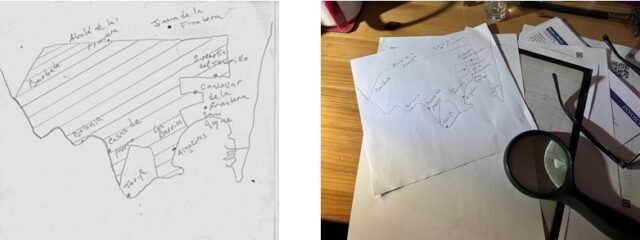
Porro may have already had the Strait of Gibraltar in mind when he left Italy. In 1719, he gathered information about the legal, economic, and social conditions of the region. By April 1720, he had presented the king with a detailed proposal for the creation of a province to be called El Finale de Algeciras on crown lands in and around San Roque, Tarifa, and nearby villages.
He arrived in Andalusia on 28 October 1720 with the express mission of founding the new settlements. After a brief stay in Jerez de la Frontera, he was installed as governor of Tarifa in April 1721. He initially began construction at Bolonia but soon abandoned the site in favour of Valdevaqueros Bay, where he founded a small hamlet that came to be known as Casas de Porro. That, too, was never completed.
That was because his ambitious project was ultimately thwarted by the opposition of local elites and the powerful noble landowners. Complaints were brought about his administration of Tarifa during his time as its governor and he was also accused of not repaying loans or paying for materials. He was jailed on charges of fraud and breach of contract and it was from jail where he brought an action before the courts to defend himself. In those days, it was jail first, defend yourself second.
Despite being provided with legal help from influential people, his enemies were powerful regional landowners who saw their position threatened. The Royal assent to the plan had involved the land which was directly owned by the Crown in the province, but it seems that people like the Duke of Medinaceli and other landowners had spilled out from their own properties and taken over areas of crown land while there was no one to protect its interests – until Porro was appointed. The plan was also resisted by those elites now in power in Algeciras, which had been rebuilt after the loss of Gibraltar, and in San Roque, where many of the influential families of the Spanish City of Gibraltar had moved and set themselves up as a centre of local power and did not want their own ambitions undermined by a rival centre.
THE END OF THE DREAM
The sources are not clear as to how or why Bartolomé Porro died but he could have been suffering from the conditions of his incarceration. The fact is that his death brought the project to a hasty end.
History might well have taken a very different course, but all that is left of the Finale Province of Algeciras are the buildings at Casas de Porro and reportedly some other structures scattered around the area. There were also people from Finale who were brought over by Porro to be settled in the Campo area and it was the financial support he had obtained for their transport that had allegedly not been repaid which fuelled some of the charges against him.
NOBLE FAMILY
So where does this leave my family history? Am I in line to succeed to swathes of land in the Campo de Gibraltar or, at least, to a link to a titled ancestor? The first Porro in my own family line who came to Gibraltar arrived as an infant with his parents. He was reportedly born in Marbella and there is a possibility that his mother’s surname, Espá, suggests a Valencian origin. However, the records show that José Porro was illiterate, that he worked as a seaman and that in his latter years as a widower had become blind and died after many years as an inmate of Gavino’s Asylum or Hospice, which points to a level of infirmity and indigence.
But it is not beyond the realms of possibility that, given the geographical context and the name that there is in fact some connection – descendants, possibly, of a branch that had not done so well subsequently.
Bartolomé Porro himself was not known to have had any children and there is no record of a marriage. In fact, in his will, he handed over his business interest in the family firm to his sister, which is of some significance. He lived from 1677 to 1724 in a life packed with adventure as an entrepreneur, soldier, spy and governor of what almost became an Italian province in the hinterland of Gibraltar.
As for me and my search for a link to such signal origins – I am afraid that any fame or fortune accruing to the Porro family will have to start with this generation.


