


Plans filed for Gib’s sewage treatment plant
Images courtsey of Gamma Architects Ltd


Plans for Gibraltar’s long-awaited sewage treatment plant have been filed with the Town Planner, with the industrial facility designed to blend into the landscape at Europa Point.
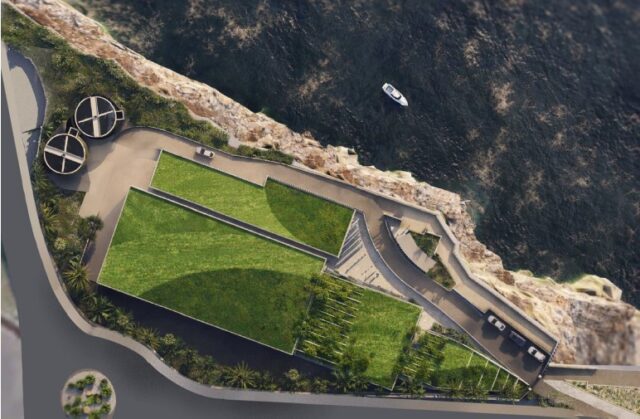
Artist’s impressions show an industrial facility on the Brewery Crusher site incorporating green roofs designed to reduce its visual impact in an area of great ecological and heritage value.
As part of the design, new pedestrian infrastructure will also be incorporated along the boundary of the site.

The application for outline planning permission, filed by EcoWaters Ltd, includes proposals for a new pumping station at Little Bay and associated connecting pipes and infrastructure that will run along Keightley Way tunnel.
In the design statement, prepared by Gamma Architects and filed with the application, the applicant acknowledged that the development of the site requires a careful balance between operational efficiency and environmental responsibility.
“The design approach focuses on minimising visual impact through appropriate massing, materiality, and integration with the surrounding landscape,” the design statement said.
Gibraltar currently discharges untreated sewage into the sea at Europa Point. While strong currents carry that sewage into deeper water, releasing it into the marine environment has long proved controversial.
The Gibraltar Government has a longstanding commitment to build the urban wastewater treatment plant but earlier projects have hit stumbling blocks.
“Untreated sewage contains nutrients, bacteria and other contaminants that degrade water quality, increase the risk of localised contamination around the discharge point, and pose a potential health risk to swimmers where tidal movements or prevailing currents carry effluent plumes toward nearby beaches,” said the design statement.
“The proposed wastewater treatment infrastructure will provide full treatment prior to marine release.”
“Full treatment will significantly reduce bacterial and nutrient loads entering the marine environment, improving near-shore water quality.”
“It will also bring Gibraltar into compliance” with the EU Urban Wastewater Treatment Directive.
The works cover three areas, including Brewery Crusher at Europa Point which will house the actual treatment plant; Little Bay where there will be a pumping station; and Keightley Way Tunnel where there will be a transfer pipelines.
The statement noted that the Brewery Crusher site’s proximity to the sea allows treated effluent to be safely discharged into the sea following treatment.
“The Urban Wastewater Treatment Plant and the Little Bay Pumping Station form two strategically connected infrastructure nodes along Gibraltar’s southern coastline,” said the design statement.
“Although physically separate, the sites are linked by the Keightley Way Tunnel, which follows existing infrastructure, minimising surface disruption and environmental impact.”
“This separation allows each facility to operate efficiently while responding to its specific environmental and urban context.”
It noted that topographically, the connection traverses varied terrain and that routing follows established access paths and service tunnels, reducing the need for new interventions and limiting impact on sensitive landscapes.
“From a contextual perspective, both sites are influenced by coastal conditions, including prevailing winds, salt-laden air, and exposure to sun, requiring robust and resilient infrastructure design,” said the statement.
“Their locations away from dense residential areas help mitigate potential impacts related to noise, odour, and operational activity, while remaining accessible for maintenance and monitoring.”
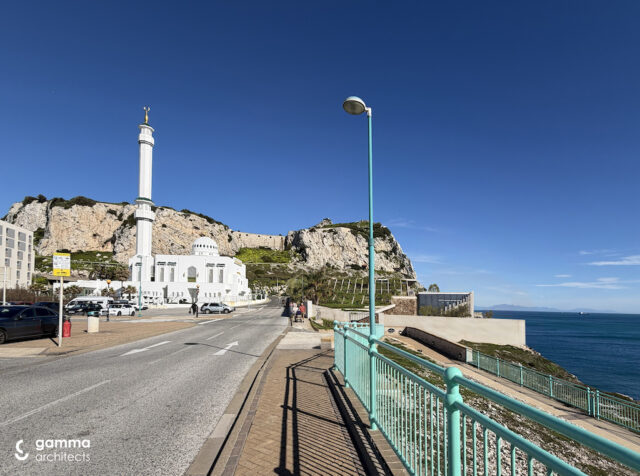
At present there is no footpath along Levanter Way where the Brewery Crusher site is located.
As part of the proposed development, the project seeks to create a defined pedestrian pavement along the site perimeter.
The design statement noted six goals for the project. They include:
- Landscape integration, where the aim is to “embed the facility within the sloping terrain and adjacent cliff faces to reduce visual impact, allowing the building to read as part of the landscape rather than a standalone industrial object.”
- Contextual sensitivity, which refers to carefully considering massing, height, and setbacks, which aims to ensure the plant respects key views, public routes, and nearby landmarks.
- Improvement for the community, where the project aims to enhance the public area and create an environmentally friendly facility while improving pedestrian routes and ensuring security and functionality.
- Environmental responsiveness, which addresses prevailing winds, strong and solar exposure through orientation, shading, robust materials, and passive environmental strategies.
- Reduction of perceived industrial character, where architects used architectural language, materiality, and green roofs to soften the infrastructure’s appearance, promoting acceptance of the facility within a highly visible and publicly accessible area.
- Longevity and adaptability, focused on a durable design and low-maintenance structures capable of accommodating future operational changes without compromising architectural coherence.
According to the design statement the Little Bay pumping station is part of the required infrastructure.
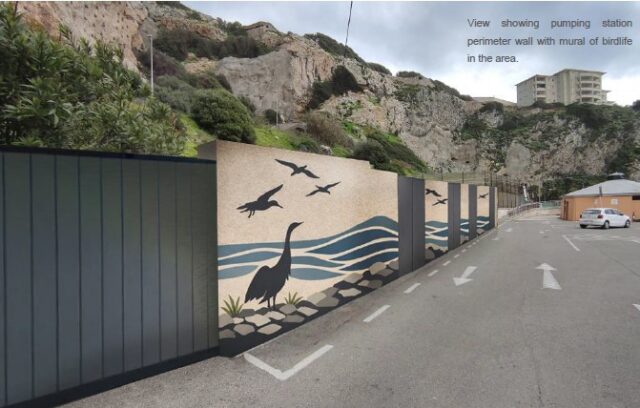
“The facility is largely discreetly tucked below the access hill to the Keightley Way tunnel to minimise visual impact within this coastal setting. A perimeter wall screens the infrastructure along the roadside and incorporates a mural that references and celebrates local birdlife,” said the statement.
The proposed transfer pipeline begins at the new pumping station in Little Bay and will then travel south through the Keightley Way Tunnel to reach the proposed treatment plant.
“Keightley Way is a single-lane southbound tunnel. The pipeline will be installed without permanently obstructing traffic or pedestrian movement and will therefore be positioned alongside the tunnel’s existing side infrastructure. The raised walkway will improve pedestrian access and safety,” said the statement.
“The proposed wastewater treatment plant represents a significant environmental improvement for Gibraltar, replacing the existing discharge of untreated wastewater with a modern treatment system that will substantially improve marine water quality around Europa Point.”
“Sustainability has informed both the engineering solution and architectural response.”
“The facility is partially embedded within the rock, allowing the surrounding ground mass to provide thermal stability and contribute to passive cooling of internal spaces. Its coastal location further assists in moderating temperatures and reducing mechanical cooling requirements.”
“Energy-efficient treatment technology has been selected to minimise operational energy demand and reduce greenhouse gas emissions compared with conventional wastewater treatment systems.”
“Process areas are enclosed and incorporate odour control systems to minimise impacts on nearby public spaces and beaches.”
“The architectural design is supported by a landscape strategy using native coastal planting and a sedum roof to help integrate the development within the cliff environment while contributing to biodiversity and microclimate improvement.”
The Gibraltar Government announced that ECO Waters Ltd have been selected as the preferred bidder for the long-awaited wastewater treatment plant in September 2023.
That year the Minister for Environment, Dr John Cortes, described the project as “a very important and positive step forward for Gibraltar”.
He said the project had been subjected to a rigorous environmental assessment process.
The application has yet to be debated by the Development and Planning Commission and the closing date for public comments is March 19, 2026.
Most Read
As long-stay patients move to Rooke, plans for new services at St Bernard’s Hospital
Mon 21st Sep, 2026
Gibraltar U15 finish unbeaten in UEFA Development tournament with a second win
Sun 20th Sep, 2026

Today's Paper
12th March 2026
Read our latest newspaper by downloading our app from the link below.


