


The oddities, realities, and general dos and don’ts of the past


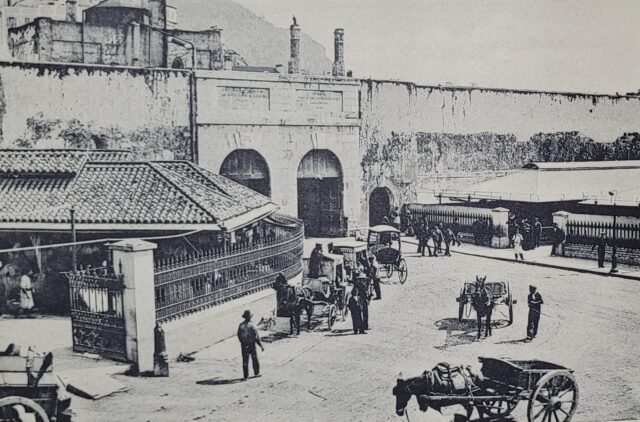
Time to venture back into the past in Alice’s Table. I was just flicking through the Directory and Guide of 1927, to see what else it could offer from our history, and life as it was. I realised we do not often look back on the monthly diary of events included in all the information. Royal visits are always a priority and there are many entries over the years. 123 years ago on 8 April, Gibraltar saw a visit from the King himself. On his way to Malta, King Edward VII visited the Rock. If we look back further to 1876, the Prince of Wales was on a visit to Gibraltar and on 17 April laid the foundation stone for the market just outside the city gates. With so much interest in space these days – and the successful return home of the Artemis II’s moon-traveling astronauts who set the record for deep space travel – I could not resist reporting on Haley’s Comet which was observed this month 116 years ago on 21 April – I suspect not many were awake at the time as the comet was observed at 4.20am.
THE POWER OF LIGHT
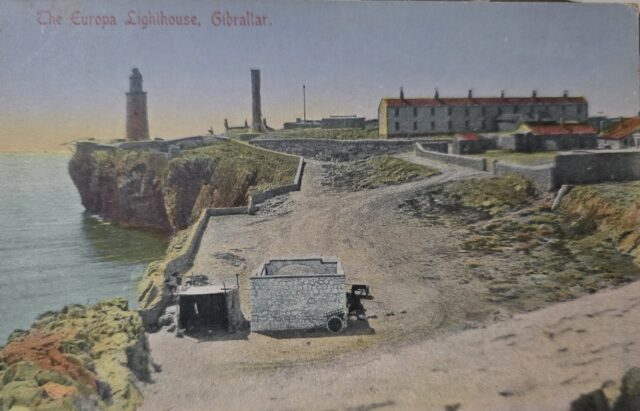
1838 saw the laying of the foundation stone of the Europa Lighthouse still in operation today. The stone was laid at Europa Flats on 26 April by the Governor of the day Alexander Woodford.
The establishment of the Lighthouse was received as a welcomed “object to ships making for Gibraltar at night” and would open a few years later in 1841. At the time its full height measured 61 feet, and above the high watermark 156 feet. Describing the character of the light when it first opened – the Directory reports: “The character of the light is two occults every 30 seconds, that is 22 and a half seconds of light followed by 21 seconds of darkness, the two and half seconds of light and again 21 seconds of darkness”.
The visible light of the Lighthouse could initially be seen, “with an Arc of Red Sector, 23 degrees, which showed over the Pearl Rock” and the power of the light was like 3,500 lit candles. By 1927, the system had changed to a new petroleum vapour burner – a 100-millimetre lamp with a single incandescent mantle known as the auto form.
The one which had previously been in use was Matthew’s incandescent oil burner which had three mantles. Up to the fitting of the new burner the visibility of the light was some 18 miles but the new installation in 1927 considerably increased the range whilst at the same time reduced the expense of the upkeep itself. There was also a fog signalling apparatus with two reports in quick succession every five minutes.
And as we follow the path into town, and since this year we are celebrating the 210th anniversary of the Alameda and Gibraltar Botanical Gardens, let us remind ourselves that the Alameda “commercial square” was actually opened to the public in 1816 on 14 April.
TIME FOR MUSIC
It is not the first time in Alice’s Table that we refer to musical societies. In 1927 three were recorded in the Gibraltar Directory and Guide. Alice’s Table has already featured the Gibraltar branch of the Association of Musical Culture from Madrid and the local delegate of the association locally who was Nemesio Cortes living on Irish town. The monthly subscription of the association was 6 pesetas for men and 4 pesetas for women. Entrance fee to the events was 10 pesetas.
The next musical entity was The Gibraltar Choral and Operatic Society which was established in June of 1908 and would prove a long-lasting venture. Its president was the Governor of the day. The object of the society, which was still producing events into the 1950s, was the study and performance of operatic and other concert music. Membership was open to all and rehearsals were held at the Royal Engineers Mess in Cornwall’s Parade. There was an annual subscription fee of 10 shillings. There were a number of prominent Gibraltarians in local society involved but the majority were officers of the Garrison. Another music society established long before the Choral and Operatic Society was founded as early as 1886. It was the Royal Minnesingers’ Society. The object of this society was to give social smoking concerts and other musical entertainments. There was an entrance fee for all its events of five shillings together with a monthly subscription of one shilling and sixpence. The quarterly subscription was four shillings – and all paid in advance. The president of this society was J Mosley, at the time a JP. The secretary and treasurer was an officer of the Garrison.
THE MARKET
The market is described in the Directory as having an abundance of supply – there was beef, fish, vegetables, fruit, eggs and poultry – and all of which were exhibited from the time the market commenced in 1876. The foundation stone had been laid by the Prince of Wales and erected at a cost of £13,000. A reminder that for many years there was a service of delivery from the market to homes – and many fruit, vegetables and milk sellers would sell their products directly to the homes carried by horses and mules.
ODDITIES
Often the Gibraltar Directory and Guide carries a miscellaneous information page in which we find some fascinating oddities. In 1927 the Directory featured the curiosities of dress. This was during the command of the late Duke of Kent whilst he was in Gibraltar in 1802 and 1803.
So, the story goes – “a field day” was ordered. As there were not enough barbers in Gibraltar to deal with all the men in the Garrison – here’s what happened.
“When a field day was ordered, there were not sufficient barbers in the town to attend to all officers in the morning, as the seniors claimed the privilege of their rank”. This meant that consequently, the juniors (the junior ranks) were obliged to have their heads dressed the night before. But in order to preserve the “beauty of this artistic arrangement – a pomatumed powdered curled code and clubbed” and “these poor fellows” were apparently obliged to sleep on their faces. The Directory section also reports that in the Adjutant’s office of each regiment “a pattern was kept” of the correct way in which the cut had to be made – a pattern which any Barber could refer to and follow.
Several punishments are also recorded in this miscellaneous section of the 1927 Directory and Guide. Imagine this - four soldiers were shot on Windmill Hill in September 1757 on charges of desertion. This was done in the presence of the whole Garrison. Private Thomas received 1000 lashes with a “cat of nine tails” but the last fifty were given by the hand of the “common hangman between Southport and Waterport” after which he was drummed out of the Garrison with a halter about his neck. The Governor gave the order that the prisoner had to be taken to the Grand Parade where he would receive as much of the punishment as he was “able to bear”.
EXPANSION OF TRAVEL
In the late 1800s to early 1900s the methods of travel near Gibraltar which had previously remained practically unaltered for some 200 years, and since the Rock first became British, were to be “entirely revolutionised” giving more access to the nearby area, and all in a 30 year period, and completed by 1927.
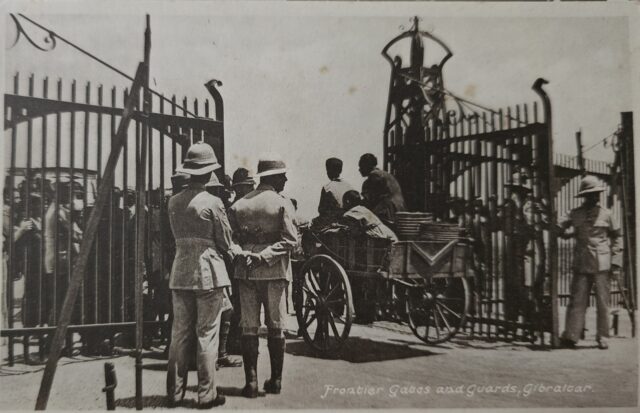
In the late 1870s construction begun on the road from Algeciras to Tarifa. It was seen as the first real advance made since and would enable wheeled transport to be employed for the first time between Algeciras and the railway near Cadiz.Up till then, the only means of communication between the Rock and the interior of Spain was by means of riding horses and pack animals.
“A yet greater advance was made when the Algeciras-Bobadilla railway opened in 1890” and was seen as Gibraltar being well placed for the first time ever in direct communication with the railway system of Spain and Europe. The railway would then lead on to the construction of various roads such as the road from the town of San Roque to the station of that name and others from Algeciras to Los Barrios. This meant that very slowly wheeled transport would be introduced into many parts of the country, and which would benefit the expanse of travellers to Gibraltar.
JUMPING TO 1950-51
Time to jump ahead now and delve into the Colonial Reports of the early 1950s. As I continued to prepare and research another Alice’s Table – I was reminded of the recent outbreak of meningitis in the UK and the importance of being immunised against such diseases. There are reports of such outbreaks in the reports which affected Gibraltar and the number of epidemics in the final years of the repatriation to the Rock. I was also reminded of the research carried out in this area by leading anthropologist, the late Larry Sawchuck, and how epidemics on the Rock came and went with frequency over its 15 sieges since the British arrived here in 1704. Larry, a great friend of Gibraltar, who has featured on these pages several times in the past, focused his work on how epidemics shaped the population, governance, and social structures of the Rock from the early 19th century onward. Larry concentrated his work around the period starting in 1804, and the Yellow Fever epidemics especially of 1804 and 1810 which had catastrophic consequences. In 1804 over 2,200 deaths were recorded in just four months. Gibraltar was also hit by cholera in the 19th century.
As I read through the notes of the Colonial Report of 1950 and 1951 – although the word “epidemic” is used - thankfully, there were no lives lost, the incident nevertheless was seen as important enough to feature in the annual-joint colonial report at the start of the decade of the 1950s. And although the health of the civil population remained satisfactory throughout the years of 1950 and 1951 the Colonial Reports point out that the “epidemic of influenza” occurred at the beginning of 1951 and although the number of cases were high the nature of the epidemic was benign. Measles also appeared in epidemic form in 1951 and according to the report no fewer than 692 cases were reported but again no deaths occurred from this disease. The health section of the report also highlights 19 pulmonary tuberculosis cases in 1950, and 22 in 1951. A year earlier there had been 21 cases reported. It further reported that Chicken Pox was by far the most noticeable of the minor infectious diseases of 1950 whilst measles easily headed the list in 1951 followed by scarlet fever. Nine cases of enteric fever were notified in 1950 and the same number in 1951 compared to 14 in 1949. No death from enteric fever occurred during 1950 and 1951 and there were no cases of major infectious diseases either.
And here is another interesting statistic: the Colonial Hospital then, had accommodation for 153 beds and was the only General Hospital. It contained a maternity block, and a segregation block. A clinic for outpatients was also held every morning. The report also refers to “up-to-date departments” such as radiography and physiotherapy” which were connected with the hospital as well as a number of clinics which included an ante-natal clinic, orthopaedic, dental and ophthalmic.
The old King George V Hospital which mostly dealt with diseases of the chest had 64 beds at the time. This hospital was mainly used for the treatment of pulmonary tuberculosis which then was still a problem in Gibraltar. However, according to the report it appeared to be under control.
At the time there was also what was known as the “Infectious Diseases Hospital” for the treatment of major infectious diseases such as cholera and smallpox. But this was reported as being contained and the facility continued to be empty throughout 1950 and 1951 - this hospital could have been brought into service without any delays at any time should the need have arisen then.
Overcrowding – an issue which was always a problem on the Rock – could have added to the numbers affected at the time. The last of the repatriation, I will point out, was also still in process – but Gibraltar was ready to turn a corner with the building of Humphries – the Alameda Estate - which had already begun construction, and where thousands of Gibraltarians would soon find new more comfortable accommodation.
RETURN TO OLD DAYS
With the British Council – The Calpe Institute – fully operational these years saw a very full programme of social and cultural activities. The British Council representative in Gibraltar headed the operation and the year 1950 was to see a Gibraltar Festival. Organised in the summer of 1950 it had a full programme of sporting events, concerts and entertainment. A similar festival was also held in 1951 as Gibraltar was finding its way back to the old days before the world war. It is also interesting to note that in those days the Director of Labour and Welfare continued to be the Registrar of Trade Unions on the Rock.
At the end of 1949 there were 11 trade unions registered under the Trade Unions and Trades Disputes Ordinance of 1947. By 1951 a further two unions had been added – one of them was the staff association of the City Council and the other an association of Master Builders. So, by 1951 there were 13 trade unions registered in Gibraltar: The Gibraltar Confederation of Labour, the Transport and General Workers Union, The Gibraltar Civil Service Association, Amalgamated Engineering Union, Gibraltar Dockyard Ex apprentices and Apprentices Union, The Civil Service Clerical Association (Admiralty Branch) Gibraltar, Civil Service Clerical Association (War Department Branch) Gibraltar, Society of Technical Civil Servants (Gibraltar Branch), Gibraltar City Council Staff Association, Association of Scientific Workers (Gibraltar Group), Institute of Professional Civil Servants (Admiralty Supervising Technical Officers Branch), Gibraltar Master Bakers Association and Gibraltar Master Builders Association.
At the time it was estimated that the total paid up membership of the workers’ unions was 2,500. This was approximately 40% of some 6,500 British subjects then registered as being in employment in Gibraltar.


