


100 years on, Calpe at 30 gives focus to the child skull found in Devil’s Tower
Dr Richard Jennings (Oxford University) briefing Dr Joseph Garcia at Gorham's Cave.


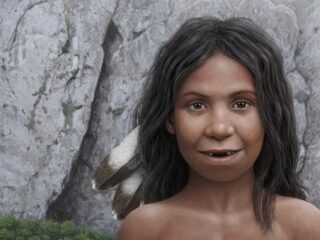
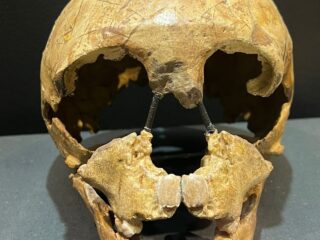
 In 1926, Dorothy Garrod made a discovery that would give greater standing and impact to Gibraltar’s place in the history of evolution and the story of the Neanderthals. Garrod, scientist and archaeologist, found the skull of a child in the Devil’s Tower Cave with a very large braincase. This specimen which would eventually become known as Gibraltar 2 today carries the name of Flint. A four-year-old Neanderthal who since 2016 has had a face and can be seen at the Gibraltar National Museum alongside Nana, or Gibraltar 1 which was found in Forbes’ Quarry in 1848.
As we featured in July this year Gibraltar reached another milestone as it celebrated the 10th anniversary of the Gorham’s Cave Complex being designated a UNESCO World Heritage Site and which continues to provide evidence, and together with Gibraltar 1 and 2, still adds to the overall Neanderthal story in global terms. The Calpe Conference 2026 – number 30 - is another milestone and kicks off next week. Not surprisingly, it will focus on the discovery of Flint 100 years ago, with a new book on the findings also being launched next week by Dr. Alex Menez. The international premiere of the film ‘The Last Traces of the Neanderthals’ will also take place in Gibraltar next week.
Calpe 2026, Neanderthal: The Conference, is bringing to the Rock the world leading experts on human evolution. They will gather in Gibraltar for what will be without doubt a lively debate in what we know so far, and in the further understanding of the Neanderthals. An event which will surely present a bigger picture of our Gibraltar ancestors as we continue to add to the Neanderthal story. 61 academic institutions will be represented from 16 different countries including Austria, Belgium, Canada, Finland, France, Germany, Gibraltar, Ireland, Israel, Portugal, Spain, Switzerland, the UK, and the USA.
Returning to Alice’s Table this week – is Professor Clive Finlayson Director of the Gibraltar National Museum with the specific roles of Chief Scientist and Curator – who is at the forefront of the research locally together with the Gibraltar National Museum team. Joining us is Professor Geraldine Finlayson, CEO at the Gibraltar National Museum, who works alongside him. The husband-and-wife team have been organising the Calpe Conferences for most of its 30-year history believing the conferences have added to our unique story and also served as a key part in the creation of Gibraltar as a centre of excellence for the study of Neanderthals.
In 1926, the Gibraltar Colonial Report carried the following passage on its pages on the historical findings: “As a result of excavations carried out at the North front by Miss D. Garrod working under the direction of the Abbé Breuil, one of the foremost authorities in Europe on palaeontology, the frontal bone and other portions of a human skull together with implements of the Mousterian age were discovered on the 11 June 1926. The skull, which is similar in shape to the famous Gibraltar skull discovered in 1848 and now in the Museum of the Royal College of surgeons in London, is estimated to be not less than 20,000 years old.”
As I sit down with Clive and Geraldine, ready to join them at the conference next week – I can’t help thinking how many I have attended and reported on for both GBC and this newspaper over the years. As I look through the programme for this year’s conference, I come across many familiar names – an interview a very young reporter carried out many moons ago with Professor Chris Stringer who returns after many years to attend Calpe 2026. Stringer, a British physical anthropologist linked to the British Natural History Museum is well known for his work on human evolution has visited Gibraltar and Gorham’s Cave on a number of occasions. As the conversation takes us to the 1926 discovery of the child skull (Gibraltar 2) they both remind me that one must consider just how far we have come since then because 100 years ago the whole science of comparative anatomy with modern humans was still very much in its infancy. In fact, when the skull was eventually studied closely in London in the early 1960s, the debate then revolved around there being two skulls (two individuals) and not just the one.
Geraldine explains the skull (Gibraltar 2) had been fractured when it was first found in the Devil’s Tower. Initially, certain features in relation to the skull suggested the child was around six to eight years old whilst other features suggested the child could have been as young as four.
“This led to a lot of debate in the scientific community in the 1960s. The question remained if there were really two skulls or just the one? Remember that back then the skulls were being compared to modern human children. Eventually, in the 1980s and 1990s the consensus would be on just the one individual skull,” she says.
Clive then adds: “By then the scientific world had realised that the Neanderthals were more precocious than us and developed faster.”
Let’s look at the timeline and remind ourselves that the first Gibraltar skull (Gibraltar 1) was found in 1848 by Captain Edmund Flint at Forbes’ Quarry. But it was not sent to Britain for examination until 1864. It was examined by Charles Darwin. The discovery of this Gibraltar skull (Gibraltar 1) pre-dated the skull found in the Neander Valley in Germany just eight years later in 1856 – with the discovery of fossil bones in the Neander near Düsseldorf in Germany. This find determined that the world would for the first time in 1863 hear about the Neanderthals. And these creatures became known as Neanderthal. When Garrod discovered the second skull (Gibraltar 2) on the Rock in 1926 the expedition was looking and hoping to find Neanderthal remains. Geraldine tells me that when the team found the stone tools in the Devil’s Tower in 1926 it was thought that further investigations should be carried out to shed more light on the date of Gibraltar 1.
And then low and behold the second skull Gibraltar 2 was discovered. It was Abbé Henri Breuil, the renowned French pre historian and archaeologist, who had already worked on several sites on the Rock and in 1911 had co-discovered and explored Devil’s Tower Cave together with English ornithologist Colonel Willoughby Verner who in 1920 called for Garrod. Breuil asked Dorothy Garrod (then a very young archaeologist) to join the excavations in Gibraltar, and this would lead to the discovery in 1926. Her detailed approach to the excavations has also provided insight into the lay of the land, the fauna in the area, and the tools which were unearthed. Clive refers to the discovery in 1926 as a “huge and major find” which is referred to by leading scientists and everywhere in the scientific world today.
“In my personal view,” he says, “its context has been of great significance because it showed – and we know that there was probably a river estuary in the area – how much marine fauna was associated with the Neanderthals living on the beach where there were all kinds of species of ducks for example, including arctic ducks. It showed particular contextual climatic environmental information that for me appeals a lot.”
Sadly, with the building of the airport, the digging and all the later developments - the transformation of the area rendered no possibility of further investigations. Clive tells me the team has been back on the Devil’s Tower (some years ago with Chris Stringer) but “there is nothing left there” only a large boulder which in any future excavations may yet uncover new material. Gibraltar 2, today known as Flint, was first named Abel. This was the name Garrod gave to the child skull. Both skulls - Gibraltar 1 and 2 - are housed at the British Natural History Museum in London. Replicas of both skulls are on show at the Gibraltar National Museum. In 2016, the Gibraltar National Museum team wanted to make the Gibraltar skulls come alive. They wanted us to relate to their discoveries and see them as one of us. Geraldine explains that in the 21st Century it felt right that we got to see what these Neanderthals could have looked like. To give them names so that in a very definite way they became real. It was in May 2016 that the faces of our Gibraltar Neanderthal ancestors were revealed to us – both forensically reconstructed by Dutch paleo artists Kennis and Kennis. They took 18 months to create the models. Working with Gibraltar 2, the five-year old Neanderthal child, and Gibraltar 1 – the 35-year-old woman. Through meticulous scientific data, anatomical measurements, and DNA research today, we identify with these Gibraltar Neanderthals permanently on display in their then natural environment at the museum – a moving experience to see the faces of people from some 60,000 years ago. But let us put aside Gibraltar 1 and 2 – for to us today they are simply known as Nana and Flint – the grandchild and the grandmother. Clive insists it was about giving them faces which were accurate – “it was all about showing their faces, what they could have looked like. Why did they have to be ape-like? In other words, we wanted to show some level of humanity in how we presented them. This was very important to us. The other aspect was that we were exploring other elements and joining in the discussion which talked about grandmothering and grandparenting in pre-history where grandparents also had a function in the community.”
The toothless face of Flint is the image associated with Calpe Conference 2026. A more human face which with recent findings have led to greater discussion in many areas: how they lived, how they interacted, children in the time of the Neanderthals, the role of grandparents, the hunter gatherers and their children.
“That would not have been written about or even debated before,” Clive acknowledges. This new approach where Neanderthals are no longer seen as those brutish ancestors means we can relate to them. He believes the image created by Gibraltar has helped to reach a clearer understanding of our Neanderthal ancestors. The Calpe Conferences, he adds, have been central to the understanding of the Neanderthals around the world and the many new discussions taking place today. Geraldine picks up the story: “Calpe has given us an opportunity to bring people to Gibraltar; leaders in their field who have participated in discussions and seen the work we have been carrying out at first hand. They read our papers and publications but changing people’s minds – that change in the perspective of the subject – something which has also required scientific lobbying had to be done face to face. In that, the Calpe series of conferences have been key. It has been vital in presenting new ideas and theories.”
Today, Clive tells me, there is a lot of research on the Neanderthals with more students interested in the subject.
“A lot of the scientists here this year were also here for Calpe 1998 – the conference then was called “The First Europeans – Gibraltar ‘98: 150th Anniversary of the Discovery of the Forbes’ Quarry Skull” – they have been leaders in their field and in the understanding of the Neanderthals of the last 30 to 40 years. They are returning to the Rock next week to look back on all that has come to the surface, what has changed, how we now view the Neanderthals and what this will mean for the future. Calpe is leading the way yet again.”
That conference in 1998, recalls Geraldine, was very successful because it brought together researchers who were very opposed in their ideas “and we managed to bring them together in the same space and acknowledge what each other was doing and they were able to discuss their ideas together”.
Calpe Conference 2026 will be held at the University of Gibraltar and opens on Wednesday morning and will be held over four days.
The first session on Wednesday morning will be by Dr. Alex Menez on ‘Gibraltar Dorothy Garrod and The Devil’s Tower Skull’ (his latest book as already mentioned earlier is released next week). Highlighting just a number of the speakers and talks (the full programme is available on the Gibraltar National Museum website where one can also register) during the week John Murray from the University of Galway in Ireland will give a presentation entitled: ‘There is an-other: William King and the naming of the Neanderthals’.
It was William King who first proposed the scientific name Homo Neanderthalensis in 1863. From the University of Vienna in Austria comes Tom Higham with: Improved chronometric methods and their impact on dating the disappearance of Neanderthals. Matthias Meyer and the Ancient Environmental DNA Analysis Consortium from Germany will go ‘Beyond bones and teeth: new sources of ancient DNA for studying Neanderthals, Denisovans and modern humans’. From the American Museum of Natural History, comes Ian Tattersall, with a talk on: ‘Neanderthals: still evolving in the human mind’.
I often wonder where the story of the Neanderthal is today – perhaps Peter Sahlins from the University of California can answer this in his talk: ‘The “Hominization” of Neanderthals: What’s Driving the Story?’ One talk I will not miss is Chris Stringer from the British Natural History Museum, who will go “In Search of the Neanderthals”. Father and son Stewart and Clive Finlayson will give new insight into the Gibraltar Neanderthals and birds. The final session on Saturday afternoon will be presented by Clive who will shed light on the Gibraltar perspective and where we fit into this great story: ‘Gibraltar Drops in the ocean: forays into the worlds of Neanderthals’. Geraldine believes Calpe Conference 2026 will reinforce Gibraltar’s place in the overall and forever growing Neanderthal story: “What we have achieved in presenting our Neanderthal story over the years is very solid. Gibraltar is a Neanderthal place. It is THE Neanderthal place. It is recognised around the world as such.”
As Clive looks ahead to next week, he wants Calpe 2026 to take stock of all that has happened in the past decades and ask – what is the state of our understanding of the Neanderthals? How far have we come? How much further can we go? Geraldine is confident the science world will continue to listen to Gibraltar and what Gibraltar has to say about “how the world now views the Neanderthals”. They both know there are now new generations of archaeologists, anthropologists, biologists, etc. who have grown up listening to the Gibraltar story and very much aware that Gibraltar is central to the Neanderthal story on a global scale.
“All we are doing now is reinforcing this message all the time. We have many enquiries from people who want to volunteer from all over the world because they are aware Gibraltar is the place to come to, and that we still have a place where a lot of excavations can still take place.”
And everyone knows Gibraltar’s Neanderthal experts are not afraid to add to the story… to tell their story and how they see it… to even change the story… and change the perception of the brute who was unintelligent when really, he/she was the complete opposite. Much of this thinking has come from Gibraltar, from our Neanderthals and the discoveries in our caves: Gorham’s and its Complex of Caves – a World Heritage Site. And the fact remains that there is still… more to tell. The last few words in relation to this major Calpe Conference taking place next week, I leave for Clive as he ends by telling me: “At this conference we would like recognition that we are now looking at the Neanderthals in a different light and through different eyes – and that we are looking at their humanity.”
The Calpe Conference starts on Wednesday 2 to Saturday 5 September. To register check out: https://www.gibmuseum.gi/news/calpe-2026
-
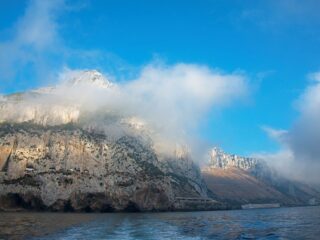
- The Caves From The Sea. -J C Finlayson
-
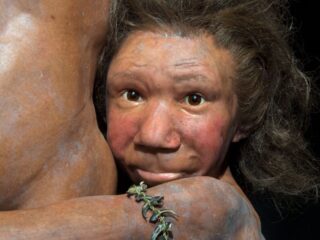
- Flint - Kennis & Kennis reconstruction of the Gibraltar 2 skull - Photo S.Finlayson.
-
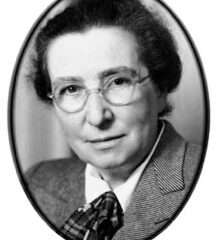
- Dorothy Garrod.
-
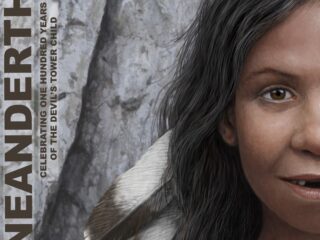
- Announcement of Calpe Conference ´26.
-
- Neanderthal conference logo.


