


Andrew Bailey recalls his father’s wartime role in tackling Italian saboteurs
Andrew Bailey, son of the Lt. William Bailey, the UWWP´s founder. / Photo by Johnny Bugeja


Andrew Bailey, the son of Lieutenant William Bailey, was emotional last Saturday as a blue plaque was unveiled at Rosia Bay honouring his father and the 15 British who worked to protect Allied shipping in Gibraltar.
Lieutenant Bailey led the Underwater Working Party, established to counter attacks by the elite commandos of the Italian Decima Flottiglia MAS, gathered a team of 15 volunteers who carried out searches of ships entering the Bay for bombs and limpet mines.
Minutes before the plaque was unveiled, Mr Bailey spoke to the Chronicle about his father’s work and the dangers faced by the team.
He highlighted that “this is a memory of 80 years ago which was so important.”
“The ships were being sabotaged in the Bay here and the Italians were placing bombs, and this had to be stopped because ships would be sunk and the Bay would be inaccessible.”
The context was complex, with Operation Torch, the Allied landings on Morocco and Algeria beginning on November 8, 1942.
Mr Bailey said the Bay of Gibraltar was an important staging point, with large numbers of cargo vessels carrying armaments and supplies.
“A lot of cargo vessels had to come into Gibraltar bay with armaments, with supplies of all sorts and the bay might have 50 or 60 ships at that time,” he said.
Italian saboteurs were able to place limpet mines and bombs beneath ships, prompting the British to establish an underwater unit to respond to those attacks.
“An underwater party had to be established. My father came from the UK, from England, with experience of bomb disposal and he set up the Underwater Working Party,” Mr Bailey said.
The unit began with three men and grew to 15 officers and men, between 1941 and 1943.
“They did the job of diving, day and night, searching all arriving vessels in the Bay to make sure there was no bombs or limpet mines,” he said, “it was a big job, because one diver could only probably do six or seven ships a day.”
“At night it's very difficult, for obvious reasons.”
“There's little more I can say about that, but [the Underwater Working Party] really did reduce the number of accidents on ships and ships being sunk.”
Mr Bailey said the Italians were well trained and equipped and used sophisticated techniques for the time.
“The Italians were very well trained, very well equipped and operating from the Spanish side. The divers were selected from all three of the armed forces in Italy, even Olympic athletes,” he said.
The Italian frogmen operated from the Olterra, an Italian-flagged vessel which was being used to launch attacks while Spain remained neutral.
There has been discussion over whether British divers were able to enter the Olterra but Mr Bailey said this only happened after Italy capitulated.
“They only did it after Italy capitulated. Not before.”
“There was a request made to, perhaps the British, to try and find a way into the Olterra vessel or find out if it definitely was the source of the saboteurs coming across. But it was denied.”
He said the British authorities did not want to violate Spain’s neutrality.
“They said ‘No, you can't operate like that in a neutral country.’ So that was not done. Even though the Italians were working from a neutral country attacking our ships.”
THE MEMORIES
Mr Bailey said much of what he knew about his father’s wartime work had been passed on by his mother, as Lieutenant Bill Bailey rarely spoke to his son about the more serious aspects of the war.
“I asked him many questions, and he would always divert the conversation to amusing things. And it's strange how during wars, funny things, amusing things do happen. But he would never talk about the serious side, only with people who'd also been through very tight situations, great dangers, as he did.”
“But he never spoke to me. He did to my mother.”
“My mother told me a few things. But, you know, they keep it to themselves. He was a very modest man. And he would never make a big issue of it. But I'm very proud of him. Of course, he did an amazing job.”
Mr Bailey said the small size of the Underwater Working Party and the fact that its members were volunteers may explain why less had been said about their work over the decades.
“They volunteered for hazardous duties, not knowing exactly what they were going to do,” he said.
“There was one diver who couldn't swim, but he was a very good diver. And it just shows how unprepared we were against an enemy that was very well prepared, the Italians.”
“So, it took a lot of courage. But this story probably wasn't told because it wasn't of a big dimension. It was underwater. It was just one of those... It wasn't a secret, but it wasn't perhaps very interesting to people. But it was a job that had to be done.”
Mr Bailey said the consequences could have been significant had the attacks continued.
“Otherwise, you'd have a parking place here in the Bay of Gibraltar with about 40 or 50 ships. Hard to imagine. And then nobody else could come in or move because all the sunken ships would be there. So, yes, it was a Herculean task.”
“And [while] they lost some cargo ships at the beginning of the Underwater Working Party, not a single Royal Navy ship was damaged to any serious extent, he added.
For Mr Bailey, the unveiling of the plaque was also an opportunity to ensure that the work of the 15 volunteers was remembered.
He said: “it's very good that it's not forgotten. And it's not one person. It's a team. And they all went through the dangers and the difficulties together, the officers and the men; that binds people together.”
“They did a fantastic job,” he concluded.
-
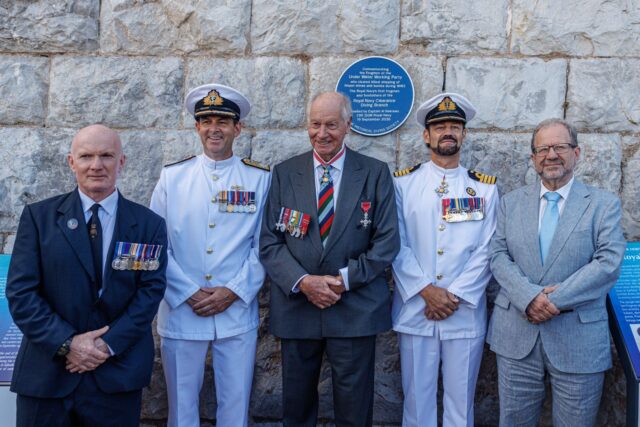
- From left to right, 'Ginge' Funhell, the CBF Tim Davey, Andrew Bailey, Cpt. Al Nekwres and the minister for Heritage, John Cortes.
-
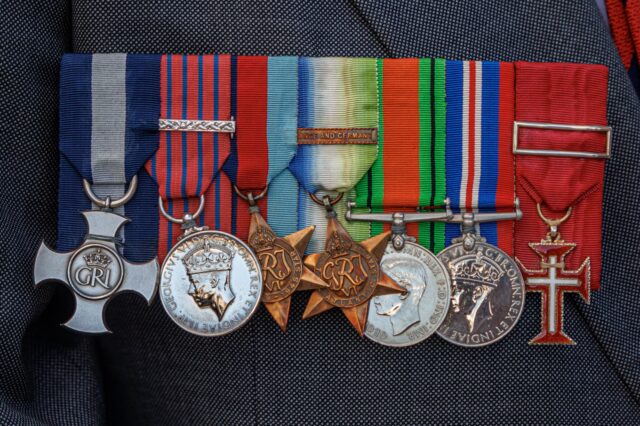
- Bailey father's medals.
-
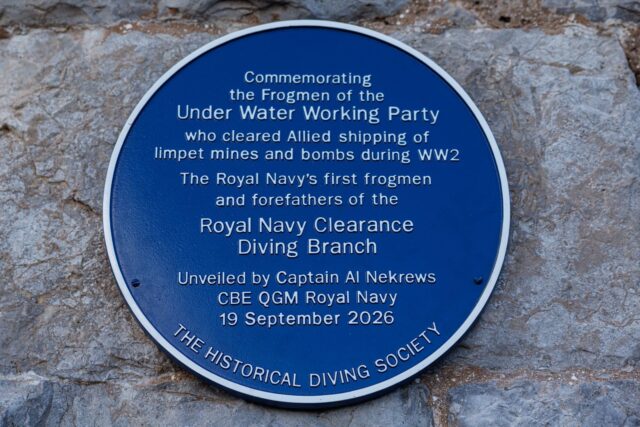
- The blue plaque.
-
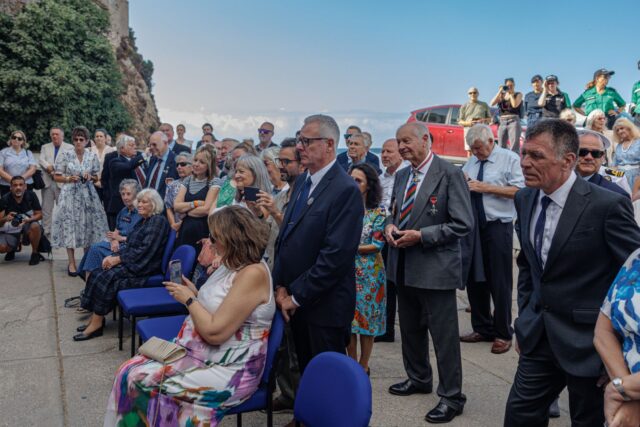
- Relatives and guests at the event.
-
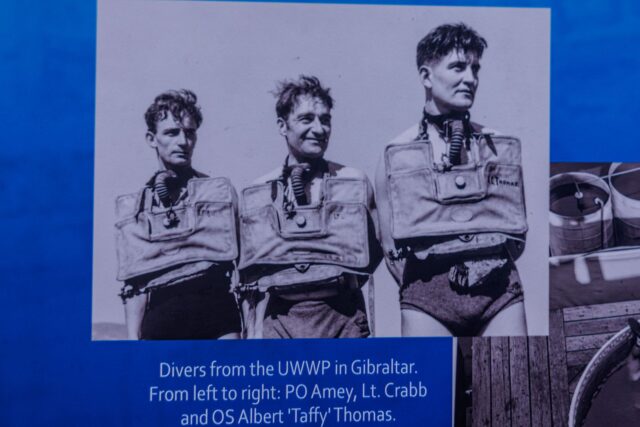
- Part of the UWWP team.
-
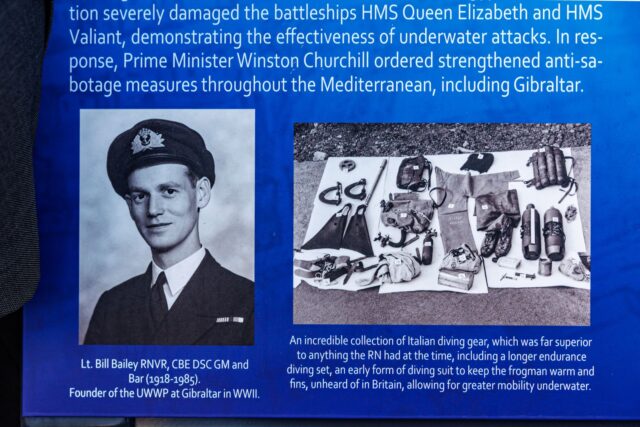
- Lt. William Bailey and the diver equipment.
-
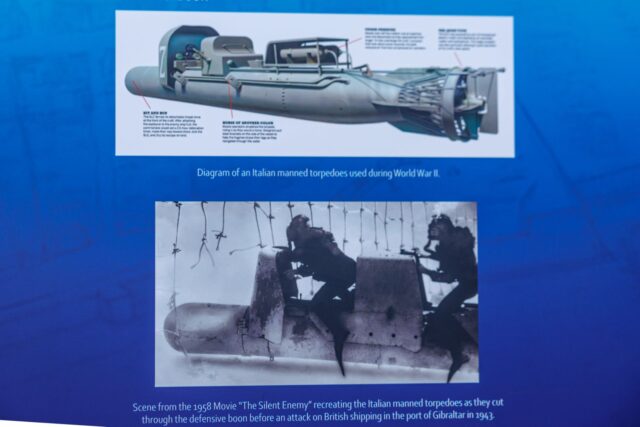
- Recreation of a Chariot.
-
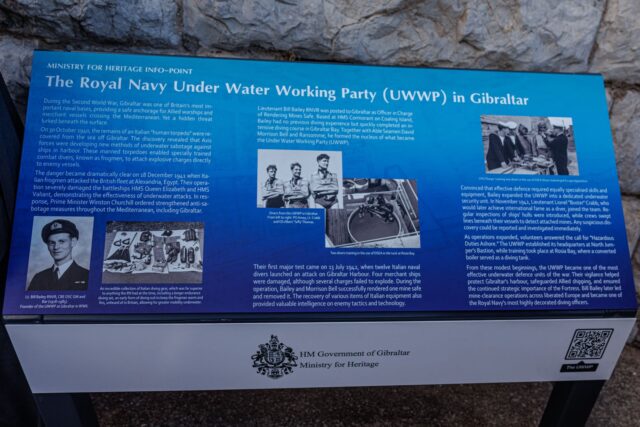
- One of the pannels at Rosia Bay.
Most Read
As long-stay patients move to Rooke, plans for new services at St Bernard’s Hospital
Mon 21st Sep, 2026
New bus stop signs and solar-powered lighting rolled out across Gibraltar
Mon 21st Sep, 2026

Today's Paper
23rd September 2026
Read our latest newspaper by downloading our app from the link below.


