


UK and Spain welcome treaty at UN amid familiar sovereignty differences


The UK and Spain both welcomed the UK/EU treaty on Gibraltar in addresses to the United Nations, even while both governments underlined their starkly opposed views on the Rock’s sovereignty and the right to self-determination of the Gibraltarian people.
Both governments made clear that the agreement did not impact their respective longstanding positions on sovereignty and jurisdiction, but that it provided an opportunity for a new relationship based on cooperation.
The messages were contained in addresses to the UN Fourth Committee in New York last Friday evening, just a few days after Chief Minister Fabian Picardo told its members that Gibraltar welcomed cooperation with Spain but would never capitulate on its right to self-determination.
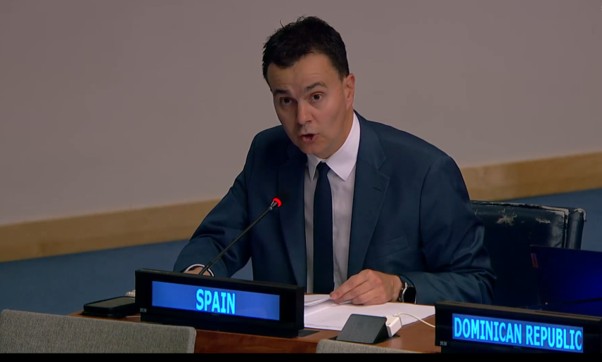
The Spanish address was delivered by Héctor Gómez Hernández, Spain’s permanent representative to the UN, who spoke positively, if briefly, about the treaty and the new framework it creates.
Mr Gomez said Madrid “supports prosperity” for both Gibraltar and the Campo “and is convinced that considerable potential remains, provided the necessary political will exists”.
“We believe in the opportunities for prosperity that can be created in the area if we are able to build a framework based on fairness,” he said, referring to the tax treaty of 2021, the earlier MoUs of 2018 and the UK/EU treaty on Gibraltar signed on July 14 in Brussels.
On the treaty, he added: “Spain welcomes that agreement, as it will improve the lives of the citizens of the Campo de Gibraltar.”
“Nothing in that agreement, nor any action or measure taken in its implementation or as a result of it, implies any change in Spain’s legal position regarding sovereignty and jurisdiction in relation to Gibraltar.”
Unsurprisingly perhaps, most of Mr Gómez’s address was dominated by an exposé of Spain’s traditional position on Gibraltar before the UN.
Year after year, Spain has argued that the Rock’s decolonisation must be governed by the principle of territorial integrity and that the Gibraltarians do not have the right to self-determination.
Mr Gómez also set out Spain’s view that the isthmus had been illegally occupied by the UK and that the waters around the Rock were Spanish, alongside Madrid’s well-documented criticism of Gibraltar’s economic model.
The Spanish ambassador also underlined Madrid’s annual call for the UK to engage in bilateral negotiations with Spain to decolonise Gibraltar, something the UK rejects every year.
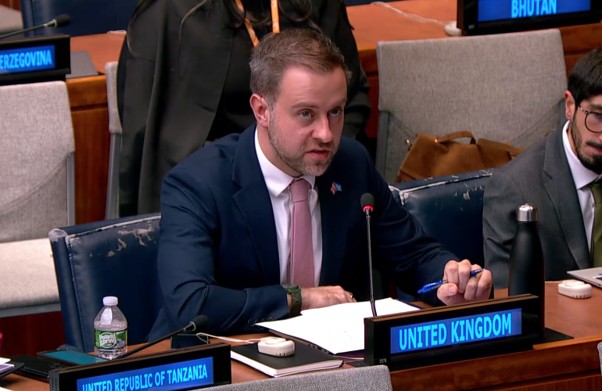
The Spanish address drew an intervention from the UK Government, which exercised its right of reply to make clear its support for Gibraltar’s right to self-determination, its double-lock commitment on sovereignty and its support for the treaty.
“[The treaty] reflects a new era of cooperation, trust and respect between the UK, the EU, Spain and Gibraltar,” a UK diplomat told the committee.
“The UK encourages all parties to build on this positive momentum in order to further strengthen cooperation and foster a mutually beneficial relationship based on solidarity, dialogue and shared prosperity.”
“As the distinguished representative from Spain also referred, the agreement is, however, without prejudice to the respective legal positions of the United Kingdom and of Spain with regard to sovereignty and jurisdiction.”
“The agreement reaffirms that those positions remain unchanged.”
The UK representative underlined that the Rock and its territorial waters were British and that, as a non-self-governing territory, Gibraltar enjoyed rights under the UN charter.
“The United Kingdom also recalls that the people of Gibraltar enjoy the right of self- determination,” he said, adding the 2006 Constitution provided for a “modern and mature” relationship between Gibraltar and the UK.
“The Government of the United Kingdom restates its long-standing commitment to the people of Gibraltar, that it will not enter into arrangements under which the people of Gibraltar would pass under the sovereignty of another state against their freely and democratically expressed wishes,” he added.
“The United Kingdom also confirms that it will not enter into a process of sovereignty negotiations with which Gibraltar is not content.”
“The United Kingdom reaffirms its commitment to safeguard Gibraltar, its people and its economy.”
The UK’s reply drew another intervention from Spain, this time delivered by a Spanish diplomat who underscored the earlier points made by Mr Gomez.
“[The treaty’s] purpose is to build an area of shared prosperity for the benefit of the region’s citizens, but it is established without prejudice to the respective legal positions of Spain and the United Kingdom regarding sovereignty and jurisdiction,” the Spanish diplomat said.
“Therefore, regardless of the solution reached to structure the United Kingdom’s relations concerning Gibraltar after Brexit for the benefit of the region’s citizens, particularly those of the Campo de Gibraltar, we reiterate that, on the question of Gibraltar, there can be no solution other than a decolonisation process negotiated between Spain and the United Kingdom on the terms established by the United Nations.”
“Spain remains fully willing to undertake that process.”


