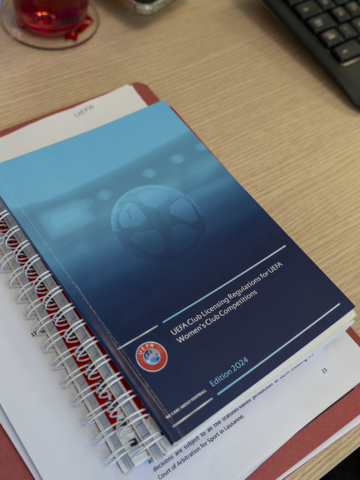
Club Licensing - The inside look


UEFA introduced Club licensing in 2002 as a ‘set of requirements clubs must meet to be eligible to participate in (their) competitions, UEFA’s club licensing system has become the point of reference for good governance both within European football and other sports’
Club Licensing’s primary goal is to ‘provide a transparent and efficient regulatory framework that guides the establishment and evolution of standards across all aspects of European football’
Gibraltarian football has two types of Club licenses, a domestic license which enables a club to compete locally, and a UEFA License aimed at those clubs who qualify to compete in European competitions.
Clubs have to submit a licensing application, every season. In doing so, upon successful completion of the licensing process, they are confirming that as a club, they fulfil the minimum criteria required for admission to domestic club competitions and if applicable, European competitions.
Fair Play Starts Off the Pitch and licensing standards, governance and year-round monitoring protect clubs, players and the integrity of the game.
The Gibraltar Football Association’s Club Licensing Manager, Kim Macedo, takes us through the process in our latest in depth feature with the Gibraltar FA:
What is club licensing and why should supporters care?
Kim: In football, the drama unfolds on the pitch, but the foundations of the game are built behind the scenes. Club licensing is the system that ensures every club competing in official competitions meets essential standards. It safeguards the integrity, sustainability and credibility of football, making sure clubs are properly run, players are protected and competitions remain fair.
Club licensing is applied across UEFA’s member associations and forms part of a wider European framework aimed at improving governance, transparency and sustainability throughout football.
What is the difference between a Domestic Licence and a UEFA Licence?
Kim Macedo: club to participate in local competitions organised by the Gibraltar Football Association. Clubs holding a Domestic Licence are eligible to compete domestically but are not permitted to participate in UEFA club competitions.
A UEFA Licence, meanwhile, is required for clubs wishing to compete in European competitions such as the UEFA Champions League, UEFA Europa League and UEFA Conference League.
The UEFA Licence includes additional and more stringent criteria, particularly in areas such as financial transparency, infrastructure standards, administration and long-term sustainability.
In simple terms, the Domestic Licence forms the foundation for participation locally, while the UEFA Licence is the higher benchmark required to compete on the European stage.
What kind of standards are clubs required to meet?
Kim Macedo: To obtain a licence, clubs must meet requirements across a number of key areas, including sporting, infrastructure, personnel and administrative, legal and financial criteria.
These standards are designed to ensure clubs are stable, transparent and capable of operating responsibly throughout a season and beyond. They cover everything from youth development and safeguarding structures to financial reporting, qualified and professional personnel and suitable facilities.
Why is governance such a big part of this?
Kim Macedo: Football clubs are more than teams. They are employers, community institutions, legal and financial entities. Without strong governance, issues like unpaid salaries, debts or operational failures can arise quickly. Licensing ensures clubs are accountable, financially responsible and well-managed, protecting players, staff and supporters alike.
Strong governance also creates trust. Supporters, sponsors, players and governing bodies all need confidence that clubs are operating fairly and sustainably.
How does the licensing process actually work & who actually decides whether a licence is granted?
Kim Macedo: The process involves several stages. Clubs first submit their applications and supporting documentation, in accordance with the deadlines set out within the regulations. The process runs annually, from early February through to mid-May.
The Club Licensing Unit (“CLU”) is responsible for assessing applications and reviewing supporting documentation. However, the Club Licensing Unit does not make the final decision on whether a licence is granted or refused. Those decisions are taken independently by the First Instance Board (“FIB”), which considers the findings and recommendations presented during the licensing process before reaching a decision.
Importantly, clubs also have the right to appeal. Any applicant who is dissatisfied with a decision of the FIB may submit an appeal to the Appeals Body, which independently reviews the matter and reaches its own determination. The decision of the Appeals Body is final and binding.
This separation between assessment, first-instance decision making and appeals is a key part of ensuring fairness, transparency and integrity within the licensing system.
Notably, the process does not end there. Clubs remain subject to ongoing monitoring requirements throughout the season.
Is licensing just about enforcing rules?
Kim Macedo: Not at all. Licensing is as much about support as it is about regulation. Throughout the year, the Club Licensing Unit works closely with clubs, offering guidance, clarification and practical assistance to help them meet requirements. The process is collaborative, designed to strengthen clubs rather than catch them out.
Licensing also encourages long-term planning. Clubs are supported in improving structures, governance, financial management and operational standards year on year.
Does club licensing favour bigger or wealthier clubs?
Kim Macedo: No. Licensing is not designed to reward spending power. The focus is on responsible management, governance and sustainability. A smaller club that is well-run and meets its obligations can satisfy licensing requirements just as effectively as a larger club.
The objective is not to create financial barriers, but to ensure that all clubs, regardless of size, operate responsibly and sustainably.
Why is continuous monitoring necessary?
Kim Macedo: Compliance is not a one-off exercise. A club’s position can change during the season, whether financially or operationally. Continuous monitoring ensures that standards are maintained at all times, not just at the point of application.
In Gibraltar, the GFA, in its role as Licensor, carries out quarterly financial monitoring for all licensed clubs. This focuses particularly on ensuring that clubs have no overdue payables to employees or public authorities at key reporting dates, reinforcing financial discipline throughout the season.
For clubs holding a UEFA Licence and competing in European competitions, this oversight is strengthened further through UEFA’s Club Monitoring requirements.
UEFA monitoring includes:
Club information requirements, ensuring transparency around ownership, group structures, ultimate controlling parties and any individuals with significant influence over the club. Any changes during the season must be promptly reported.
Solvency requirements (overdue payables rule), assessed at specific dates during the season, including 15 July, 15 October and, where applicable, 15 January, to ensure clubs are meeting their financial obligations on time.
Stability requirements (football earnings rule), which require clubs to submit financial data across reporting periods to demonstrate longer-term financial sustainability.
This layered approach, with national and UEFA-level monitoring, ensures that clubs are not only assessed at the start of the season but are held to consistent standards throughout.
What happens if a club fails to comply during the season?
Kim Macedo: The system does not simply look the other way. There are monitoring mechanisms and proportionate measures in place to address non-compliance. These can range from warnings and corrective action plans to more serious sporting or administrative sanctions where necessary.
The aim is not punishment for its own sake, but to protect fairness, player welfare and the integrity of competitions. Without enforcement, standards would quickly lose their meaning.
How does licensing protect the competition itself?
Kim Macedo: Supporters expect a level playing field. Licensing ensures that all clubs operate under the same rules and meet the same standards. Fair competition is not only about what happens during ninety minutes, on the pitch. It is also about ensuring no club gains an unfair advantage through poor governance or failure to meet its obligations.
The system exists to protect the credibility of competitions and the long-term health of the game.
How does licensing help young players and future generations?
Kim Macedo: Licensing encourages clubs to invest in youth development, safeguarding, qualified coaches and long-term planning. It pushes clubs to think beyond short-term results and build stronger foundations for the future.
Ultimately, the system is designed not only to protect today’s game, but to create better environments and opportunities for the next generation of players, coaches and supporters.
How does club licensing support the women’s game?
Kim Macedo: For the 2025/26 season, the Gibraltar Football Association introduced a Domestic Club Licensing process for women’s teams for the first time. This marked an important step in the development of the women’s game locally.
Before its introduction, discussions were held with clubs through the Women’s Football Department, where the requirements of a UEFA Club Licence were explained in detail. It was collectively recognised that clubs were not yet in a position to meet the full UEFA criteria.
As a result, the Domestic Licence was introduced as a foundational framework. Its purpose is to support clubs in building the right structures, strengthening governance and ensuring consistent minimum standards across the women’s league.
The long-term vision is clear. As clubs continue to develop and reach the required levels, the next step will be the introduction of a UEFA Club Licensing system for women’s football, opening the door to future participation in European competitions.
What is the bigger picture behind all of this?
Kim Macedo: Club licensing is about safeguarding football’s future. It promotes professionalism, encourages transparency and helps clubs build sustainable foundations rather than chasing short-term success.
When licensing works well, it goes unnoticed. Matches happen, clubs meet their commitments and competitions run smoothly. That quiet stability is not by chance. It is built on strong governance, clear standards and continuous oversight.
Fair play, it turns out, starts long before kick-off.