


Festival judge impressed by ‘off the scale’ musical talent
Photos by Eyleen Gomez


The Gibraltar Festival of Young Musicians organised by GAMPA, now in its 21st year, has been taking place all week at the John Mackintosh Hall, with a Gala set to take place on Saturday night.
The Gala will see a finalist of each category perform and compete.
The person who has been deciding who those finalists are is adjudicator Nancy Litten, who has been on the Rock since Saturday.
The festival comprises entrants from the age of 4 years old to 18, competing in different categories, including solo instrumental and vocal performances, duets, ensembles, and choirs.
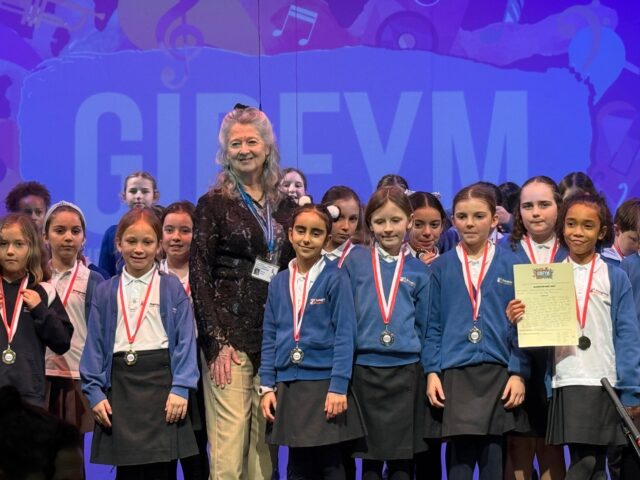
Speaking to the Chronicle after the performances of the Sotogrande school choirs, who performed a day early due to school closures ahead of a storm on Wednesday, Ms Litten said that the standard of local musicians was “off the scale” and comparable with the very best on the international circuit.
She had been “very impressed” by what she had seen and heard in Gibraltar, noting that “the standard compares very well” with those at other festivals she has adjudicated in the UK, Thailand and Sri Lanka.
She added that Gibraltar being a small country may be part of the reason for the strong results on stage.
She highlighted in particular the dedication and determination of the young performers, qualities which she believes will serve them well regardless of whether they pursue professional music careers or follow other paths in life.
“They've learned poise, haven't they? They've learned how to be methodical, how to prepare for a performance,” she said.
“That is the beauty of having festivals and all gratitude to the people who work so hard to put them on.”
“It is one of the few places where a platform is provided for young people.”
“It's something for them to build up to all year. It's something that encourages them to explore new repertoire so that they can show it to an audience at the end of the year.”
She also placed strong emphasis on the skills the youngsters learn in doing something tricky but making it look easy.
This, she said, will stand them in good stead one day when they are interviewing for a job, or when they need to make a speech, when they need to throw a party, whatever it is that that requires poise.
She knows this from experience, recalling how she was entered into a pier-end talent contest because she could recite a poem well at the age of 5, but being frozen by fear on stage.
It was only later, after taking up the piano at six and the violin at nine, that her confidence grew through regular performance. Over time, she found herself better able to manage nerves and even to enjoy being on stage.
Drawing a parallel with the classic film The Sound of Music, she spoke of the way performers can “tell themselves they are not going to be afraid” and gradually grow into that belief.
“You start to believe that this is the piece above all others you want to present,” she said.
“This is the audience above all others you want to perform too.”
“That this is the place above all others in which you want to perform.”
“And those three come together and create something quite special.”
She likened the process to teaching a child to say thank you.
At first the words may not be heartfelt, but with repetition they acquire real meaning.
In the same way, presenting oneself as pleased to be on stage and keen to perform can, over time, develop into genuine enjoyment and engagement.
Asked about standout performances so far, while it was still early in the week, she confirmed there had already been “some really outstanding” moments.
In particular, she praised the work of the Gibraltar Academy of Music and Performing Arts (GAMPA), highlighting the standard reached by some of their vocal and instrumental ensembles.
She described one performance by the GAMPA senior ensemble as exceptional, awarding it 96 marks, one of the highest marks she has ever given.
She said the performance “could have stood up in any concert hall throughout the world”, it was “that good”.
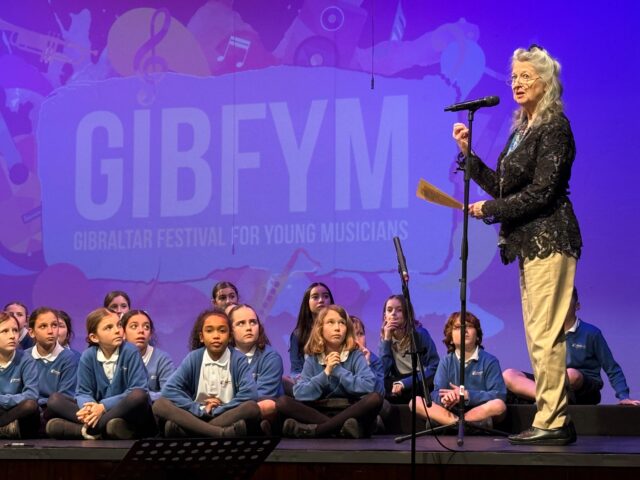
Despite having clear criteria for assessment there is still emotion involved when adjudicating.
“I feel what a privilege it is to be able to listen to them and be given the honour of judging them,” she said.
“I do feel emotional because I am trying to encourage even those who are starting out or those who are weak. Who like to have a go at music but aren't particularly good at it. Who may feel overawed by the superior talents of others.”
“I'm here to encourage as well as to educate.”
“I do feel quite emotional when I can see somebody is doing their best and it doesn't quite go according to plan.”
“And I feel that every single child who gets up there and performs is a winner because they've had the courage to do so.”
“They've had the courage to get up in front of a dark theatre full of people and perform.”
Looking ahead to the gala night, she said she was “very much looking forward” to the event, calling it the “cream” of the festival’s standard.
She acknowledged that difficult decisions would have to be made in selecting and ranking the finalists, but emphasised the importance of fairness and independence in this process.
One of the reasons an adjudicator from outside the area is invited, she explained, is to ensure no personal connections or favouritism influence the outcome.
“I don't know anyone, and therefore I'm allowed to make these decisions, and I'm not showing any favoritism, and someone has to make the decisions,” she said.
“And at the end of the day, I can only judge what I hear on the night.”
“Although another person might have won another day, you can only judge on what you experience at the time, and I am trusted with making that decision.”
She also reiterated her appreciation for the festival, its organisers, and the young performers who bring it to life.
NANCY LITTEN
This year’s adjudicator, Nancy Litten, entered the Royal Academy of Music at age 16 on an open piano scholarship, winning prizes while there. She also studied violin to a high level, freelanced as an orchestral player, and led a string quartet.
She has performed as a soloist, chamber music and orchestral player on both instruments and as a piano accompanist. She has taught in primary, secondary and specialist music schools, privately and on courses.
Piano albums Piano Postcards and These Sweet Days have been published by EVC and Clifton Edition (Stainer & Bell) and she has contributed to many other books, including exam syllabuses.
She has advised the Associated Board of the Royal Schools of Music (ABRSM) and Trinity exam boards on electronic keyboard, and had a series of keyboard tutors, Keyed Up, published by Alfred UK.
She was founder and director of National Electronic Keyboard Courses from 2005-2012.
Singing is another string to her bow, and she has many years experience of conducting choirs, teaching, and coaching singers. Choral and Vocal Warm-ups for Pianists, Choral and Vocal Sight Singing with Keyboard Harmony, and Rounds with Accompaniment have also been published by Alfred UK.
Nancy has been an ABRSM examiner since 1998, involving much travel in the UK and abroad. She has been an adjudicator with The British and International Federation of Festivals since 2014 and served on the Adjudicators’ Council for seven years, including as vice chair.


