


Gibraltar urged to embrace AI as summit highlights opportunities and responsibilities
Photo by Johnny Bugeja


Gibraltar must act now to make the most of new technology, speakers at an AI Summit stressed, highlighting the transformative impact of AI on global industries.
The AI Summit was organised by Artimus Consulting and held on the Sunborn on Thursday.
Toby White, a managing partner at Artimus Consulting, whose firm specialises in AI and technology and has been based in Gibraltar for the past five years, said that Gibraltar could not afford to watch from the sidelines.
Mr White said that what was once a niche topic had rapidly become mainstream and over the past nine months, he has noticed that there has been a big shift in Gibraltar, with more businesses moving from talking about AI to actively implementing it.
This growing interest, he said, comes at a pivotal moment with the UK–EU treaty in its final stages.
He said it makes the Rock an increasingly attractive base for technology entrepreneurs and innovators looking to live, build and grow their companies here.
“We can’t wait to see that happen,” he said, adding that he hoped the summit would act as a catalyst for further adoption of AI across local industries and services.
Following Mr White’s introduction, the Minister for Health and Business Gemma Arias-Vasquez, addressed the room and emphasised the importance of AI in Gibraltar, highlighting its practical applications in improving productivity, decision-making, and service efficiency.
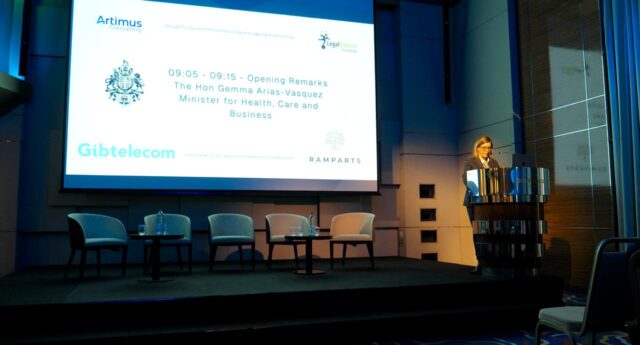
“Artificial intelligence is no longer a conversation for some point in the future,” she said.
“It’s already changing the way that people work, the way that organisations operate and the way that services are delivered.”
The summit, she added, was both “timely and important” because AI presents “very real opportunities, but also very real responsibilities”.
“The question is not whether this technology is going to shape the future, it already is. The question is whether we are prepared to use it well.”
She said AI should improve productivity, reduce unnecessary administrative burdens, support better decision-making and deliver better outcomes for the public.
She also stressed the need for responsible AI adoption, focusing on where it adds value and supports human judgment, adding that there are practical deployments in the GHA, such as an AI-supported dictation system for referral letters.
The system, designed to recognise medical terminology, reduces the need for manual typing and cuts administrative workload.
“This small use of AI technology shows the benefits that it can have to a system,” she said.
She added this raises serious questions about risk, ethics, transparency, workforce adaptation and how regulated businesses maintain confidence in their services, and that Gibraltar’s size gives it a competitive edge in adapting to AI.
“We’re a small jurisdiction, and that gives us a huge advantage,” she said.
“We can move quickly. We can bring decision makers together. Regulators and industry interact in a more direct way.”

Sam Hazeldine, COO and founder of Great Wave AI, described practical ways to mainstream Generative AI into the operations of regulated businesses and government bodies.
He said that many projects are “stuck” in what he called the “Gen AI half‑life trap” where early prototypes look impressive, but never mature into robust, production‑grade systems.
He added that most generative AI initiatives fail not because of technical integration challenges, but because organisations have not clearly defined what success looks like.
Mr Hazeldine said there are three recurring problems, no clear definition of ‘good enough’ which makes progress impossible to measure.
“Most Gen AI projects do not stall because plugging in a large language model is difficult,” he said.
“They stall because making Gen AI good enough is really hard. Making it consistent is even harder, and measuring that consistently is the hardest part of all.”
Instead of chasing an ever‑growing list of potential AI use, he urged organisations to invest first in what he called a “Gen AI production line”.
He said that three ingredients are essential for this.
These are finding a way to build precise generative AI systems quickly using existing teams, have a consistent evaluation framework, with metrics defined by the organisation’s own experts, and have security, audit and governance at scale, so teams are not “reinventing the wheel every time”.
While many AI programmes start with a top‑down mandate from senior leaders, he advised the opposite and said that organisations should go directly to domain experts which are the staff who are closest to the work and identify the most valuable opportunities.
He suggests that organisations focus on admin intensive, document heavy tasks that staff “do not want to do anymore” and avoid “AI for AI’s sake” by prioritising work that wastes time but is essential.
During the question and answer session at the end of his speech, one audience member from a US private sector company asked how smaller firms such as legal, accounting or real estate practices without a Chief Technical Officer or in house tech team could take the first steps.
He acknowledged that Great Wave AI, as a software provider, typically avoids the very earliest “where are our inefficiencies?” conversations and he recommended working with consulting partners who specialise in process analysis.
However, he offered a practical starting point and said: “If you are looking at where you can benefit from generative AI, look to the admin. Look to the documents.”
“Where are you wasting time reading, writing, comparing, changing and amending documents and doing administrative processes that are vital, important, but maybe not value‑add?”
Above all, his advice for organisations exploring AI was to: “Please lay the tracks first.”
“Only then can you move from shiny demos to production grade generative AI that really changes how you work.”


