


‘Traces of Humanity’ brings cultural exchange of identity, history and memory to Gibraltar
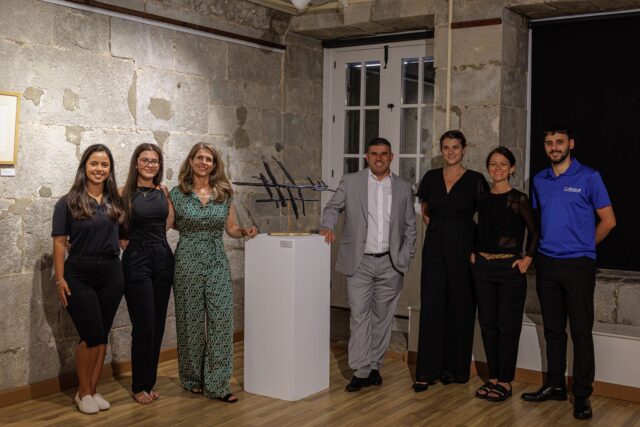
All the artists featured in exhibition and the authorities, during the opening. / JOHNNY BUGEJA


The third and final exhibition of Traces of Humanity has arrived in Gibraltar, bringing together local and British artists in a major cultural exchange centred on identity, history and memory.
The exhibition at the Gustavo Bacarisas Gallery marks the final stop of the project following successful exhibitions at the Schwartzman Gallery in Margate and in London.
Organised by Gibraltar Cultural Services on behalf of the Ministry for Culture and curated by Philippa Beale, the exhibition features 35 artists and more than 65 artworks, creating a dialogue between Gibraltar's heritage, contemporary artistic practice and the enduring story of human creativity. Most of the local and international artists represented in the exhibition attended the opening.
Inspired by the internationally significant Gorham's Cave Complex UNESCO World Heritage Site, Traces of Humanity explores themes of identity, history, memory and human expression through the work of Gibraltarian artists, members of the Lloyd's Art Group and internationally recognised artists.
The Gibraltar exhibition follows a successful programme in London's West End, which generated interest in Gibraltar's cultural offering and created opportunities for artistic collaboration and exchange.
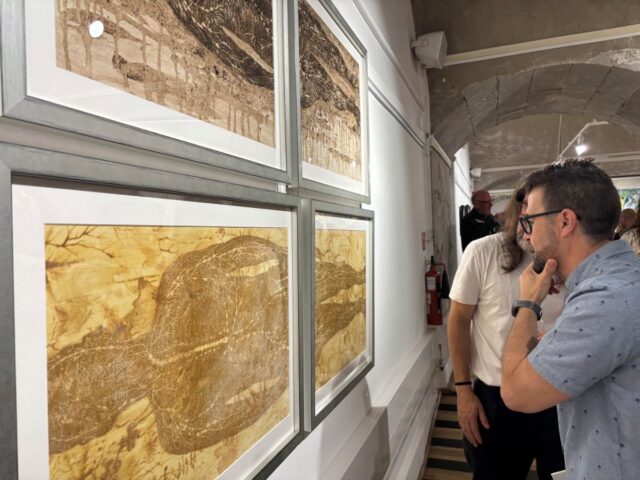
A reproduction of the lymphatic system, made with a base of pollen and mosquitos, by Andrew Carnie.
The official opening was preceded by a sponsors' event organised by Aon and supported by the Lloyd's Art Group. A reception at the Mayor's Parlour followed, bringing together artists, supporters and invited guests to celebrate the culmination of the project.
Rooted in the Neanderthal discoveries at Gorham's Cave, and inspired by the engraved hashtag symbol found there, Traces of Humanity examines human evolution from a wide range of artistic perspectives while reflecting Gibraltar's place in the story of humanity.
The exhibition transforms the gallery into a diverse artistic landscape where paintings sit alongside installations inspired by Gorham's Cave, architectural photographic works, large-scale murals exploring migration in the Mediterranean, and striking contemporary pieces.
Among the exhibits is a detailed recreation of the human lymphatic system created using pollen and mosquitoes, while another installation combines suspended boxes containing everyday objects, including a fish and a Chronicle front page, to deliver a commentary on environmental decline.
The eight Gibraltarian artists represented in the exhibition are Ambrose Avellano, Ermelinda Duarte, Mark Montovio, Alan Perez, Monica Popham, Sebastian Rodriguez, Michele Stagnetto and Karl Ullger.
Artists exhibiting from the Lloyd's Art Group are Philippa Beale, Sophie Brassey, Ore Daodu, Susannah Hubert, Chloe Hughes, Matthew Inwood, Katie Murrell, Yap Pau Ling, Chris Plato, Priya Shah and Les Williams.
Invited artists are Rosalind Archer, Andrew Carnie, Peter Clossick, Herve Constant, Tim Craven, Frank Creber, Ferha Farooqui, Paul Finn, Vaughan Grylls, Natasha Lien, Fiona McIntyre, Sarah Medway, Angela Rumble, Tom Shipman, Maria Storey, Sandra Wore and Alex Wright.
The Minister for Culture, Christian Santos, described Traces of Humanity as a "remarkable journey showcasing Gibraltar's culture, identity and artistic talent to international audiences".
He thanked the local artists "who always support our initiatives" and welcomed the visiting artists to Gibraltar.
"We are delighted to bring this prestigious exhibition home for its final chapter and to offer the public the opportunity to experience this exceptional collection while engaging with a programme that celebrates our heritage, creativity and place in human history."
The Chief Culture Officer at Gibraltar Cultural Services, Seamus Byrne, highlighted the long-standing collaboration between Gibraltar, Aon and the Lloyd's Art Group in London over the past decade.
He thanked his team, the sponsors and the artists for helping deliver the exhibition.
The Director of the Gibraltar Museum, Clive Finlayson, whose research identified evidence of Neanderthal symbolism at Gorham's Cave, also attended the opening alongside his son.
In addition to the exhibition, visitors can take part in an extensive educational programme of talks, presentations and public events throughout July. The programme will further explore the exhibition's themes and the significance of the Gorham's Cave Complex as a window into humanity's shared past.
Traces of Humanity is open to the public until July 31 at the Gustavo Bacarisas Gallery. Opening hours are Monday to Friday from 10.30am to 6.30pm and Saturdays from 10.30am to 1.30pm. Admission is free.
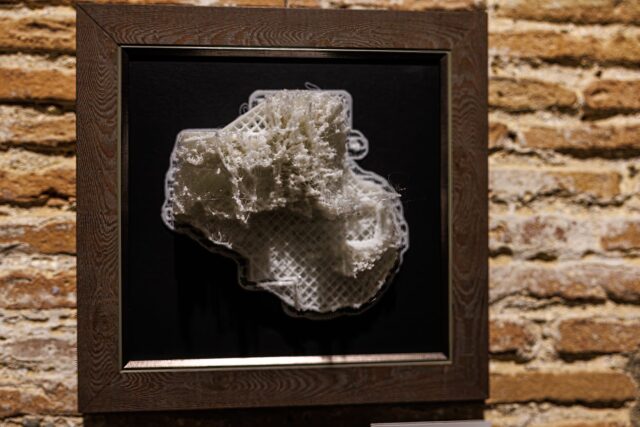
Evolution of the Rock, by Karl Ullger
Local artist Karl Ullger explores science, evolution and the environment through his artwork. He illustrates how the Rock’s landmass has changed since the Neanderthal era and how the landscape on the east side has evolved into what we see today. Using Gorham’s Cave as a reference point, this work examines the changing coastal shelf surrounding the cave complex. It comprises four pieces: a depiction of the Rock and its surrounding landscape during the Neanderthal period; a closer view of the exterior of Gorham’s Cave; a further zoom towards the cave complex; and a three-dimensional representation of the site.
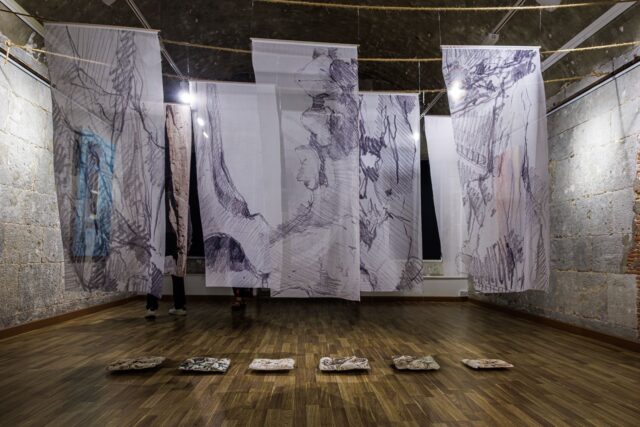
Fragments of presence, by Alan Perez and Ermelinda Duarte
Alan Perez began his research with sketches drawn from a boat, tracing the contours of Gorham’s Cave and the rugged cliffs that surround it. He later studied artefacts uncovered at the cave to explore how its inhabitants lived and interacted. Created in collaboration with Ermelinda Duarte, this elegant mark-making installation occupies the centre of the gallery. According to Duarte, the work explores the idea of imprints as records of time, presence and human connection, drawing parallels between past and present through the enduring traces of human activity.
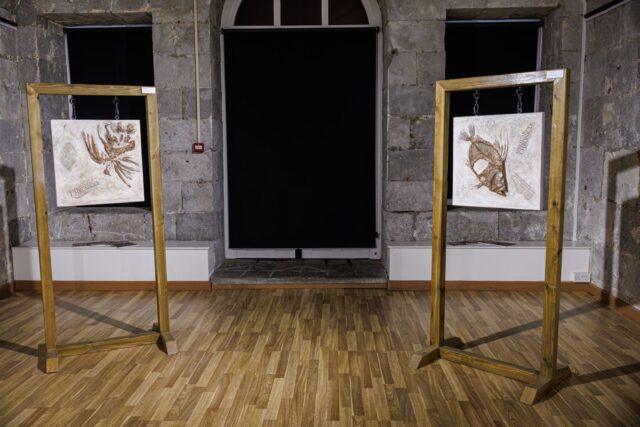
Remnants, creativity and harm, by Mark Montovio
Contemporary artist Mark Montovio presents two sculptures that explore the delicate traces of humanity within the world’s ongoing evolution. His work questions whether progress is inevitably linked to cycles of destruction and renewal by contrasting humanity’s creative impulse with its capacity for harm. The sculptures depict fossilised animals suspended from gallows-like structures. These artistic ‘boxes of time’ also incorporate headlines from the Gibraltar Chronicle, linking the themes of memory and history with the present day.
The play of Mediterranean light, by Monica Popham
Gibraltarian artist Monica Popham is internationally recognised for her architectural landscapes and her exploration of the interplay between light and architecture across Mediterranean settings. Her acrylic-on-canvas works The Blue Wall and Dappled Light Doorway demonstrate her ability to capture the distinctive quality of Mediterranean light as it interacts with different surfaces. Both paintings depict shifting moments of light and shadow, reflecting projections of Gibraltar’s flora and fauna across walls, windows and doorways.
Neanderthal Traces, by Ambrose Avellano
The well-known Neanderthal hashtag is one of the exhibition’s most recognisable works. Created by Gibraltarian multimedia artist Ambrose Avellano in 2025 using metal, wood and black lacquer, Neanderthal Traces transforms prehistoric engravings into a minimalist linear sculpture. The work reinterprets primal expression through a contemporary form, creating a dialogue between past cognition and present creativity.
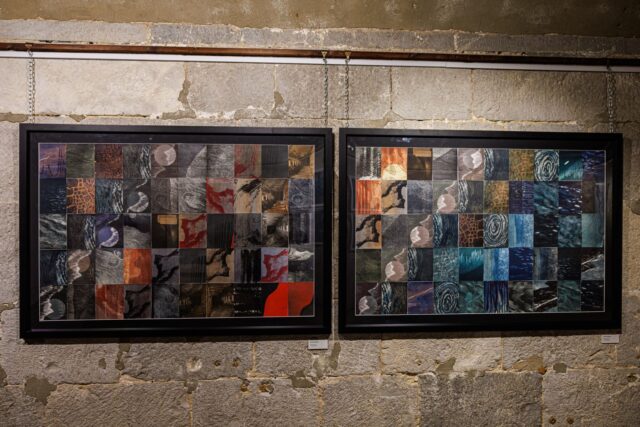
Sebastian Rodriguez and Michele Stagnetto explore imprints and mark-making
Painter Sebastian Rodriguez, who prefers to work from life, often en plein air, explores the traces left by past generations while reflecting on how most human experiences are never formally recorded but simply lived. Self-taught artist Michele Stagnetto selected 100 of her original prints to create two mosaic works that establish a dialogue between sea and stone. Fragmented elements combine to form abstract landscapes rich in texture, offering a contemporary exploration of memory and humanity’s deep past.
Most Read
New group to plan healthcare jobs and placements for returning graduates
Tue 13th Oct, 2026
Gibraltar treaty marks ‘new era of cooperation’ with EU and Spain, UK tells UN
Wed 14th Oct, 2026

Today's Paper
3rd July 2026
Read our latest newspaper by downloading our app from the link below.


