


Youth Parliament seeks to strengthen young people’s role in democracy
Speaker of the Gibraltar Parliament, Karen Ramagge Phillips. Photo by Johnny Bugeja


The first Gibraltar Youth Parliament starts this week and aims to give young people a voice in the institutions that impact their lives, ensuring their views and ideas help shape Gibraltar’s future.
The initiative, which launches at 5pm on Monday, is spearheaded by the Speaker of the Gibraltar Parliament, Karen Ramagge Phillips.
Speaking to the Chronicle, she said the idea had been with her from the moment she was appointed Speaker because many countries based on the Westminster model already had youth parliaments, while Gibraltar did not.
Critical to the initiative is ensuring young people understand that Parliament is about more than party-political confrontation.
The Gibraltar Parliament is well known for its often “fiery and lively” exchanges, but a key element of the Youth Parliament is that it should be non-partisan.
While the GSLP and the GSD have well-established youth sections, the goal from the outset was to open the initiative to wider participation.
“There’s nothing wrong with partisan politics, but the purpose for me [of the Youth Parliament] is to open the idea of Parliament to younger people who may not have at this stage a political leaning or really any particular political knowledge, or knowledge of parliamentary procedure,” Ms Ramagge Phillips said.
That thinking also shaped the age group selected for the project.
The target was to attract 16 to 19-year-olds, young people who were still in school and who might not yet have formed firm political loyalties, but who should still feel their views mattered.
“The whole idea is for them to feel that whether or not they are politically aligned, they have a voice, a voice as young people and a voice that then Parliament in its shadow ministers and ministers can take account of,” the Speaker said.
She was equally clear that the initiative should not become a competition between schools.
Instead of an inter-school structure, applicants were invited to put themselves forward individually, with participants later mixed into teams.
“People come together from all walks of life who may not be friends socially, but then work together in the Parliament for a particular purpose,” she said.
“So the idea essentially was to make young people feel that they have a voice.”
The project initially got off to a slow start. Despite publicity through GBC, the Chronicle, schools and the Youth Symposium, the initial response was very limited.

That prompted the Speaker and the clerk of Parliament, Phillip Borge, to visit schools directly and speak to pupils in person.
That direct engagement proved decisive.
“I could tell they were interested when I was talking,” Ms Ramagge Phillips said.
“The feedback was, how can we apply?”
“We created an Instagram page. We went around the schools, and then we had a really fantastic response,” she added.
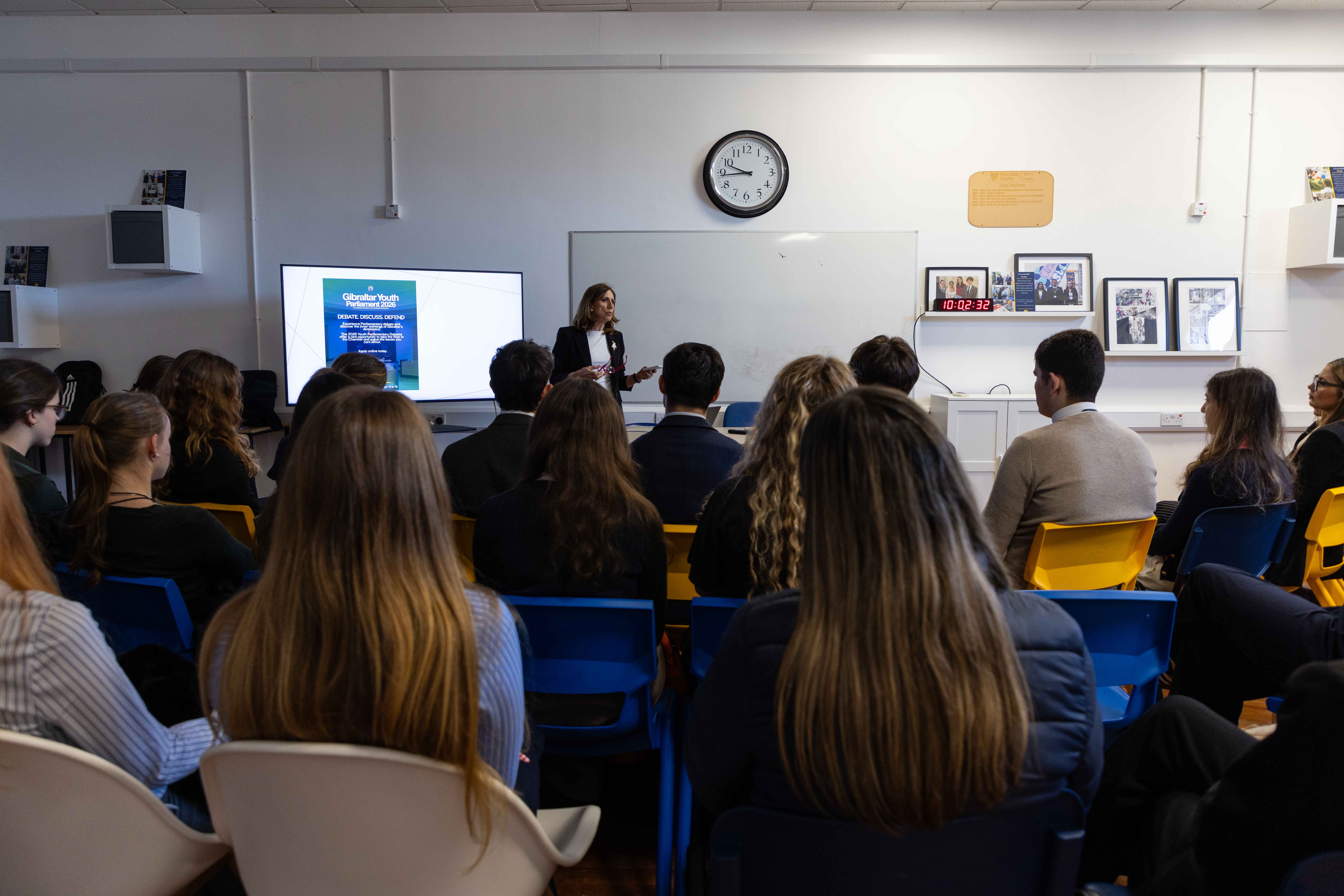
The number of applications rose to around 38 and from those, 16 participants were chosen for the debates after submitting a short, written piece on why youth debates in Parliament were important.
Ms Ramagge Phillips said the process was anonymised before assessment.
“We took away names, we took away ages and we took away schools,” she said, adding that the selection was based only on the written submission.
That process also put a spotlight on one of the issues facing younger people more broadly, the increasing use of artificial intelligence.
Applicants had been warned that obvious reliance on AI would detract from the merit of their submission, but some applications had clearly relied too heavily on the new technology.
“There were a few that were very similar,” she said. “They had been clearly AIed.”
The topics chosen for debate were drawn from the young applicants’ own suggestions.
Ms Ramagge Phillips said this was important because it ensured the agenda reflected what mattered to young people rather than what adults assumed should matter to them.
The first rounds on Monday will cover freedom of speech and whether there should be strict regulations and controls over the use of AI in schools and the workplace.
The final on June 22 will debate whether the voting age should be lowered from 18 to 16, something the Speaker said was “by far the most popular” topic among the applicants.
“They feel that they are the ones who would be affected by this decision,” she said.
“So they are the ones who want to speak on it.”
Holding the debates in the Parliament’s chamber will also serve to underline its role in Gibraltar’s democracy and the importance of ensuring all voices are heard.
Ms Ramagge Phillips said many of the participants had no knowledge or experience of Parliament and its function.
“Most of them have never been in the chamber before, never even knew how to get here,” she said.
“Some of them didn’t understand what a shadow minister was.”
She stressed that this was not criticism, but evidence that Parliament needed to be made more accessible.
That is why, she said, the debates had been designed to feel like parliamentary debates rather than ordinary school exercises.
“Ultimately this is not just a debate, this is a parliamentary debate,” she said.
She has prepared simplified rules based on parliamentary procedure, guidance on how to build arguments respectfully, and a dress code to reflect the institution.
“I want it to feel like a parliamentary debate,” she said.
Ms Ramagge Phillips also appealed for public support, saying a full chamber would send a message to the participants that their contribution mattered.
“I would encourage as many people of the public as can support us, I would encourage them to come in,” she said.
“We should all be behind this youth Parliament, because I think it’s very important.”
Above all, she said, those taking part deserved credit for putting themselves forward.
“What they’re doing is very brave,” she said.
“A lot of these people, these children, these young people have no experience in speaking publicly and formulating an argument.”
For Ms Ramagge Phillips, the wider ambition is not limited to one set of debates, but to build a stronger relationship between young people and Parliament itself.
Most Read
HMS Queen Elizabeth sails into Gibraltar, strengthening long-standing links
Sun 25th Oct, 2026
Police governance reform aims for ‘democratic accountability’ alongside ‘operational independence’
Mon 26th Oct, 2026
Govt raises concerns with Taxi Association over weekend service outage
Fri 23rd Oct, 2026

Today's Paper
7th June 2026
Read our latest newspaper by downloading our app from the link below.


