


The flying bombs


In this two-part series Joe Gingell looks back at World War II and has shared his and fellow Gibraltarians recollections when evacuated in London. This is the second part of the series, the first was published earliter this week.
As a result of the bombing, many buildings, including evacuation centres, had either been destroyed or extensively damaged making it very difficult to find alternative accommodation for evacuees. In view of this, it was decided to expedite the repatriation of nearly 1,400 evacuees in early April 1944. And by May 1944, about 500 evacuees were also transferred to transit centres in Neilston and Bridge of Weir in Scotland and Chorley in Lancashire to await their repatriation. However, as there was a ban on travel to and from the UK owing to the D-Day Landing, the evacuees at these transit centres, had to wait until July 1944 to be repatriated.
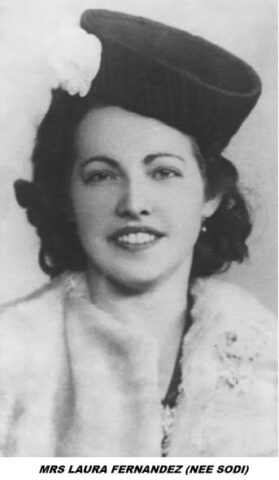
In retaliation to the D-Day landing, Germany attacked London with flying bombs as from the 13 June 1944 when there were still nearly 10,000 evacuees in London hoping to be repatriated soon. On the 17 June, the flying bombs claimed it first Gibraltarian victim - Mr Francisco Pereira from Linden Hall. The next victim was Mrs Laura Fernandez (nee Sodi) from the York Hotel when a flying bomb hit Goodge Street in Tottenham Court Road on the 19 June. By then, my family had been lodged at the York Hotel also waiting to be repatriated. It was about teatime, and my mother had gone to get some sandwiches from a restaurant opposite. After a short while, all of a sudden, there was a huge explosion. I remember that my two brothers and I were lying on the floor with cups and saucers. The windows were completed smashed and the room full of very dark dust. Sometime later, my mother returned accompanied by one of our neighbours both, naturally, very shocked. During my research, I found out from Mrs Fernandez’s family that she was due to be repatriated in March with the Sodi family but opted to stay with her husband’s family that was due to repatriated later. Photo 1- Mrs Laura Fernandez (nee Sodi).
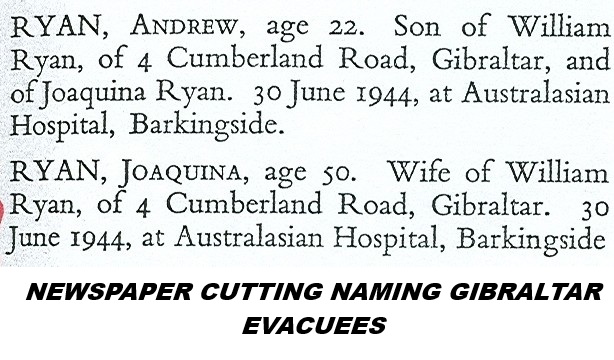
The next victims were Mrs Juaquina Ryan and her son Andrew at the hospital within the Dr Barnardo’s Homes complex. In connection with this bombing incident, it is interesting to mention that Henry Massetti (Mr Fabian Picardo’s uncle) was at the same hospital with a sprained ankle on a bed beside Andrew Ryan who was lying on a mattress on the floor because there were no more beds available. Henry’s mother decided to take her son out of the hospital feeling worried about the bombing and Andrew Ryan took over Henry’s bed a few hours before the blast. Photo 2 – Newspaper cutting naming Gibraltar evacuees.
Victor Gonzalez, then a schoolboy said: “We were in the school playground when the teacher came rushing and told us to run to the shelter. A while later we heard a tremendous explosion. The floor of the shelter seemed to have lifted and there was a lot of dust everywhere. When eventually we came out of the shelter, we got to know that the hospital at Dr Barnardo’s had been hit and that there were casualties. I also remember seeing an ambulance which had its doors wide open and could see the corpses covered with sheets and which impressed me for the rest of my life.”
The other two flying bomb casualties were that of Mrs Rosa Vella and Mrs Dolores Garcia from Kensington Palace Mansion on the 18 July 1944 when they were packing their belongings to be transferred to Northern Ireland.
In one month, six Gibraltar evacuees were killed by the flying bombs. By the 28 July 1944, all the evacuees in London were either repatriated or transferred to Northern Ireland with some having to wait an average of four yours to be repatriated.


