


The Secret Lives of Gibraltar’s Peregrines
Griffon Vulture attacked by Peregrine Falcon (photo Shane Shacaluga)


By Vincent Robba
Raptors have always been my greatest passion, with peregrine falcons at the heart of a lifelong fascination. Whenever I go birding, it is raptors that I seek out to watch and study, and for more than fifty years my focus has been on peregrines here in Gibraltar. Alongside decades of field observation, I have worked hands-on as part of a rehabilitation team, training injured falcons to survive again in the wild. I have also been involved in breeding from birds whose injuries were too severe for release, and in training and releasing their offspring back into the wild. This unique combination of long-term observation and practical experience has offered a rare insight into how peregrines think, behave, and respond to the pressures of their environment.
High above Gibraltar’s limestone cliffs, a daily drama unfolds that few places on Earth can match. Migrating raptors; eagles, vultures, kites, and hawks cross the Strait in their thousands, funnelling directly through the territories of one of the densest populations of Peregrine Falcons in the world. The result is a spectacle of precision, instinct, and aerial mastery that has captivated me for decades.
For more than fifty years, I have documented and watched this drama unfold. My lifelong fieldwork has made Gibraltar one of the most closely studied peregrine strongholds anywhere. My long-term records reveal a remarkable truth: peregrines do not simply attack other raptors at random. Their behaviour is selective, strategic, and rooted in an instinctive understanding of which species pose a threat and which do not.
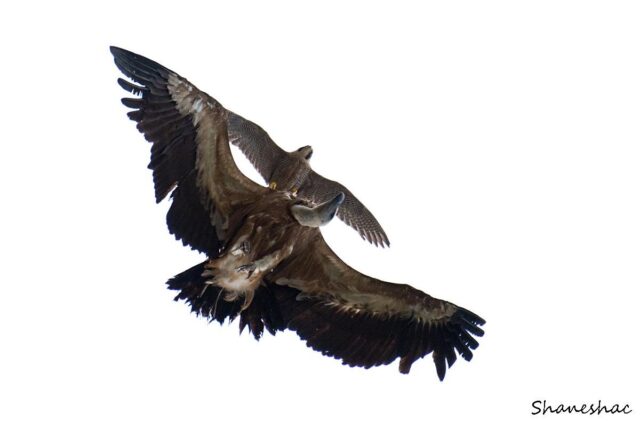
Griffon Vulture attacked by Peregrine Falcon 2 (photo Shane Shacaluga)
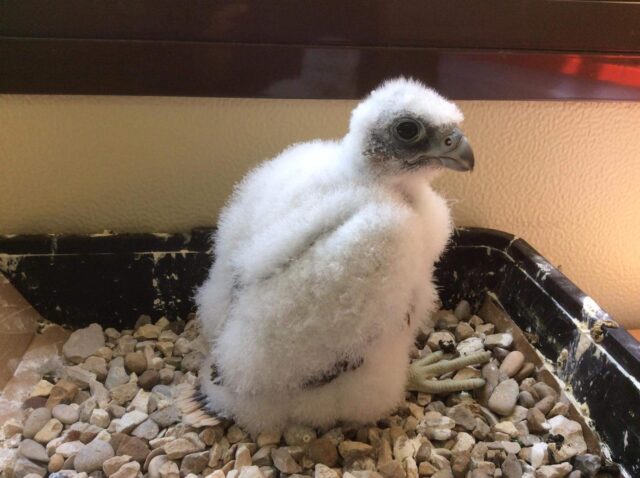
Peregrine chick bred in captivity for release.
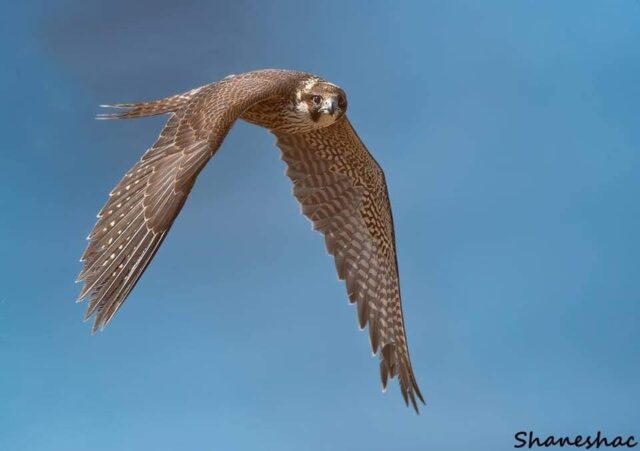
Juvenile Peregrine in Flight (photo Shane Shacaluga)
To understand Gibraltar’s peregrines, one must first understand their world. Each pair occupies a sharply defined territory carved into the Rock’s cliffs and extending far out over the surrounding sea. These territories are defended with absolute precision, especially during the breeding season when eggs and fledglings are most vulnerable. When a migrating raptor enters this airspace, the peregrine’s response depends on several key factors. Some species trigger an immediate and intense reaction because they resemble the peregrine’s most dangerous natural enemy: the Eagle Owl. The Short‑toed Eagle is the clearest example. Its large forward‑facing eyes and rounded head give it an owl‑like profile. Even though short‑toed eagles rarely threaten peregrines directly, their appearance alone seems to activate a deep evolutionary alarm. This is not aggression for its own sake, it is survival instinct.
Peregrines appear to instinctively recognise which species are capable of preying on birds, especially fledglings. Booted Eagles, active hunters of birds and mammals, are treated as genuine threats. Sparrowhawks may be stooped at, but usually as prey rather than rivals. Ospreys, Merlins, and Hobbies are harassed occasionally but not with the same intensity. This selective behaviour suggests a sophisticated ability to assess danger based on species‑specific traits rather than simple size.
Large soaring birds such as Griffon Vultures are attacked frequently, but not because they are predators. Their sheer size and broad wings make them highly visible intruders, especially when they drift close to nest sites. Yet other large species such as Black Kites, Red Kites and Honey Buzzards pass through with little or no harassment. Peregrines seem to recognise that these birds pose no threat to their young.
Aggression peaks during the breeding season, with eggs laid in early March and chicks fledging in mid‑May. As fledging approaches, peregrines defend their territories with extraordinary intensity. A raptor passing high overhead may be ignored; the same bird drifting near the ledge will be driven off instantly.
The female peregrine, being larger and more powerful, is usually the primary attacker. The male participates but is less effective against large raptors. Their attack method is unmistakable: a high‑speed stoop, a violent strike with the talons, aimed at the head and eyes of the intruder, followed by blows to the wings to destabilise flight. Many injured birds taken into care by the Raptor Unit show exactly these patterns; eye trauma, wing fractures, and concussion from mid‑air impacts. Some fall unconscious into the sea and drown unless rescued. Others survive if they land in vegetation rather than on hard rock.
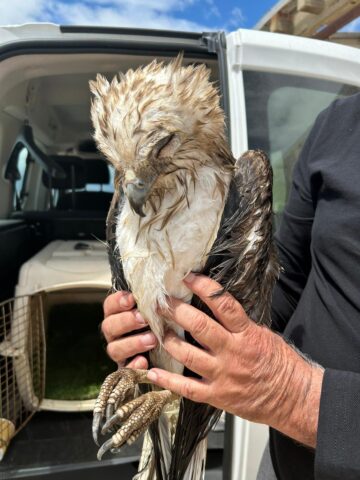
Short-toed Eagle just rescued
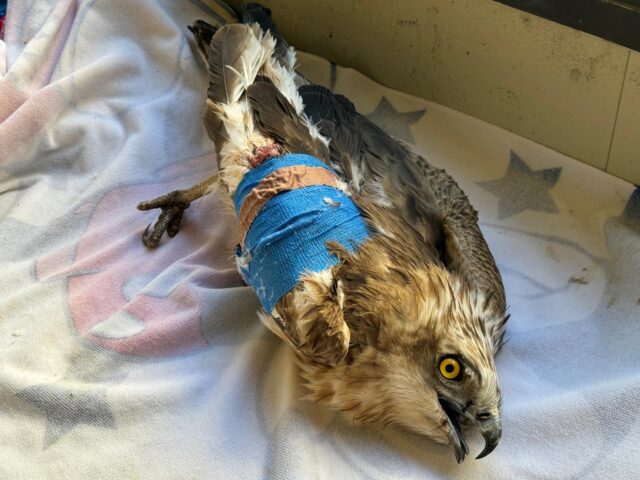
Short-toed eagle with wing injury sustained from peregrine attack undergoing vetenary treatment
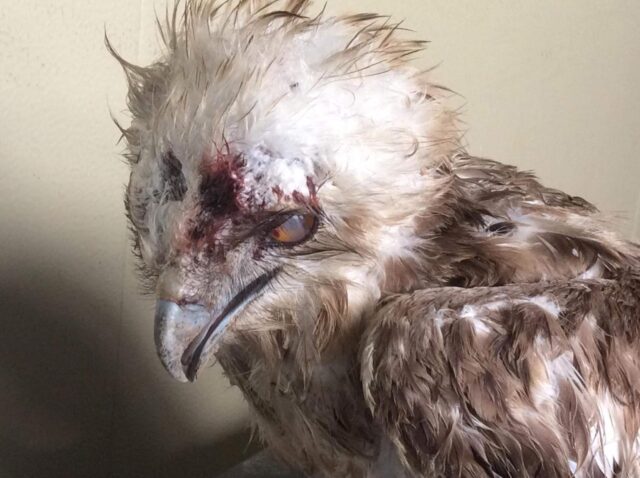
Short toed Eagle with eye and head injury sustained from peregrine attack
Yellow‑legged Gulls, often dismissed as noisy opportunists, play a surprisingly important role in the Rock’s aerial politics. They mob large raptors relentlessly, their alarm calls alert peregrines to approaching intruders, and their harassment often forces exhausted migrants into the sea. Along the Strait, however, another interaction between birds reveals a very different dynamic. Gulls have learned to exploit migrating sparrowhawks when they cross the open sea. Rather than attacking peregrines, gulls tend to target these smaller hawks, pursuing them persistently over water. Through repeated harassment and mobbing, the gulls are sometimes able to exhaust the sparrowhawk, forcing it down into the sea. Once the hawk is in the water, the gulls will consume it. In this context, gulls appear to pose a greater danger to sparrowhawks during sea crossings than peregrines do.
A peregrine male hunting miles offshore may return instantly when gulls sound the alarm. The female leaves the nest to join the attack, creating a coordinated defence system that spans the entire territory. Gibraltar’s peregrines maintain tightly defined territories that extend seaward as well as inland, forming invisible boundaries or channels in the sky. Boundaries are so precise that peregrines rarely cross into neighbouring territories, pursuits stop exactly at territorial borders, and the next pair immediately takes over the chase. This “relay defence” is rarely documented elsewhere and is only visible here because of the Rock’s density of breeding pairs.
The Raptor Unit’s rehabilitation records, stretching back to the early 1970s, show clear patterns in the species most often admitted: Short‑toed Eagles, Griffon Vultures, Booted Eagles, Sparrowhawks, Black Kites and Honey Buzzards, Harriers, Ospreys, Merlins, and Hobbies. Many arrive exhausted after crossing the Strait. Others are injured by gulls or peregrines. Juveniles of local species such as Common Kestrels, Little Owls and Peregrines are sometimes brought in after falling from nests or being attacked during the perilous fledging. The Unit’s work in rescuing, treating, and releasing these birds has saved countless individuals and provided invaluable insight into the pressures of migration and other human‑made threats.
The story of Gibraltar’s peregrines is, above all, a story of observation; patient, persistent, and spanning generations. It is the story of meticulous records and lifelong dedication playing a crucial role in protecting Gibraltar’s peregrines and other local birds of prey. This has laid the foundation for understanding how these raptors behave, how they defend their territories, and what they require to survive in an increasingly pressured environment. What I documented so patiently is not only the behaviour of established peregrine pairs, but the way this behaviour is inherited; socially, instinctively, and across generations. Each time a new peregrine arrives on the Rock, exploring its cliffs in search of a territory to claim, it is inevitably shaped by the birds already here. Through constant interaction, disputes, displays, and the daily choreography of defending the skies, these newcomers absorb the same defensive strategies and territorial instincts that have defined Gibraltar’s peregrines for centuries. In this way, every successful new pair becomes part of an unbroken cultural lineage, ensuring that the traits I first recorded 50 years ago continue to echo through every generation that follows.


