


Sir Mo Farah’s Around the Rock Run raises £4,000 for charity
Photo by Johnny Bugeja


It was a ‘MO’ment most runners and fans on the Rock will never forget, their chance to run around the Rock with the Olympic gold medallist, Mo Farah.
In doing so, £4,000 was raised for the Gibraltar Community Association and Research Into Childhood Cancer (RICC).
Arguably one of the greatest track athletes in British history, Sir Mo Farah was on the Rock as part of a prelude event to the Gibraltar Gibunco Literary Festival.
On the Friday night of his two events, Sir Mo captivated a packed audience on the Sunborn as he was In Conversation With Thomas Watt, where he shared the powerful story of his life.
He spoke openly about his path from a reluctant schoolboy runner, who dreamt of playing for Arsenal, to a four-time Olympic champion and one of the most recognisable figures in world sport.
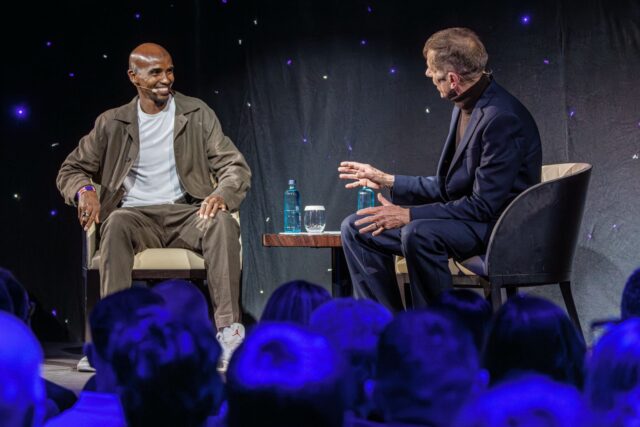
On his first ever visit to Gibraltar, he recalled a university friend, Lee Taylor from Gibraltar, who had urged him to visit nearly two decades ago, showing him photos and promising he would love the place. Joking at how long it had taken him to finally make the trip, Mr Watt assured him the place gets to you and it will not be his last.
With Arsenal set to play over the weekend, the two fans opened up their conversation about that sport rather than running.
As a boy, Sir Mo was obsessed with football and did not initially see himself as a runner. A PE teacher at secondary school spotted his talent when he was well ahead of his classmates in a fitness drill.
The teacher persuaded him to join an athletics club, that he would drive him to, by allowing him to arrive early to play football before training.
From there, he progressed steadily, winning everything in sight for his club, county, then England, before his first Great Britain vest.
On the track, he moved gradually through the distances, starting with 1500m, then 3000m, then 5000m, eventually tackling 10,000m.
The turning point, he said, came in 2011 at a 10,000m race in Eugene, Oregon.
On paper he was an outsider in a field packed with East African runners. Late in the race he found himself still with the leaders, moved to the front and drove the pace. He crossed the line with a European record and a British record, having beaten many of the athletes he had previously seen as untouchable. It was then he began to believe he could genuinely challenge other runners.
He described the London 2012 Olympic Games as the most extraordinary experience of his career. He arrived knowing that success there could transform his life, but tried to approach his races as calmly as any other championship.
The scale of the occasion made that difficult. At the warm-up track, supporters were everywhere and entering the stadium for the 10,000m final, he was struck by a sea of Union Jack flags and a wall of noise.
He recalled how the roar built through the final lap and intensified down the home straight, to the point that he could no longer feel his feet and could hear nothing but that sound.
A week later he returned to win the 5000m, making it an Olympic double. He later learned that the noise in the stadium was so intense it affected the finish line camera, a rare technical distortion attributed to crowd volume.
After dominating the 5000m and 10,000m, he eventually moved to the marathon, driven by a desire for a new challenge. He explained that marathon preparation is more complex and unforgiving than track running.
On the track, an athlete can race frequently, learn from mistakes and quickly try new approaches. Over 42km, there are far fewer opportunities, and most elite marathoners only race twice a year.
One of the most personal sections of the evening touched on his childhood and the BBC documentary that revealed the circumstances of his arrival in the UK.
Sir Mo said that revisiting that period of his life for television was one of the hardest things he had ever done, but he needed answers for himself and honesty for his children, who had reached an age where they were asking difficult questions about his past and his family abroad.
Family has been central to his career. He paid particular tribute to his wife, Tania, who shouldered enormous responsibility with their children while he spent long periods away.
His twin daughters were born shortly after his London 2012 triumph and Tania, together with his team, had even agreed that if they arrived early, they would not tell Sir Mo because he had worked so hard and they did not want to distract his focus.
When he stepped away from elite track competition, it took him around six months to decide on his direction. He completed a coaching licence and began investing more time in helping young athletes and the wider running community.
He described his Running with Mo initiatives and app URUNN as an attempt to make running feel simple, social and inclusive rather than intimidating.
He wants people to see it as something that clears the head, supports mental health and can be shared with friends, rather than an activity reserved for the talented or ultra-competitive.
He admitted that, even in retirement, he often goes out for a short jog simply to reset his mind.
He also spoke about raising his children in a sporting household. He does not insist they follow him into athletics, but he does expect commitment to whatever they choose, whether that is football, badminton or running. The only non-negotiable element, he suggested, is that everyone remains active and spends time away from screens.
Looking ahead to the Rock Run, he said that everyone on the start line will have their own goal, whether chasing a fast time or simply reaching the finish. What matters, he said, is taking part, supporting one another and remembering that the event is raising money for good causes.
He promised not to start his watch and to treat the route as an opportunity to share the road with local runners, rather than a race to be won.
After the event, there were drinks and canapes while people bought his books, however some attendees left early to prepare for the run on Saturday morning.
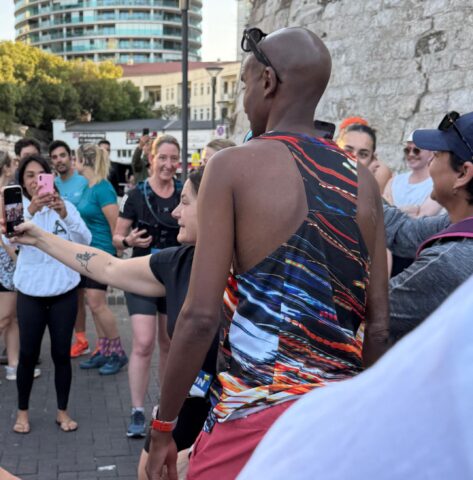
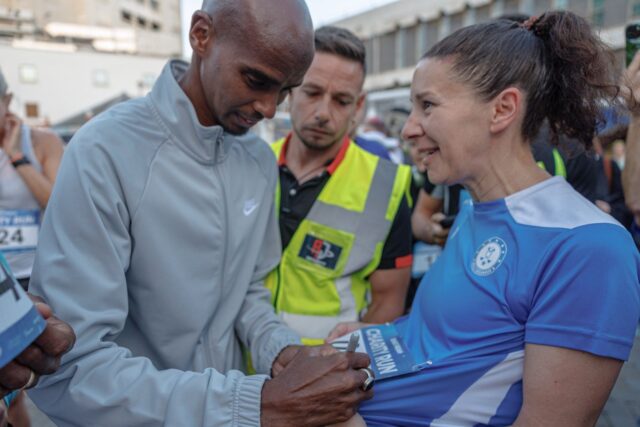
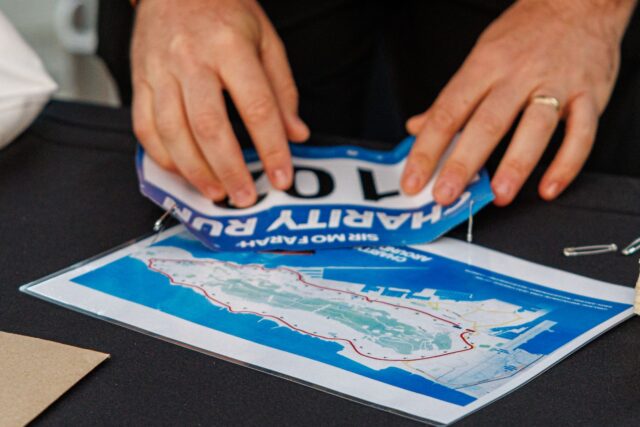
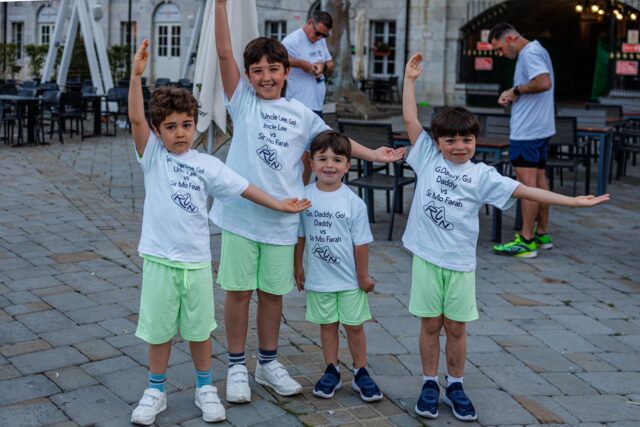
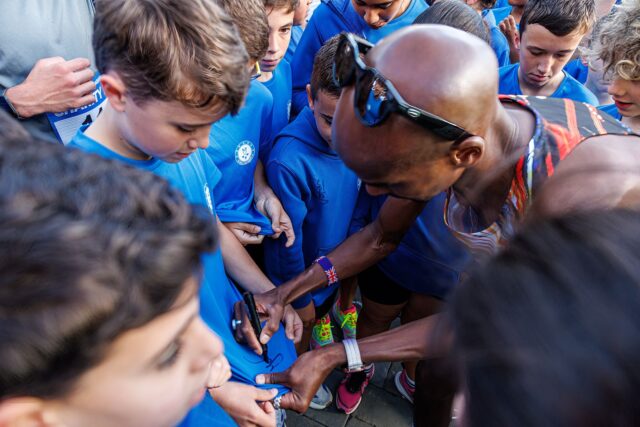
Casemates was a buzz of excitement by 8am on Saturday with the legend posing for photos, signing autographs and spending time with local runners, fans and giving extra time for all the children around him.
With road closures, police escorts and dozens of marshals lining with route, the event had to start on time at 8.30am.
Lining up at the start line were numerous local athletes and fellow medal winners, albeit not Olympian, as well as Sir Mo’s university friend Lee. Over 150 people ran behind Sir Mo as they left Market Place and headed towards Devil’s Tower Road. However, a handful thought of it as their potentially one and only chance to beat the legend in a run and they sprinted off once the whistle blew.
As runners made their way around, public participation was greeting them on the way, be it bus drivers tooting their horns in support or a group of women at Camp Bay waving Gibraltar flags.
By the 100-ton gun, Sir Mo reacted with a huge grin to Hounslow Boys being shouted by a local fan, Manny Sardina.
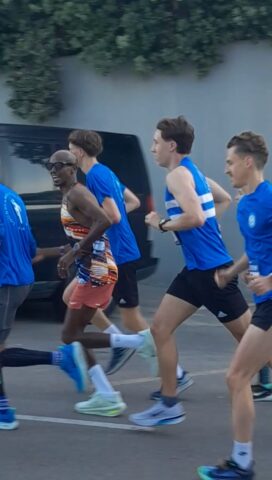
Perhaps one of the most special moments of the iconic run was when dozens of youngsters met him at the Piazza on Main Street and ran with him the final leg of the race into Casemates. Here he encouraged them to shout ‘Come on Mo, Come on Mo’. Numerous high fives was exchanged at the finish line.
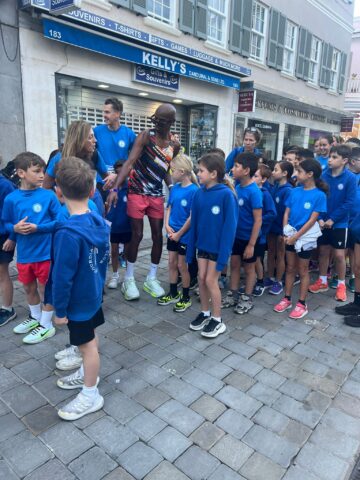
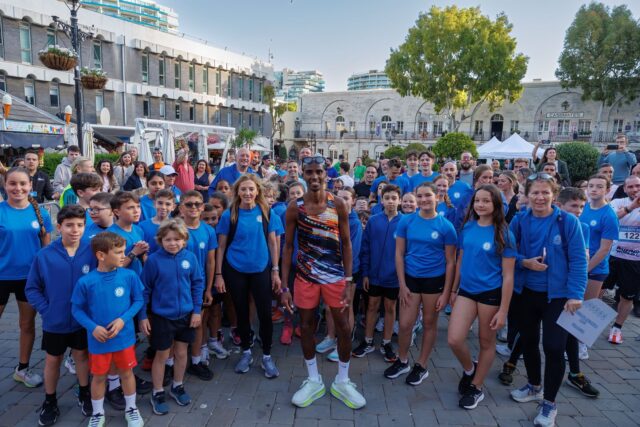
The event raised approximately £4,000 for two charities, the Gibraltar Community Association and Research Into Childhood Cancer (RICC).
For Gibraltar’s running community, young and old, having one of the greatest distance runners in history leading them out around the Rock will be a moment to remember.
A video created by Gibraltar Cultural Services of the run can be viewed here https://www.youtube.com/embed/AZ0Q_F8tJXg


