


Letters from Washington: A city votes on itself and the nation


By Molly Gill
That Tuesday night in Washington, nobody seemed to remember it was Tuesday.
I have been in the American capital since September, and this was the week the whole city had been holding its breath for.
Politics is always the conversation here, but this week it was the only one. It hummed in coffee shops and on street corners, in offices and on the Metro, as though the city were leaning in to hear its own future read aloud.
The midterms fall midway through a president’s four-year term. The president’s name is not on the ballot, though his presence is felt in every race. On the ballot is Congress: all 435 seats in the House of Representatives and 35 of the 100 seats in the Senate. Congress writes the laws and holds the purse strings, so whichever party controls it decides how much of the President’s agenda survives the next two years.
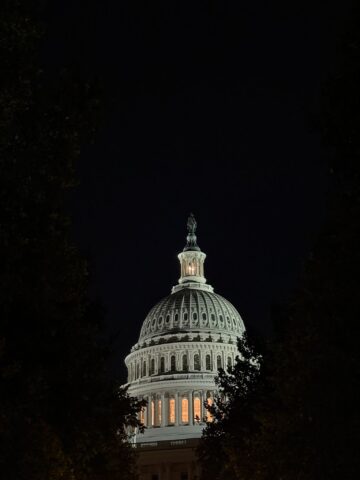
Republicans entered the vote with narrow majorities in both chambers. By Wednesday morning, both had slipped away. The Democrats took the House and the Senate, flipping at least seven Senate seats, including in states long considered safely Republican, such as Texas, Kansas and South Carolina. It was one of the most lopsided midterm results in modern American history.
For a Gibraltarian, the closest comparison might be a general election for Parliament held midway through a government’s term, with the head of government watching from the sidelines and waking to find the ground beneath him has shifted.
By Wednesday afternoon, recriminations had begun. Vice President JD Vance laid the losses at the door of the war with Iran, while Democrats spoke of a coalition that had held together on the cost of living. In Washington, the post-mortem began before the counting ended.
What surprised me most was that the people of Washington were also voting on something closer to home. After twelve years, Mayor Muriel Bowser is stepping down, and the city has chosen Janeese Lewis George, a self-described democratic socialist, to succeed her. The District has also elected a new delegate to Congress, the first in 36 years.
That local vote carries more weight here than you might expect. Washington is not a state. Its residents send a delegate to Congress who cannot vote on final legislation, and Congress can overrule the city’s government. The capital of the world’s most powerful country has less say over its own affairs than almost any other American city. The new mayor’s first test may come from just down the road, the President has already called her a threat to the capital.
As a Gibraltarian, I found it strangely familiar. We know what it is to live in a small place with a strong sense of self, whose future is partly shaped in rooms elsewhere. That truth came into sharp focus last month, when the United States called at the UN for the Decolonisation Committee to be abolished, the very body before which Gibraltar makes its case each year.
Polls closed at eight in the evening here, and the city did not go to bed. Around the Capitol, watch parties spilled out of bars onto the pavements, screens glowing with maps that slowly changed colour, state by state, as the night wore on.
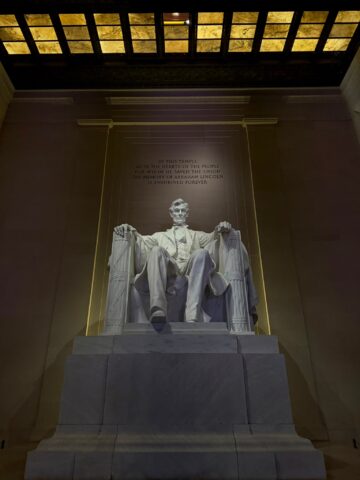
What struck me was how freely people talked about politics, with friends, with strangers, even with a Gibraltarian they had only just met. At home, politics is close enough to touch.
Here, it is vast, with a single congressional district holding the population of the Rock many times. Yet the conversations felt no less personal. People spoke about the results the way we speak about family.
Coming from a place of thirty-odd thousand people to a city that sets the agenda for much of the world, I expected to feel small. Sometimes I did. But I have been quietly struck by how many people here not only know Gibraltar but also understand how it works. Its Parliament, its identity, its delicate position on the map.
That has been a refreshing surprise. It reminded me that the instincts a small place teaches, that every voice counts and that relationships matter, are exactly the ones that carry weight in a capital like this.
Gibraltar has always had to make itself heard in bigger ponds than its own. Watching Washington vote, I understood a little better how it is done.
Molly Gill, a Gibraltarian writer, is currently in Washington, D.C. on the Global Emerging Leaders Programme.
Most Read
Govt launches Westview residential project with plans for over 2,000 new homes
Thu 12th Nov, 2026
CM has concerns over data centre project but says Gib ‘needs a foothold in digital future’
Wed 18th Nov, 2026

Today's Paper
18th November 2026
Read our latest newspaper by downloading our app from the link below.


