


Govt will leave ‘no stone unturned’ to deter child sex offenders, Feetham says
The Minister for Justice, Trade and Industry, Nigel Feetham answering questions in Parliament.


The Minister for Justice, Trade and Industry, Nigel Feetham, said he will leave “no stone unturned” when it comes to deterring sexual offences against children, even if that means deporting sexual offenders to another jurisdiction.
During a question-and-answer session in Parliament on Wednesday afternoon, Mr Feetham said he believes that his statements and proposed legislation would act as a deterrent to potential offenders.
Mr Feetham stressed that the Government needs a tough stance on this type of offending, having previously floated possible measures including mandatory chemical castration, deporting prisoners, and potentially legislating for wealthy inmates to pay towards their stay.
This comes as the Justice Ministry is currently drafting the Criminal Justice Child Protection and Victims Bill, which would introduce offences involving psychological and physical abuse towards children.
“If it means that we pass the constitutional threshold of chemical castration, that is what we on this side of the House are preparing to do,” Mr Feetham told Parliament.
“If it means, Madam Speaker, to deter any person outside this House from committing these horrendous crimes against our children, if it means us deporting sexual offenders to another jurisdiction, Madam Speaker, whether it happens to be Morocco, Spain or any other jurisdiction, that is what we will do.”
Mr Feetham underscored the importance of deterrence when it comes to these offences, adding that the Government “will leave no stone unturned to protect our children and grandchildren here in Gibraltar.”
“And if we have to consider even more proposals and even going harder, that is exactly what we will do, Madam Speaker.”
Mr Feetham’s statements were in response to questions put forward by GSD shadow minister for justice, Joelle Ladislaus, who pressed him on his proposals aimed at convicted child sexual offenders, and the possibility of implementing financial contributions by wealthy prisoners.
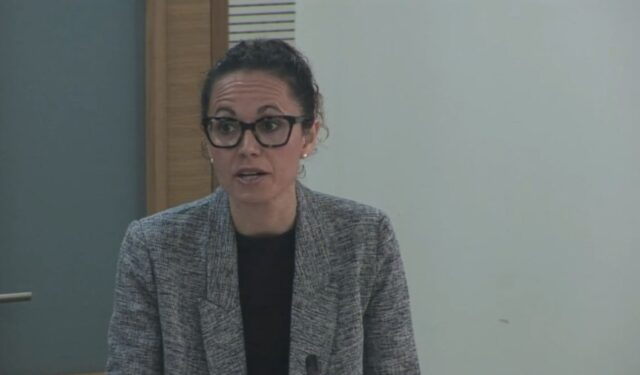
Ms Ladislaus asked whether these provisions were intended to apply to all wealthy convicted prisoners or only certain limited categories, and how would wealth and ability to pay be assessed.
Mr Feetham replied that the Government had sought legal advice which is currently under consideration, and that the next stage will be for the justice ministry to consider the terms and conditions of any scheme.
He added that the proposal for implementing financial contributions by wealthy prisoners was being considered more broadly than solely prisoners convicted of sexual offences.
Ms Ladislaus also pressed Mr Feetham on his proposal to transfer convicted child sex offenders serving their sentence in Windmill Hill prison to foreign prisons.
The question stems from an interview published in this newspaper last week where Mr Feetham detailed that he plans to initiate contact with Morocco over the matter, having already discussed the issue with authorities in El Salvador.
Ms Ladislaus questioned whether local authorities would retain oversight of transferred prisoners, if this would be voluntary or compulsory, if prisoners will have access to independent legal representation, what would be the cost of maintaining prisoners abroad, and whether the foreign facilities would be inspected.
“No formal feasibility study has been commissioned at this stage in respect to the possible transfer of convicted child sex offenders to prison facilities in other jurisdictions,” Mr Feetham said.
“The Government is, however, undertaking preliminary exploratory work through the Ministry to establish under what framework such arrangements might be legally, constitutionally and practically possible."
"Initial approaches to relevant overseas facilities are also being considered with a view to ascertaining whether there is a willingness in principle on their part to examine the possibility of such arrangements.”
“Without the willingness of a foreign authority to engage with such a proposal, the other questions necessarily cannot be meaningfully advanced."
"If the constitutional position can be satisfactorily established and there is such a willingness on the part of a foreign authority to explore the proposal, the Government will then consider what legislative changes may be necessary.”
Ms Ladislaus also questioned comments made by Mr Feetham to this newspaper where he said he was not concerned about the rehabilitation of offenders.
Holding a copy of the Chronicle, Mr Feetham read an excerpt of his interview, underscoring that the comments were made in the context of the parole regime that the Government introduced through legislation.
During the interview Mr Feetham had said he initially wanted child sex offenders to serve the entirety of their sentence, but when he received advice he changed his position to 75% of the sentence, which is now law.
“I stand by what I said, and I meant what I said,” Mr Feetham said.
Mr Feetham added that Ms Ladislaus supported the removal of the word rehabilitation from that legislation.
“She certainly supported it, and indeed all honourable members supported the removal of the rehabilitative test under that threshold,” Mr Feetham said.
Ms Ladislaus responded that she did not disagree with Mr Feetham’s statements in Parliament, but that rehabilitation was important to safeguard the public once an offender had left prison.
“We believe very firmly, Madam Speaker, that the law should act as a deterrent to those horrendous crimes that are being committed against children,” Mr Feetham said.
“We have changed the law to ensure that offenders spend more time in prison, albeit through the increasing of the threshold condition in the new statutory provision."
"Of course we accept, Madam Speaker, that when an offender is released, there is a rehabilitative process.”
Mr Feetham said that the Government believes in deterrence and that some of his statements have “deterrent value”.
He added he cannot remember reading a ruling where a child sex offender “shows an element of remorse”.
“No remorse at all, Madam Speaker, unless as a society we are prepared to go very hard, not just on those offenders, Madam Speaker, but those that are thinking of committing horrendous crimes against our children, then I'm afraid that as a society we are just inadvertently turning a blind eye,” he said.
He described the “harrowing experience” of recently visiting a convicted child sexual offender in prison in Gibraltar who showed “no remorse”.
“As things stand, there is no evidence that offenders actually even accept that they have done anything wrong."
"So of course there is a process of rehabilitation."
“But certainly my view is that offenders of this type of offences have to face the full consequences for their actions."
"And I will not dilute what I'm just saying in this House.”
Most Read
CM has concerns over data centre project but says Gib ‘needs a foothold in digital future’
Wed 18th Nov, 2026
Govt launches Westview residential project with plans for over 2,000 new homes
Thu 12th Nov, 2026

Today's Paper
19th November 2026
Read our latest newspaper by downloading our app from the link below.


