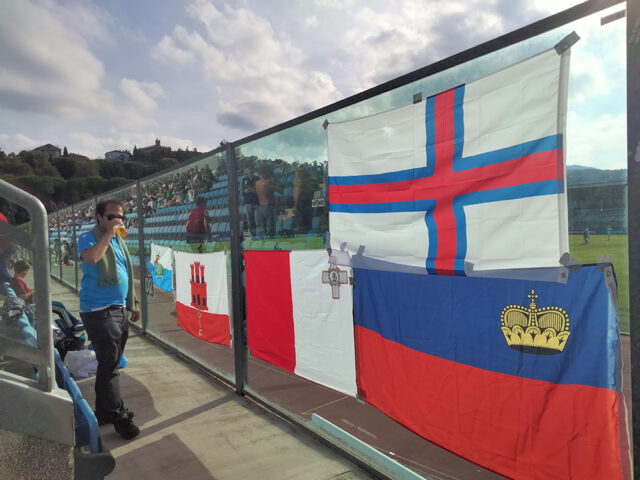
Supporters of the Small States of Europe oppose announced reforms to international football


The recent announcement by UEFA of a restructure to its World Cup and Euro qualifiers, in which teams would play across various league divisions and elite teams would no longer face the minnows, has prompted a response from supporters claiming to represent smaller football nations. UEFA had described such fixtures as “dead matches.”
Although not an officially well-known organisation, the Coordination of Supporters of the Small States of Europe, which claims to represent supporters from Brigata Mai 1 Gioia (San Marino), Team 54 (Gibraltar), South End Core (Malta), Landleblock & Mormile Raeticae (Liechtenstein), and Skansin (Faroe Islands), has strongly criticised UEFA’s newly approved reform of the qualification system for the European and World Championships, claiming it will marginalise smaller countries and damage the spirit of international football.
In a joint statement issued this weekend, the Coordination of Supporters of the Small States of Europe said the reform, approved by UEFA’s executive committee in Istanbul on May 20, would create “a structural separation between larger and smaller nations” by placing stronger teams into their own league system from 2028 onwards.
The group argued the changes would effectively prevent smaller nations from regularly facing Europe’s top teams and would “destroy the principle of equality between national teams.”
Supporters said the reform would particularly harm microstates, where opportunities to play against elite opposition are viewed as vital for player motivation and development. “These matches are everything,” the statement read, describing them as “the highest stage” players from smaller countries can reach.
The coordination also warned the reform would create “a two-tier system in European football,” contradicting UEFA’s values of “unity, inclusion and the widely promoted #footbALL.”
Fans further criticised the likely loss of home-and-away fixtures, saying such matches build friendships, cultural exchange, and respect between nations.
The statement also highlighted memorable shock results involving smaller nations, including San Marino scoring against England after eight seconds in 1993 and the Faroe Islands defeating Türkiye in 2022.
The group concluded by urging UEFA and national associations to reconsider the reforms, insisting football “must remain a game where every nation, no matter how small, has the right to compete, to dream, and to belong.”
The reforms are understood to have raised concerns within UEFA during discussions with member associations, with Gibraltar believed to have called for safeguards while raising concerns over the impact on its own development.
Although passed at the latest Executive Committee meeting in Istanbul, at which Gibraltar was among those represented, the full details of the reforms have yet to be published, with further details expected later this year.
It is expected that the reforms will include alternative pathways through which teams in the lower divisions could still qualify for major tournaments such as the World Cup and Euros, similar to the current Nations League pathways provided to lower-division league winners.
However, the reforms have also raised concerns that UEFA may have set a precedent within the national team structure that could encourage club football to seek similar changes. Some within the game have warned that UEFA’s rejection of the European Super League could be undermined if clubs argue the latest reforms provide justification for comparable changes at club competition level.
So far, there do not appear to have been any public statements from UEFA member national associations openly opposing or supporting the reforms since they were announced on May 20.
UEFA stated the new format was approved following “extensive consultation with all UEFA member associations,” suggesting federations were involved in discussions before the decision was finalised, although it is understood concerns were raised over the potential impact on smaller nations prior to the final vote.
Most public reaction so far has come from supporters’ groups, media analysis, and online debate rather than official football associations, with the strongest organised criticism appearing to come from the Coordination of Supporters of the Small States of Europe, despite the group itself not being widely known officially.
Media reports have noted concerns that the changes could disadvantage smaller nations, but no federation has publicly broken ranks with UEFA or issued a formal protest.
At present, the only official comments directly linked to the reform have come from UEFA President Aleksander Čeferin, who defended the changes as a way to improve competitiveness, reduce “meaningless matches,” and maintain fairness without increasing the international calendar.