Boat walk gives children insight into Gibraltar’s Neanderthal past


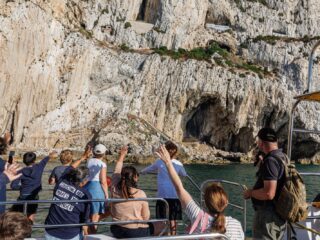
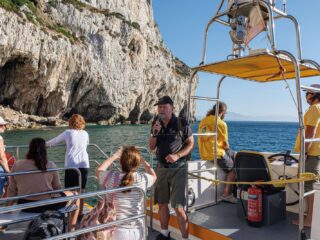
Around 10 children and some of their parents joined the Gibraltar National Museum for a boat walk along Gibraltar’s east side, learning about the Neanderthals who once occupied Gorham’s and Vanguard caves.
The visit forms part of Walks Through History, led by guide Mr Phil Smith and Naomi Fa every Wednesday as part of Gibraltar Cultural Services activities on the Rock.
The children were shown how the caves were formed by wave action and how falling sea levels during the last ice age exposed a coastal plain in front of them.
Mr Smith explained that the coastal plain was around five kilometres wide and provided access to freshwater, vegetation and a wide range of animals.
The Neanderthals were at the top of that food chain and used sophisticated hunting techniques.
Animals in the area included rhinoceros, brown bears, hyenas and leopards, while smaller animals such as rabbits and goats could also be found around the Rock.
At Europa Point, the rocky coastline provided access to shellfish and fish.
The children were also introduced to the Neanderthals themselves, who lived in Europe and Asia before modern humans arrived.
Mr Smith explained: "we are cousins with the Neanderthals. We've got the same grandparents 400,000 years ago in Africa."
Some of those earlier humans moved north into Europe and Asia, where their bodies adapted to colder conditions.
Neanderthals were generally short and stocky, with a pronounced ridge above the eyes and wider noses with larger nasal passages, Mr Smith explained. The larger nasal passages helped warm and moisten cold air before it reached the lungs.
He also explained that Neanderthals lived in small groups of between 12 and 20 people and followed a hunter-gatherer lifestyle.
They sometimes lived in caves but also moved around, collecting freshwater, firewood, fruits, berries and shellfish while hunting animals.
Gibraltar’s caves provide a detailed record of that way of life because evidence left behind by the Neanderthals was repeatedly covered by sand.
When groups moved away from the caves, strong winds could blow sand inside, sealing the evidence they had left behind. Birds and animals also entered the caves and left remains that were subsequently covered by sand.
The result was a series of archaeological layers, with each layer providing another part of the story, Mr Smith explained.
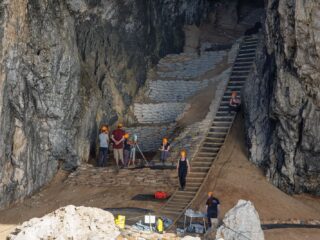
International archaeologists return every summer in July and August to excavate the caves, involving a 344-step journey down to the excavation area and another 344 steps back up.
Mr Smith described the route as the archaeologists’ “commute to work”.
The children were able to see archaeologists working at the site during the boat walk, with teams wearing orange helmets as they excavated the caves.
Small finds can be just as important as larger ones, including a Neanderthal baby tooth recovered from the site a few years ago.
“We were after the complete skeleton; we only ever found the tooth.”
“So maybe they're out there, that's why we keep digging.”
At the end of each excavation season, the areas are protected because of winter rainfall and the presence of birds.
Mr Smith said: “The archaeologists keep immaculate records of where they're working, what they're finding,” so it means that they have fresh information about everything they were doing when they stopped.
THE TWO CAVES
Gorham’s Cave takes its name from Captain Gorham, who entered the cave in 1907 and painted his name on the wall.
Vanguard Cave has a less certain history. Mr Smith explained that the British Navy had a ship called HMS Vanguard, but there was no confirmed explanation for how the cave acquired its name.
The two caves also contain different evidence of Neanderthal occupation.
In Vanguard Cave, sand filled the cave to the top around 40,000 years ago, forcing the Neanderthals to move out.
A small opening made by an archaeologist several years ago revealed a rear chamber containing shellfish remains, bird bones and scratch marks on the wall.
The marks were eventually identified as the work of a brown bear that had been hibernating in the cave.
When the bear woke in spring, it scratched its claws against the wall to sharpen them before leaving to hunt.
Other evidence of Neanderthal activity includes fireplaces and animal bones bearing cut marks from stone tools.
Charcoal from the fireplaces can be accurately dated and helps establish the chronology of the archaeological layers.
GORHAM’S CAVE
In Gorham’s Cave, evidence also points to a more complex side of Neanderthal life.
The Neanderthals made jewellery using bird claws as a status symbol and used shells with holes made in them to create necklaces.
An engraving on the floor of Gorham’s Cave was initially thought to have been accidental because of earlier assumptions about Neanderthal abilities.
The archaeological evidence later established that the engraving had been made by Neanderthals.
Mr Smith said: "The Natural History Museum in London had to rewrite that section of the book to say we now know that Neanderthals are clever enough to understand a concept like art and design."
Evidence from Vanguard Cave also challenged assumptions about Neanderthal technology.
NEANDERTHALS AND MODERN HUMANS
The boat walk also provided a view of the wider landscape around the caves.
The limestone formations above the caves were once at sea level around 250,000 years ago before being pushed upwards.
Today, the Rock rises 426 metres above the sea, Mr Smith explained.
By the time of the Neanderthals, the Mediterranean was a deep and wide body of water.
The Neanderthals who reached Gibraltar came from Africa through the eastern Mediterranean, not by the Strait, according to Mr Smith, passing through areas including Israel and Lebanon before spreading west into Europe and east into Asia.
Modern humans arrived in Europe about 45,000 years ago and coexisted with Neanderthals for around 5,000 years.
Neanderthal numbers subsequently declined before the species disappeared around 32,000 years ago.
The final known Neanderthal lived in Gorham’s Cave, but the interaction between the two groups left a legacy.
Later, the boat continued past the caves, with the children able to see the archaeologists at work below their distinctive orange helmets.
The journey connected the landscape around Gibraltar’s east side with a much older history, preserved layer by layer in the caves.
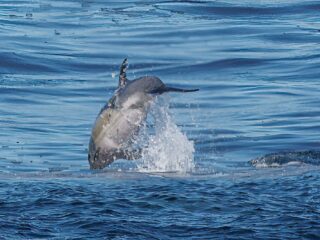
Later, on the return to the Bay, those onboard enjoyed the sight of families of dolphins jumping and playing in the water.
Gallery by Johnny Bugeja: