


A day in the life of lifeguards at Camp Bay and Little Bay
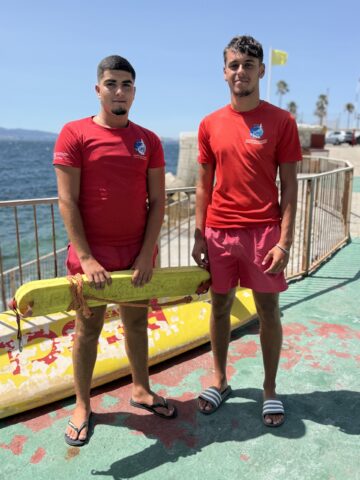
Isabelle Ryan Jake and Tom at Camp Bay Photos by Eyleen Gomez


Gibraltar’s lifeguards have reported a “really good” summer, with enhanced training, targeted staffing and new measures supporting safety at the Rock’s beaches and public pools.
In the first of a four-part series, the Chronicle visited Camp Bay and Little Bay to meet some of the lifeguards on duty and spoke to Lee Coombes, who oversees the service.
Mr Coombes, who has overseen lifeguard operations for eight summers, said the service had continued to improve year-on-year.
“We’re never perfect, it’s really hard to achieve that in the type of field we’re in, but I genuinely do think it gets better every year in terms of the service, because we’re always trying to improve and adjust wherever we can,” he said.
One of the main areas of focus has been training, with weekly sessions designed to build confidence and “muscle memory” for when lifeguards are required to respond to emergencies.
“The training is weekly,” Mr Coombes said.
“We just set our own kind of standards. The more they attend, the more training they do, the more prepared they are for a real-life situation.”
He stressed there was always “a major difference between training and a real-life situation,” but described regular training as “the best thing we can do to prepare”.
There have been numerous rescues this summer at both beaches and swimming pools.
“There’ve been plenty of rescues in the beaches,” he said.
“We have had a number of rescues in pools as well. Beach is very weather dependent. Just any day, we could turn up to work and the sea is really rough, and that’s a high-risk day.”
There are around 30 pool lifeguards and between 45 and 48 beach lifeguards working this season. Recent risk assessments have resulted in increased staffing at locations identified as higher risk.
“We are really well staffed,” Mr Coombes said, although he acknowledged that after numbers were increased at some posts, “at the moment maybe it is quite tight”.
“We definitely have enough, but it is quite tight.”
A new beach lifeguard course was therefore run during the season, qualifying “about five or six” additional beach lifeguards. A pool lifeguard course is also under way.
“We do see that it has been a bit tight on certain days. So, to better the service, we felt that we needed to run these courses mid-summer, which we don’t usually do,” he said.
Another change this year has been the introduction of fixed red lifeguard chairs.
Mr Coombes said lifeguards had previously patrolled up and down beaches, which could make it harder for members of the public to locate them quickly in an emergency, particularly on larger beaches such as Eastern Beach.
“The idea is that the public will always know exactly where the lifeguard is,” he said.
“In any emergency, people know exactly where to go to, where to shout to or wave to or signal to.”
The chairs also provide lifeguards with some respite from constant patrolling, leaving them with “more energy for when it actually comes to a rescue situation”.
Changes have also been made to the way people with disabilities are assisted into the water.
Beach attendants no longer assist people into or in the water. Instead, trained professionals from the care agency carry out that role, with beach attendants providing support.
“Getting a disabled person into the water is a delicate situation,” Mr Coombes said.
“It requires certain training. We thought it would be much better to have actual full-time professionals doing that, with people who do that on a daily basis.”
“It’s better, more professional and safer, really, for the public.”
He added that carers often already had established relationships with the people they assist.
Security has also been increased at public pools, with OSG personnel now present at The Pavillion and Europa Pool.
“They’re literally there for anything that happens. It gives me time to get there and get things under control,” Mr Coombes said.
He added that there had been no incidents since the security personnel were employed and described their presence as “a very good” deterrent.
There is no dedicated security presence at Camp Bay, but Mr Coombes said he had observed increased police patrols there over the past month, which he described as “really helpful” for lifeguards and the public.
He said the service was already looking ahead to next season.
“We are really, really happy with everything. Really happy with the public. Really happy with the lifeguards, with the attendants,” he said.
“As soon as the summer finishes, we’re already planning and working on what we can improve for next season. So yeah, looking forward to that.”
Camp Bay
Head lifeguard on duty at Camp Bay when the Chronicle visited was Tom Appleton, who said the biggest challenge this summer had been preventing youngsters from jumping into the sea from the rocks and pier.
Mr Appleton, who is in his second year as a lifeguard, described the role as “a really good job for summer, because I’m still in school, so the whole summer is just free for me, and then I can just work, and I can make some money as well”.
Asked about the main issues at Camp Bay, he said it was “the people jumping off the rocks or the pier”.
“It is quite dangerous. You could hurt yourself. You could break your leg. Even the tides, they’re not forgiving. They will take you,” he said.
Lifeguards use whistles to move people away from the rocks and pier, with a lifeguard positioned nearby to deter risky behaviour and respond quickly if anyone gets into difficulty.
Mr Appleton has not had to carry out a rescue himself this season, but estimates there have been around five rescues at Camp Bay.
The most common incidents involve swimmers misjudging their strength after swimming too far from shore.
“Usual ones are just people who have swam out too far and they need help getting back in because they’re tired,” he said.
“If they swim out to them, and then on the way back in, they get too tired, and they just need help. We’ll assist them,” he said.
In these cases, lifeguards enter the water with a rescue tube to help the swimmer back to shore.
Lifeguards rotate between different beaches, with Mr Appleton identifying Eastern Beach as the most challenging posting because of its size.
“Because it’s the biggest beach, so you’ve got more area to cover,” he said.
If an incident occurs at the opposite end of the beach, a lifeguard may have to run the length of the beach before entering the water.
“That means running the whole beach and then swimming out the whole way. So yeah, I’d say that’s probably the most difficult,” he said.
He particularly enjoys working at Sandy Bay, describing it as “a more calm beach. There’s less, well, danger. Obviously, there’s still dangers in every beach, but there’s less danger there”.
Jake Berini is returning to the role for a fourth year and also holds the position of head lifeguard.
His reason for returning is because it is “something to do over summer. Easy money. It’s entertaining as well to be here.”
He said no two days were the same.
“Every day is different. There’s always something that happens, either we’re doing rescues, or members of the public complaining, or something. And some basic first aid and that,” he said.
Jellyfish have been less of a problem this year compared with last season, although Mr Berini said there had still been a few sightings of the common mauve stinger.
Managing members of the public was one of the more challenging aspects of the job, particularly when he was head lifeguard.
“Managing members of the public some days, because sometimes they don’t listen, and you have to really put a point across for their safety,” he said.
Ryan Porter Silva said he returned to the role because he enjoyed helping people.
“It’s a good job. I actually like helping people,” he said.
“You do something good, and someone says thank you, and you feel good a lot.”
He said criticism from members of the public could be difficult.
“The criticisms from the public,” he said.
“A lot of people, they tell you a lot of things. Obviously, you just have to ignore it and try do your best to do your job.”
Some complaints relate to lifeguards taking breaks or expectations that they should assume full responsibility for supervising children in the water.
“The parents should be watching them, not only us,” he said.
Despite the pressures, Mr Porter Silva said he enjoyed meeting members of the public.
“I like talking with a lot of people from the public,” he said.
“You get to meet a lot of new people, and after a while you get familiar faces and you just get to know them.”
His preferred posting is at the northern end of Eastern Beach.
“I like it a lot. I know a lot of people there, and I like the post as well.”
First-year lifeguard Isabella Bellingan said she had followed her sister into lifeguarding after seeing how much she enjoyed the work.
“She’s been a lifeguard for five years now, and she’s always enjoyed it, so I thought I might as well try it because I’m working outside at the beach, which is good,” she said.
While most days are calm, rough weather can bring additional challenges, particularly when swimmers ignore warnings.
“I’ve not had many situations where it’s been stressful, but organising people is,” she said.
“Someone has to go figure out if people over there are okay, someone has to stay here for the people on the shore, because people will go in the water even if it’s red flag.”
She said colleagues had had to respond directly in the water during rough conditions.
“Jake and another guy, they’ve had to go on boards in Caleta to go round in rough waves because these guys were jumping in,” she said.
Ms Bellingan said she felt comfortable with the training required for the role.
“Training I find quite easy. I’ve always been into sports, so it’s not like I’m exerting myself too much. It’s like a normal amount,” she said.
Little Bay
Kayden Gonzalez has stepped up to the role of head lifeguard and was on duty at Little Bay when the Chronicle visited.
“I’ve been working here for three years, and I think the supervisors have just trusted me to be promoted as head lifeguard,” he said.
“It’s a good feeling, obviously, to know that I have the trust of the supervisors.”
He begins each day by briefing the lifeguard team on rotations, weather conditions and the plan for the day.
“I brief the lifeguards on the plan for rotations and the state of the weather, and I make sure everything’s organised throughout the day,” he said.
“I make sure the first aid is up to date, and I make sure everyone goes on rotation on time. If they have a problem, they can come to me and talk about it.”
Now in his third year on the beaches, Mr Gonzalez said he continued to return because of the responsibility and challenge involved.
“I like the challenge of being in charge of the safeguarding of the beaches,” he said.
“I enjoy that as a role, and I think it’s nice.”
One of the greatest tests comes when lifeguards are required to carry out a rescue in difficult conditions.
“I think maybe having to go for a rescue on a rough day,” he said.
The sea on the day of the interview “could be considered” rough, although Gonzalez added that “there’s been worse”.
“Today there’s not many people in the water, every now and again, I wouldn’t mind having a challenge, but then again, it’s always better to be safe,” he said.
Mr Gonzalez, who grew up at Eastern Beach, said he enjoyed being stationed there and noted changes to local sea conditions following reclamation works.
“There’s not as many waves coming in. It’s a lot calmer,” he said, adding that the reduced swell and shifting sands had made patrols somewhat easier.
First-year lifeguard Islam Dahrouch said friends had encouraged him to take up the role.
Earlier this summer, he rescued two children from a dangerous current at Eastern Beach after spotting them being pulled out by the water.
“They were getting dragged down by the water, and I had to go see them,” he said.
Without using a boat or board, Mr Dahrouch swam out to the children and brought both back at the same time after telling them to hold on to him.
“The rescue took five minutes,” he added.
Mr Dahrouch, who has been swimming from a young age, credited his training with helping him respond quickly.
“Training obviously is hard but, like my coach always says, training makes perfect. The more you train, the better you get.”
“The more professional you get, the easier it is for you,” he said.
Asked which beach he preferred to patrol, he chose Camp Bay.
“I think the vibe there is very good. I know everyone that goes there. I grew up in that beach,” he said.


