Children walk into the history of the Great Siege tunnels
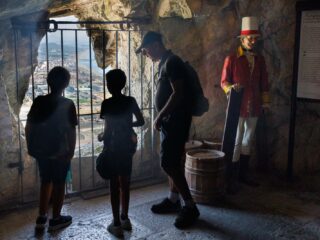
The children had the opportunity to explore the tunnels while learning about the Great Siege. / JOHNNY BUGEJA


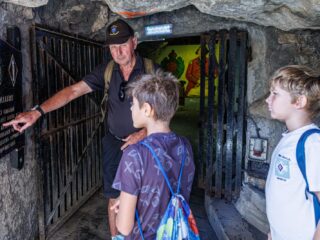
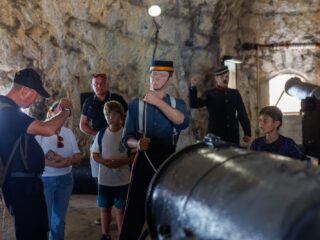
Children were taken on a journey through Gibraltar’s military history during a visit to the Great Siege Tunnels led by Gibraltar National Museum guides Phil Smith and Naomi Fa.
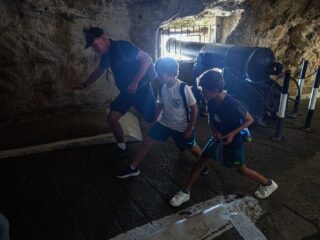
The Wednesday visit gave the children an opportunity to explore the tunnels while learning about the Great Siege and how Gibraltar was defended against Spanish and French forces.
Mr Smith described the siege as “a war in a small space,” with “lots of enemies surrounding the Rock of Gibraltar”.
He explained that the enemy “sealed off” the Rock, “stopping anything from getting in.”
The lack of food, ammunition and medical treatment would normally have led to surrender, but Mr Smith explained that Gibraltar’s defenders found ways to survive.
“On several occasions, the Spanish had tried to take the Rock of Gibraltar from the British. The biggest one of those was what we call the Great Siege. It lasted from 1779 to 1783, so it was almost four years long,” Mr Smith said.
“It was the largest and longest siege in British military history.”
Mr Smith said the people of Gibraltar were “very enterprising”, collecting rainwater and growing vegetables, while the Royal Navy managed to bring relief convoys into Gibraltar on three occasions.
He also explained how civilians were taken away to safety and described how Spanish and French forces eventually joined together in an effort to capture Gibraltar.
The children were also told about the challenges faced by Gibraltar’s defenders under attack.
Mr Smith explained that the main concern for General Elliot, the Governor at the time, was that Spanish soldiers could cross the isthmus at night and reach the bottom of the Rock, where Gibraltar’s defenders would be unable to fire down on them.
That would mean “they could then get thousands of men at the base of the Rock and, when they were ready, those men could storm around and try and capture the town.”
One of the children asked whether Spain had attempted such an attack and whether Gibraltarians had bombarded the advancing forces.
“Yes,” Mr Smith replied, and explained how the Great Sortie helped matters, when
a few thousand soldiers were sent out one night to attack Spanish positions.
“So, General Elliot, with his big nose, said to his soldiers ‘we need to work out a way of protecting Gibraltar against these attacks’.”
The solution was to excavate tunnels through the Rock, allowing Gibraltar to be defended from inside and from higher positions.
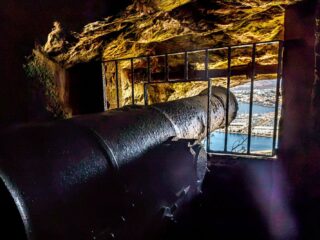
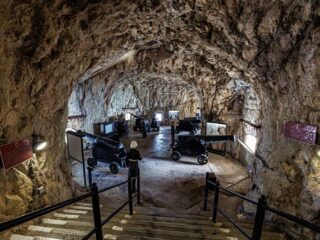
The children then entered the tunnel galleries, where they saw historic cannons and learned about the construction of the network.
Mr Smith explained that Sergeant Major Ince, a member of the Company of Military Artificers (the forerunners of the Royal Engineers), suggested tunnelling through the Rock.
Permission was granted and work began on May 25, 1782, under the direction of Lieutenant J. Evelegh, Aide De Camp to the Governor.
The tunnellers relied on their strength and skills with sledgehammers and crowbars, as well as gunpowder for blasting.
Within five weeks, 18 men had driven a tunnel eight feet square and 82 feet long.
The first gallery became known as Windsor Gallery and, by the end of the siege in February 1783, it had been extended to 370 feet and had four guns mounted in it.
Further galleries, known as King’s and Queen’s Lines, were later excavated lower down on the northern face of the Rock.
Work continued after the siege, with a tunnel driven downwards and a large chamber excavated beneath the Notch. Known as St George’s Hall, it housed a battery of seven guns.
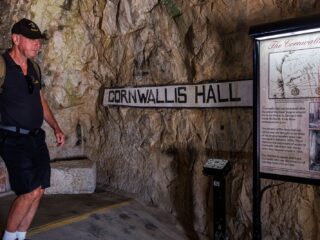
The Cornwallis Chamber was also excavated during this period, the guide said.
The Upper Galleries also contain guns from later periods, including a Victorian-era 64-pounder cannon, other guns dating from 1850 and an original 18th-century cannon.
The children also learned how the tunnelling tradition continued into the Second World War, when the Royal Engineers, including a Canadian contingent, added some 33 miles of tunnels to Gibraltar’s underground network.
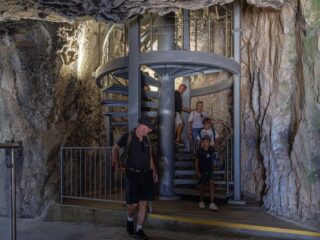
The Great Siege Tunnels are not recommended for people with limited mobility due to the steep inclines and stairways required to fully explore the site.
Gallery by Johnny Bugeja: