


The Calpe Conference 2026: A personal view (part four)
Professor Clive Finlayson at Calpe Conference.


By Dr Alex Menez
The fourth and final day of the Calpe Conference began with a lecture by Dr Ludovic Slimak from the Université de Toulouse.
For the past thirty years, he has directed archaeological fieldwork from the Horn of Africa to the Arctic Circle.” He described “recent, and partly unpublished, discoveries from the Rhóne Valley that are challenging our understanding of Neanderthal societies,” and adding that the findings “will serve a starting point for a broader reflection on the meaning of our scientific views of Neanderthals,” including what they reveal about us as researchers, and about the narrow ways in which we still define humanity and alterity.
After coffee break, Professor Joao Zilhao from the University of Lisbon spoke of the remains of the Feldhofer Neanderthal in 1856 which prompted “both scientists and the general public to accept that humans, like the rest of nature, were a product of evolution, not creation.”
Over time, these and other fossils “were recognized as belonging to a distinct fossil group, the Neanderthals. Their status and role in the family tree went from ‘half man/half beast’ to almost-but-not-quite human.”
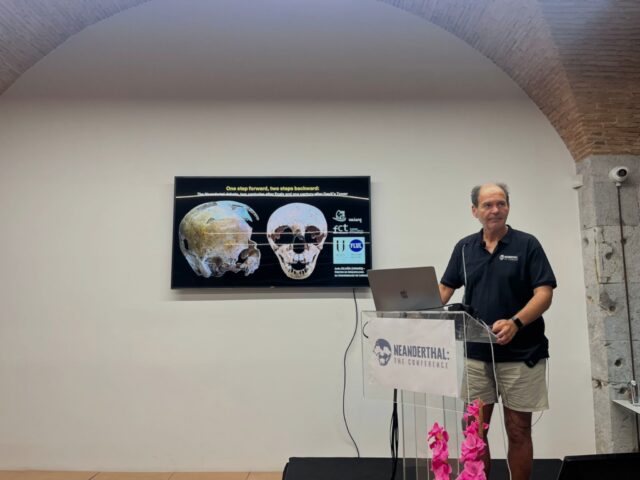
Professor Joao Zilhao at Calpe Conference.
Eventually a consensus emerged that, even though closely related to us, the Neanderthals had been driven to extinction by the expansion of ‘our species,’ Homo sapiens, adding that “over the last quarter century the discovery of morphologically ‘mixed’ fossils and the aDNA evidence for extensive interbreeding at the time of contact has shattered that consensus and strongly supported alternative, single-species.”
Next was Professor Francesco d’Errico from the University of Bordeaux. He proposed an “integrated scenario for the culturalization of the body over at least 500,000 years,” noting that “the emergence of clothing was triggered by climatic changes during the Middle-Upper Pleistocene transition… humans developed cultural innovations to cope with harsh environments, which gradually evolved from utilitarian uses to expressions of identity and social affiliation.”
He explained evidence from “Middle Stone Age sites in Africa, including the increasing use of ochre for various protective and symbolic purposes,” and the “production of personal ornaments,” adding that “cognitive evolution, particularly in areas of the brain that enhance social cognition and symbolic reasoning, was crucial in processing the complex social signals conveyed by body modifications.”
Next was Dr Linda Amos from Christian Albrechts University of Kiel, Germany. She described her study of birds from Devil’s Tower Cave “revealing direct evidence of deliberate Neanderthal bird exploitation… new evidence of cutmarks and thermal alteration demonstrates butchery and processing of birds at the site,” adding that “the spatial distribution of remains across occupational layers indicates that this activity was recurrent rather than occasional, spanning phases of Neanderthal presence… taxa including pigeons, corvids, ducks, and game birds, reflect exploitation of both rocky and wetland habitats, indicating a flexible, ecologically broad approach to avian resource acquisition.”
Following lunch were Dr Stewart Finlayson and Professor Clive Finlayson from The Gibraltar National Museum, University of Gibraltar, and Liverpool John Moores University.
Exploring the Neanderthal ecological niche, they explained that “climate tolerance sets the limits of occupation at the geographical scale; habitat sets a local occupation scale which may be expanded to larger spatial scales as landscape, and resources are key to ensuring survival and reproduction,” adding that the “three scales are interconnected.”
Exploitation “of birds by Neanderthals was a widespread phenomenon, in space and time,” and they were “perfectly capable of planning foraging and hunting activities,” and capable of catching fast moving small prey, adding “the growing evidence of the use of feathers and talons for apparently symbolic purposes.”
Next was Professor April Nowell of the University of Victoria, Canada. She explained that the study of “children in the deep past presents Palaeolithic archaeologists with unique challenges relative to scientists researching this topic in other periods. While all archaeologists grapple with the vagaries of the differential preservation of subadults,” adding that “the situation is exacerbated for those of us working in Deep Time.”
Further challenges specific to the “Palaeolithic include the use of children as holotypes, the choice of human or non-human models for the pace of ontological growth and development, the difficulties of defining what it means to be human in the Palaeolithic and the necessity of moving between ethological and ethnographic frameworks” arguing that “the youngest members of our oldest societies are key to understanding the human story.”
After a tea break, Professor Clive Finlayson from The Gibraltar National Museum, University of Gibraltar, and Liverpool John Moores University explained that “after battling and dismantling many of the barriers put before us with regards to Neanderthals’ abilities…one still lingers,” he deciding to foray into that one of many parallel worlds… the world of human symbolism.
“Neanderthals and Magdalenian Modern Humans alike exploited birds for food and for symbolic or ornamental purposes, yet the specific taxa targeted reflect the environments in which each population lived and the opportunities those landscapes afforded… The relative scarcity of Neanderthal symbolic culture is best understood as a demographic problem rather than a cognitive one.”
“What we see in the archaeological record may reflect the size and structure of Neanderthal populations, not an absence of innovative capacity…Cultural transmission is not simply a matter of individual ingenuity. It depends on population size, density, and inter-group connectivity.”
“When populations are small and socially fragmented, even successful innovations struggle to persist.”
He held that “in the arrogance of our ignorance, we continue to narrate a millennia-long story as though we possessed all its pieces. Yet, what we have from the vastness of space and time, are mere drops in the ocean.”
Following the final talk, Geraldine thanked everyone involved with the conference: The Gibraltar National Museum conference team, IT technicians, caterers, conference chair, speakers, and audience.
The conference was a great success, featuring four full days of lectures.
For presentations with more than three contributors (with one lecture at 21), only the primary author was named, followed by "co-authors."
A complete list of names can be found in the 30th Calpe Conference Abstracts and Speakers’ Bios booklet (The Gibraltar National Museum, 2026).
Each day also featured lively, open discussions where participants asked insightful questions and offered diverse perspectives on the topics.
Ultimately, the conference added more than the opportunity to share research; it forged vital new connections and laid the groundwork for future collaboration.
Most Read
Govt launches Westview residential project with plans for over 2,000 new homes
Thu 12th Nov, 2026
CM has concerns over data centre project but says Gib ‘needs a foothold in digital future’
Wed 18th Nov, 2026
Minister brands Market Place cabin a 'chicken coop' as DPC rejects plan
Thu 19th Nov, 2026

Today's Paper
23rd November 2026
Read our latest newspaper by downloading our app from the link below.


