


GONHS 50: Flowers, plants and habitats, a project still ongoing 2


 This is the last of our Table looking back on the history and work of the Gibraltar Ornithological and Natural History Society in its 50 years of history. Last week we learnt how Leslie Linares of the Gibraltar Photographic Society first got involved in a project with GONHS which continues to this day and which led to the compilation of a book on the ‘Flowers of Gibraltar’.
The book was written by the late Arthur ‘Arturo’ Harper (then the Chair of the Gibraltar Photographic Society), Leslie Linares (today the Chair of the Gibraltar Photographic Society), and Gibraltar’s Environment Minister Professor John Cortes (then Secretary General of GONHS), who identified the need for a first local field guide on the flora of the Rock. The book and field guide - The Flowers of Gibraltar – would be published in 1996 by Wildlife (Gibraltar) Ltd. A website of the same name - The Flowers of Gibraltar – was much later on set up in 2017.
The Gibraltar Natural History Society – GONHS – is a long-established organisation which continues to play a vital role in the life of this community as we have learnt over the last few weeks - a natural history and conservation, membership-based NGO which works across all the biological world: plant and animal, vertebrate and invertebrate, terrestrial and marine life.
With a growing membership in its 50th anniversary year, its current Secretary General Dr Keith Bensusan, assures its aims in 2026 are to conserve Gibraltar’s biodiversity and natural environment, foster research into local wildlife, and educate the public and official bodies in all these areas.
Leslie Linares began his involvement with GONHS when it moved from being an Ornithological Society to a Natural History Society. Arturo and Leslie using their photographic skills brought to our attention Gibraltar’s flora in a project that continues to this day.
Leslie tells me that over these past 50 years, there have been many important changes in Gibraltar’s natural habitats. He has continued to record all the changes, and the effect that these changes have had and are still having on Gibraltar’s native flora.
“The spread of the dense overgrowth of the matorral throughout the Upper Rock has resulted in a decline in open ground and clearings which are important to many of our species. As these are reduced, so is the diversity and abundance of species, and I have noted these changes over time.
“A few species have become locally extinct, and many have become very rare. This includes the various species of wild Orchids. Many species are surviving along roadsides and footpaths, on firebreaks and other clearings, on Windmill Hill Flats, on the East Side Sand Slopes, and on our cliffs, especially the North Face of the Rock.
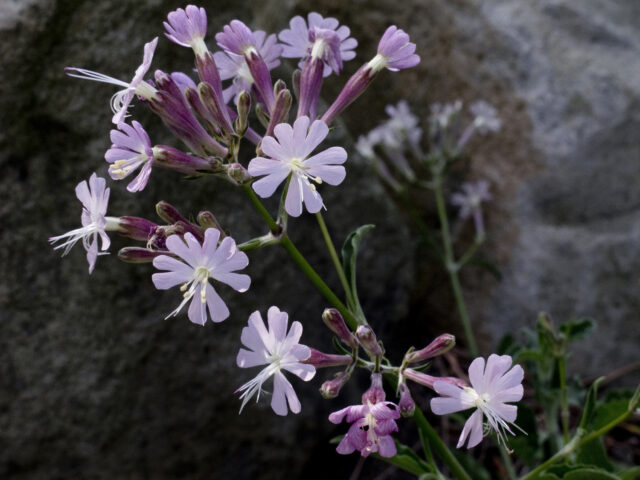
Gibraltar Campion flower.
“At the same time introduced invasive species, such as the Bermuda Buttercup, are also having an important, negative effect, as they spread into natural habitats, and out-compete the native species, taking over from them.”
Leslie has been an active member of GONHS for a long time and also leads outings locally and to Spain in search of flora and fauna. He admits that to him this project on our local flora, at a personal level, has always been and still continues to be a labour of love. It has kept him busy for 50 years.
Importantly, it has got him out and about, enjoying Gibraltar’s natural environment, studying it, learning about it, finding out things he had no idea about, and generally expanding his own knowledge on nature.
But just as important, he adds, has been “sharing my work with others, meeting many interesting and interested people”. Nature, he believes, is something we should all engage with – it is good for one’s well-being. It also adds a great deal to one’s life as he has discovered over the years.
And on top of all this, he continues, it has also helped in the developing of his own interest in the world of photography – and especially in “honing my skills in natural history photography, especially macro photography”.
And he adds: “Not bad, I think! Especially when considering that I had never done Biology, let alone Botany, at school, and that my academic career has been based on Physics and Mathematics.”
Even now, 50 years on, he admits, he still finds great enjoyment in seeing every one of the local species as they make their appearance during the flowering period.
“There are some that I particularly love: the Paper-White Narcissus flowering over the Christmas period; the Colchicum at the start of Autumn; the beautiful Giant Squill; the Romulea around the southern parts of the Rock; etc.
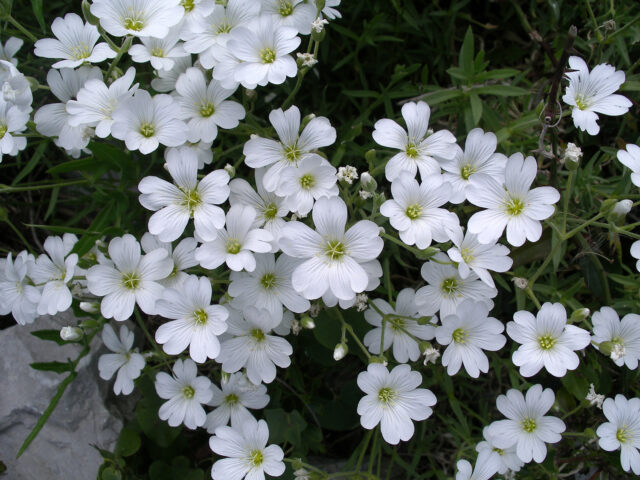
Gibraltar chickweed flower.
“And, of course, our special species: the Gibraltar Campion (which were-discovered in 1994 after my last sightings in 1979 and 1985); the Gibraltar Sea Lavender; the Gibraltar Candytuft; the Gibraltar Chickweed; the Gibraltar Saxifrage; the Gibraltar Thyme; the Gibraltar Restharrow,” he continues.
Over the years, and as Head of the Botanical Section of GONHS, he has led many field outings (as already mentioned), to inform on the local flora and has also given many public talks on the subject.
“I have also taken part in the Calpe Conference and in the Community Lecture Series, delivering talks on our flora. I have also given lectures and led some field trips to students studying for their degrees in Environmental Science at the University of Gibraltar,” he adds.
In more recent years – and more recent research – Leslie and the team have gone into the identification and classification of Gibraltar mosses, liverworts, fungi and lichens.
The work on mosses and liverworts, carried out in collaboration with Michael Grech, is virtually complete. The research on fungi and lichens, which involves the collaboration of Albert Gonzalez, is on-going, he offers.
At the present time, Leslie has been collaborating in a project to produce a Red List of Gibraltar’s Flora, funded by a Darwin Plus Local grant, and led by the Gibraltar Botanic Gardens in partnership with the Department of the Environment. He forms part of the team as this work is being carried out mainly by professional Botanist Helder Santiago, who is confirming identifications, preparing herbarium specimens, and carrying out field work, but Helder continues to draw heavily from Leslie’s personal knowledge and records to complete the project.
As we close our conversation, I can’t help feeling that Leslie will continue his work in this area – and will continue to grow his and our knowledge on the Rock’s flora and fauna – and who knows we may one day see an updated version of the book on the flowers of Gibraltar.
For certain the research at GONHS will never stop – and who knows what the next 50 years will bring.
GONHS through the years...
Charlie Perez has been with GONHS since its inception, and he knows he will continue to foster interest in all disciplines to the very end. He was one of the original members – one of the young boys interested in birding.
GONHS, he says, has come a long way since he was in school and when he first joined.
“I remember, in those days of a closed frontier, these pastimes (birding and finding nature) were not understood. We were always seen as somewhat strange by people, who did not appreciate nature in those days. But eventually families would encourage their children to come with us to count raptors, watch birds and enjoy nature.”
Dr. Ernest Garcia (his cousin) became a schoolteacher at the Boys Comprehensive School and had a small group of pupils who were interested. Charlie recalls how he would drive them in a minibus to Jews’ Gate layby on Saturdays to watch birds. Among them in later years, he recalls, would be Robert and John Perez, Nigel and Darrien Ramos, Paul Rocca, Paul Acolina, Steven Morgan, Andrew Fortuna, Martin Caruana and Roger Rutherford.
“Many of those members have returned to the fold after leaving to attend to family duties and have also encouraged their children to participate in GONHS activities. Keith Bensusan was also encouraged by his parents and later became one of the most prominent birders on the Rock. Older members like Harry Van-Gils who lived at that time at Catalan Bay also had an interest in birds together with Vincent Robba, Geoffrey Saez and Tony Santana.”
Charlie also recalls the late Eric Shaw involved in the Marine Section who encouraged students to study the marine environment, with the likes of Terence Ocana and Darren Fa, who continues to promote marine ecology at the University of Gibraltar.
He then moves to the early 1970s and Brian Etheridge, who was stationed at RAF Gibraltar for three years, started to ring birds, helped along by Harry Van-Gils, and Norman Elkins, also from RAF. They worked on a site below the layby at Jews’ Gate (which is still active today), and at Gorham’s Cave, targeting the Crag Martin roost.
Charlie recalls they published their work on Crag Martins in the journal ‘British Birds’. Then later on, he adds, Clive Finlayson commenced ringing at this site, and Ernest Garcia followed.
“By this time, I was interested in ringing birds and eventually went on a course to the UK at Spurn Head together with Paul Acolina and John Cortes. We achieved our ringing permits with the help of ringer, Tim Parminter, who visited Gibraltar with several UK Observatory wardens on a project initiated by Clive Finlayson, which was quite successful.
“Christopher Romero also joined the ringing team in its early years.”
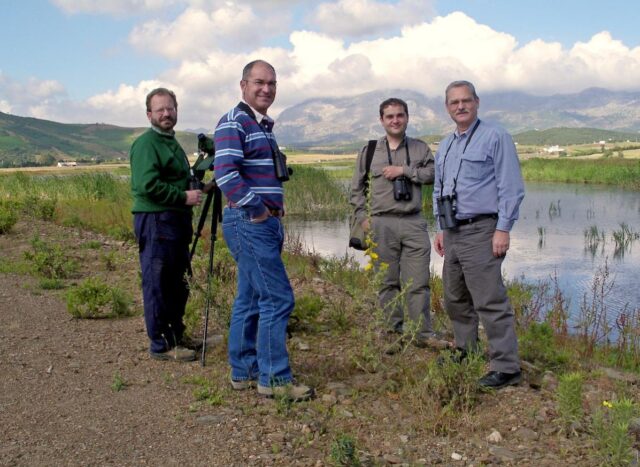
He then explains how GONHS rings birds with British rings, under the auspices of the British Trust for Ornithology (BTO), and the Gibraltar Ringing Group was formed. GONHS then had the great fortune, he continues, of the posting of the late Governor Sir John Chapple, an avid ornithologist and eventual honorary life president of the organisation, who would frequently join other GONHS members to watch bird migration at the Jews’ Gate Field Centre and Europa Point, and eventually arranged the transfer of the old Governors Cottage just below Spur Battery to GONHS. This Observatory, he says, would provide the organisation with accommodation for visiting ringers and birders from around the world, and from as far afield as the US, Japan, Germany, Sweden, Denmark, Italy, Spain and of course, the UK.
Keith, he explains, recalls meeting an American birder in Costa Rica in 2022 who told him he had stayed at Jews’ Gate many years earlier.
With all their help, GONHS have now ringed since 1992 over 150,000 birds, and have recorded recoveries of birds mainly from north-western Europe but also as far afield as Germany Finland, Slovakia and even a Swallow that had found its way into a building in Angola in Africa. This work provides insights in migration patterns, population abundances, and survivorship.
It was in the mid-1970s that GONHS published the first ‘Bulletin of the Gibraltar Ornithological Group’ followed by the journal ‘Alectoris’ which contained numerous articles on birds, cetaceans, and flora. In 2001 it published the first Gibraltar Bird Report that provided a systematic list of bird observations and articles and continues to this day in digital format.
A GONHS website was also set up, with information on all aspects of the work done, together with daily bird records, flora discoveries and environmental decisions.
Today the website is much improved, and it is Charlie who keeps it updated on a daily basis. He also collated all bird and ringing records which are also published on the website together with photographs.
On Retiring from GBC (Charlie was a cameraman who I often worked with in my early years at GBC) was commissioned to write a report on the ‘Upper Rock Management Plan’ together with a young Keith Bensusan and which was published in 2005. He also wrote the Biodiversity Action Plan with advice from Keith, published in 2006 – “this report was welcomed by the Development and Planning Commission, where developers took into account conditions that were highlighted in it.”
It was at this time whilst working out of the Alameda Botanic Gardens, that he interested Keith in insects, and they set about collecting the Coleoptera of Gibraltar (Beetles) for a reference collection. A few years later they had amassed over 500 different species of beetles, including some new to Europe and two new to science. One named Buprestis sanguinea ssp. calpetana, named after the Roman name of the Rock, and Torneuma bensusani named after the finder Keith.
Setting up a Rothamsted Moth Trap at the gardens, they collated catches on a daily basis. Rhian Guillem joined the team in the late 2000s, and she then began working on the ant species of Gibraltar recording over 60 species on the Rock; more than the whole of the UK.
Eventually the premises at the gardens underwent a transformation, with a laboratory, and temperature-controlled room that would house the insect collections. These constitute the GONHS insect reference collections of insects of Gibraltar. It is composed of Butterflies, Moths, Beetles, Ants, Flies and Bees and Wasps.
The Governor’s Cottage, Charlie points out, was transformed into the premises of the Cave and Cliffs group of the Society, led by John Paul Latin and Richard Durrell.
They surveyed the caves of Gibraltar and in 2004, members of the caving group collaborated with the Royal Holloway University of London’s Department of Earth Sciences on a project to determine the reaction of speleothems to weather and seasons.
Finally he says GONHS also collaborated with the Gibraltar Museum to work on the Pallid Swifts that nest in the roof of the Museum, and on the Crag Martins in Gorham’s and Vanguard caves.
“The results were groundbreaking and led to the publication of numerous papers in peer reviewed journals.”
Most Read
£7.1m worth of personalised licence plates sold in two years, with more options lined up
Thu 26th Nov, 2026
Govt launches Westview residential project with plans for over 2,000 new homes
Thu 12th Nov, 2026

Today's Paper
27th November 2026
Read our latest newspaper by downloading our app from the link below.


